|
As the Marion
County community moved from the l9th to 20th century, the people
of the town looked around for ways to restore their city to the
prominence it enjoyed as an inland port area in the mid-1800s.
Building a good library became a major project.
Jefferson already
had a library located on Walnut Street, but it had only 200 books
and asked for a usage fee of $1 per person a year. So in an effort
to revive trade in the business district, the women of the Jefferson
Library Association proposed that for $30 a month, they would furnish
downtown “rest rooms” to local people and visitors alike.
“The rest rooms will be a place where merchants can take customers
for social intercourse and to learn to know them personally. The
cost will be small, but in the days to come, it is certain to bring
fruit,” the proponents wrote.
The plan apparently flopped, so the ladies of the Association tried
something else: a ten-cent tea in the library to buy badly-needed
bookcases for the 200 books.
A year later, the Association received a $7,500 grant to build a
library from the Andrew Carnegie Foundation in Pittsburgh, Pennsylvania,
with the stipulation that Jefferson
provide a budget for its upkeep.
Carnegie
built a host
of libraries in Texas. The first, ironically, was at Pittsburg,
Texas.
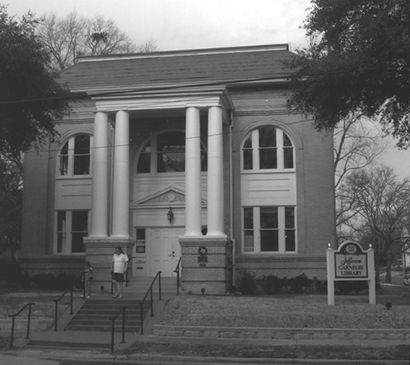
In
1907, J.F. Berry of Morris
County won a contract to build Jefferson’s library with a bid
of $8,750. The Jefferson Jimplecute praised the project: “In the
good old town of Jefferson,
which has figured more in the formation and upbuilding of teeming
Texas than most any other city...the town is again assuming its
sway of ancient supremacy as a leading city and center of a superbly
rich county in Northeast
Texas.”
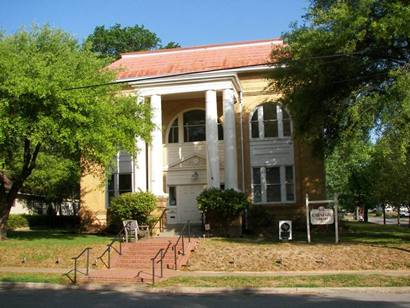
The library brought recognition to Jefferson
and today, only two of the original Carnegie libraries built as
a result of Andrew Carnegie’s gifts, Hearne
and Jefferson,
are still used as libraries. Others remain standing, but serve other
uses.
Between 1886 and 1919, Carnegie
donated more than $40 million that paid for almost 1,700 new libraries
across America.
|
 HOME
HOME