| |
The
Carnegie Library in Texas or
Guilt
is Good
by John Troesser |
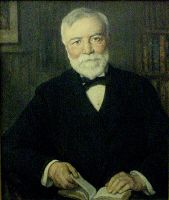
| | Andrew
Carnegie
Photo Courtesy The Carnegie Center of Brazos Valley History
|
| Perhaps
the inspiration for the Horatio Alger rags to riches stories, Andrew Carnegie
started as an immigrant bootblack and ended up one of the richest men in America.
He attributed his success to having had access to the library of Colonel James
Anderson, a businessman in Allegheny, Pennsylvania who opened his library to factory
boys in order to better themselves.
Mr. Carnegie dismissed his philanthropic
generosity saying that the libraries only help those who help themselves.
This attitude also explains why he contributed nothing towards universities, since
the class system of the time favored those who could get into college.
Conditions
for construction funds were: the city would provide a suitable site, (in at least
two cases Carnegie Libraries were built in cemeteries), and the city would provide
money equal to one tenth of the grant annually for maintenance and books.
Although the name Carnegie is prominently displayed on nearly one third of the
libraries built, this was never a prerequisite for a grant.
Of the 1689
Carnegie Libraries built, 32
were in Texas. Of these, 13 remain with only 4 serving their original
purpose. While around the country Carnegie Libraries are being used for
everything from dance studios to law offices, in Texas
all serve civic functions. |
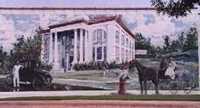
| Corsicana
Carnegie Library Mural painted by Brad Smith | |
|
|