|
In
early East Texas, dozens
of forts were built by settlers to provide a safe and sturdy refuge
from Indian attacks.
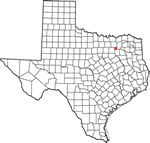
One such fort stood in north central Houston
County where Indian attacks were common. Known as Fort Brown,
it was built near Grapeland
by Reuben Brown and his neighbors in the mid-1830s.
Reuben and his wife Sarah settled on San Pedro Creek in 1834. Sarah
was the daughter of Elder Daniel
Parker, who came from Illinois around 1830, hoping to build
a church, but Mexican colonization laws prohibited the establishment
on any church except those of the Roman Catholic faith.
Parker returned to Illinois, organized his church there, and brought
his forty members back to Texas in
1833 in a ox-drawn wagon train of 24 wagons laden with members of
eight families and their possessions.
Following the route of the Mississippi River, the wagon train crossed
Missouri, Arkansas, Louisiana and entered Texas.
Crossing the Sabine
River, they followed an old Indian trail, the Coushatta Trail,
used by Indians for trading and migration, and eventually crossed
the Neches
River and made their way to the banks of San Pedro Creek in
Anderson County.
Near the creek, the families built Fort Brown in what is today known
as the Refuge community.
Several tribes of Indians lived in the Houston
County area and, while attacks were not consistent, they were
enough to make settlers feel uncomfortable without a place of safety.
From the Refuge community, the Parker family went in different directions.
Daniel Parker took his children and went to a site near Elkhart
and reestablished the “Pilgrim Predestinarian Regular Baptist Church”
in 1833. It was the first Baptist church in Texas.
Other members of the Parker clan traveled westward to Limestone
County and built Fort
Parker near Groesbeck.
Fort
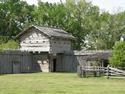
Brown was built of post oak logs. Little is known about the fort,
but it was used from 1833 until 1860 when the Indian scares subsided.
It stood several hundred yards from Refuge Cemetery on land later
owned by Huford Allen.
Some descendants of families who lived near the fort recall seeing
the decaying logs used in the fort’s construction. Others say the
logs were moved to other home sites for construction purposes. Pieces
of pottery, glass and even cooking utensils have been found in the
area.
Today, little is left of the Refuge
community. Its principal landmarks are a rock store used for many
years and Refuge Cemetery, where Reuben Brown, his wife and several
children are buried.
The Browns’ oldest son, John, who died in 1921, lived his entire
life within a mile of Fort Brown, his birthplace in 1865.
In the mid-1930s the settlement had four stores, two churches, and
a number of houses. After World
War II, many of the residents moved away, and by the mid-1960s
only a cemetery, a sawmill, and a few scattered houses remained.
|
 HOME
HOME