|
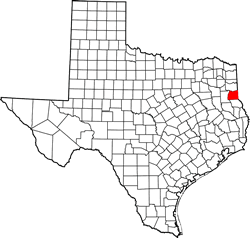
Few remnants
exist from Grand Bluff, a community once considered as the seat of
government for Panola
County.
One of the remnants is an isolated cemetery containing a hint of why
the town died.
In 1846, when Panola
County was created by the Texas Legislature, Grand Bluff and Pulaski,
both ferry towns on the Sabine
River, were the only two settlements in Panola
County.
County commissioners court decided to let voters choose which of the
towns they wanted as the county seat. In the summer of 1846, the county
ordered two elections. One saw the election of John Allison of Pulaski
as chief justice, a job similar to today’s county judges.
In a second election, Allison swayed voters to pick Pulaski as the
county seat, but it was only temporary. In 1848, voters picked a piece
of high ground in the county’s center as the county seat and named
it Carthage.
Grand Bluff, originally known as Brewster’s Ferry for
an early ferry operator, grew up in the 1840s ten miles north of Carthage,
and provided a gateway to settlers coming into East
Texas.
In 1844, David and Lucinda Vawter and their children came to Grand
Bluff from Louisiana. David was licensed to operate a ferry at Grand
Bluff in September of 1844, but he died unexpectedly in July of 1845,
not owning the ferry.
Lucinda traded the family’s land in Louisiana for the ferry and land
on both sides of the river, making the purchase from the Brewster
family. Grand Bluff grew rapidly, a post office was established in
1847 and by the early 1860s the town had several stores, a blacksmith
shop, a school and a grist mill. Daily stagecoaches stopped in the
community.
Lucinda’s son David became a popular physician who treated patients
suffering from a disease epidemic, likely yellow fever. He contracted
the disease and died on February 11, 1898.
The epidemic had become so widespread that burials in mass graves
were commonplace, including the Grand Bluff Cemetery, where a large
mound of earth—covered with bricks, perhaps the remains of a
crumbling brick vault—marks the site of a large number of victims.
Dr. Vawter was buried in a separate grave beside the graves of “so
many of his patients,” an epitaph that was placed on his gravestone.
The epidemic in 1898 caused the migration of many of Grand Bluff’s
residents to areas distant to the river, but the town’s demise was
hastened by the arrival of the railroads
in Panola County
in the 1880s.
In 1887, the town’s post office was closed and by 1900 many of the
community’s businesses had closed.
The Vawter family continued to own the ferry until 1912 when a bridge
was built over the Sabine River, eliminating the need for a ferry.
The old cemetery was once shaded by a large grove of huge cedars,
now dead, but their stumps still stand as sentinels of a forgotten
village. |
 |
Bob
Bowman's East Texas
December
13, 2009 Column
A weekly column syndicated in 109 East Texas newspapers
Copyright Bob Bowman
(Bob Bowman of Lufkin
is the author of more than 40 books about East Texas.) |
|
| Texas
Escapes, in its purpose to preserve historic, endangered and vanishing
Texas, asks that anyone wishing to share their local history, stories,
landmarks and vintage or recent photos, please contact
us. |
|
|
 HOME
HOME