|
Leagueville
by Bob
Bowman
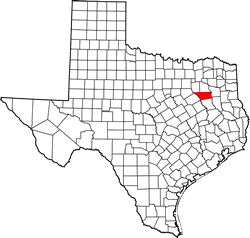
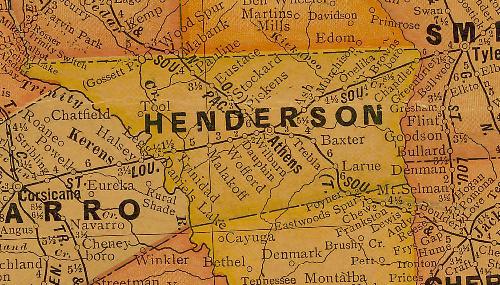
Leagueville, an isolated community in eastern Henderson
County, owes its beginning to a land certificate that originated
in 1850 by Aaron York, surveyor of a league of land west of the Neches
River.
The area was referred to “The League” and the “ville” was later added,
probably when the community secured a post office in 1889.
By 1855, the Sublett family had gained control of the land around
Leagueville and sold it to Matthew Cartwright in 1857. In 1871, B.T.
and Annie (Cartwright) Roberts had acquired the property. But when
the couple died, the York heirs sued to regain control of the property,
but lost on appeal in 1875.
The litigation slowed the development of the area and it really didn’t
become a community until the late 1800s. The community had a school,
and a cemetery was established on the school property. The school,
however, was consolidated with Brownsboro in 1934.
At its peak, Leagueville had two general stores, its church, two cotton
gins, a blacksmith, and a grist mill.
A broken discarded mill stone from the grist mill was placed around
a Texas historical marker by the cemetery when it was erected in 2004.
The coming of the railroad through Brownsboro in the late 1800s left
Leagueville off the beaten path and, with the building of Highway
31 from Tyler
to Athens beside the
railroad, Leagueville
suffered another blow. In the old days, a road running through Leagueville
was known as the Athens-to-Tyler
road.
Leagueville’s cemetery was once maintained in the way of many old
East Texas cemeteries.
The grounds were hoed, grass was removed, and the graves were mounded.
But because of erosion and the time required to maintain the graveyard,
mowing was begun in the 1950s.
Many graves in the cemetery are unmarked and the names of those buried
have been lost in the passage of time.
One year, when the cemetery was being expanded, an old dipping vat
used to control ticks on cattle was discovered in the ground.
Leagueville’s church, which began as the Hopewell Missionary Baptist
Church in 1880, remains in its original location and was preceded
by churches at Rock Hill and New York.
One of the town’s earliest settlers was Malachiah Reeves, a Civil
War veteran, who served as a postmaster in 1906 and 1907. He was licensed
to preach at Leagueville and is buried in the local cemetery.
Each second Sunday of June, Leagueville’s former residents and their
families come back to the old town for a memorial day.
Bob Bowman's East Texas
February 20, 2010 Column
A weekly column syndicated in 109 East Texas newspapers
Copyright Bob Bowman |
 |
| Texas
Escapes, in its purpose to preserve historic, endangered and vanishing
Texas, asks that anyone wishing to share their local history, stories,
landmarks and recent or vintage photos, please contact
us. |
|
|
 HOME
HOME