Books
by
Byron Brown
Order Here |
|
Texas
San Antonio
Missions
National Historical Park
World Heritage
Site
by Byron Browne |
|
Remember
the Alamo? Well, put
that idea aside for a moment because if visiting that veteran icon
of the downtown San Antonio
area is on your itinerary, there are several other historical and
captivating missions to enjoy than just that singular totem of tourism.
Beginning two and a half miles south of downtown San
Antonio there are four eighteenth century missions along what
the National Parks Service refers to as the “Mission Trail”. This
route will lead you on an afternoon’s journey through some of this
country’s few, yet greatest, antiquities. Recently, my wife and I
toured these demi-cathedrals and were amazed at the relative seclusion
and magnitude of the relics. |
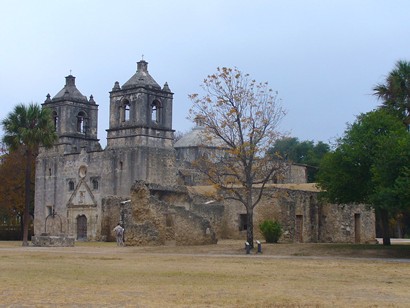
Mission Concepcion
Photo by Byron Browne |
Like
most of the missions south of San
Antonio, the mission Nuestra Señora de la Concepción, usually,
simply Concepción, was relocated to south
Texas from east Texas
in 1731 to escape the threat of the encroaching French soldiers from
Louisiana. The mission’s sacristy is a wonderful design of beauty
and purpose, its twin bell towers (perhaps symbolizing the incorporation
of two distinctly different cultures occupying the same site) framing
a single, central entranceway to the church’s nave. Due to its proximity
to the city’s center, the mostly-extant condition of the building
and the fact that this mission is still exhibiting some of the original
fresco decoration, this presidio draws many visitors. Once
inside you will notice that the frescos are sketched over in pencil
by a new hand; a necessary step before the actual restoration begins
next year. These frescos illustrate an interesting duality of both
Catholic and Indian doctrine- a rare example of the Franciscan friar’s
attempts to indoctrinate the indigenous population into the faith
without the prototypical heavy-handedness.
When visiting for the first time you might consider that the amount
of space the mission’s sites occupy is unusually large and spread.
That is until you realize that, when in operation, the mission’s purpose
was to house the Spanish friars and soldiers as well as some of the
local population of Coahuiltecans Indians. The acreage afforded the
area necessary for worship, housing, gardens, workshops, granaries
and even cemeteries. The land, although initially open, is bordered
with the remnants of stone walls, protection from the hostilities
of the Apache and Comanche Indians. The Alamo
also exhibited a similar construction. However, unlike these other
missions, much of the expanse that was the Alamo’s
has been overrun by the aggression of parking lots, hotels, restaurants
and office buildings. |
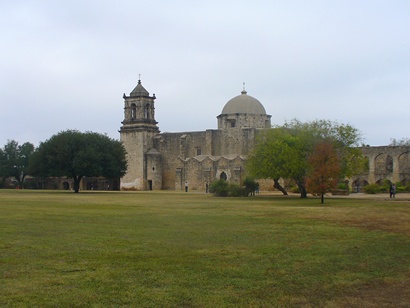 |
Mission San José
Photo by Byron Browne |
| A
little farther south on ‘Mission Road’ is the mission of San José
y San Miguel de Aguayo. Due to its stunning architecture and relative
opulence, San José was termed the “Queen of the Missions” even 270
years ago. Because the site has maintained its structural integrity
and appears today much the same as it did then, the moniker remains
appropriate. For the same reasons the number of tourists at this site
is greater than the others. We found that we had to wait longer for
photograph opportunities at San José. We also experienced that many
of the visitors were involved in the same expedition as ourselves;
we kept seeing the same faces as we passed from one mission to the
next. In fact, at three of the four missions, I had to wait for the
same woman to pass my camera’s frame before I could get a shot of
the churches facades. |
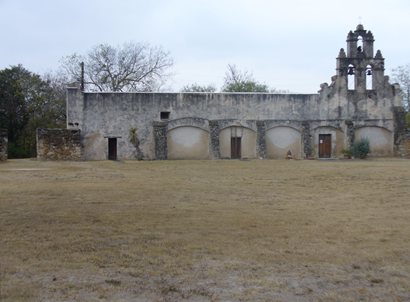
Mission San Juan
Photo by Byron Browne |
| The third presidio
on the ‘Trail’ is the Mission San Juan Capistrano. Originally
commissioned in 1716, again in the woods of east
Texas, this mission was reestablished to its current position
in 1731. Sparse and somewhat remote, this presidio more resembles
an architectural site than its relatives. The church’s tower stands
atop a thin, mostly reconstructed wall and is crowned by a trinity
of bells, which give this mission a markedly different appearance
than Concepción or San José. There is a fragility here that suggests
a degree of spartanism. However, the reality was that the land within
and surrounding this mission was so fertile, due in no small part
to the fifteen miles of aqueduct meandering throughout the countryside,
that the mission frequently had surplus food with which to supply
the neighboring churches and communities. Sadly, on the day that we
visited, the church’s nave was closed. A sign on the wooden door read
that the sacristy was closed “because of thefts and vandalism,” the
inevitable and sorrowful indicator of modernity. |
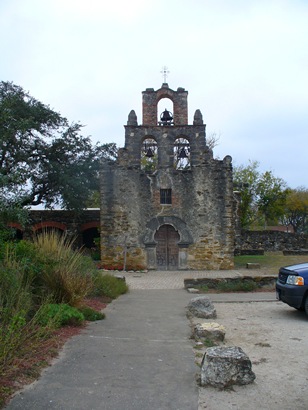 |
Mission Espada
Photo by Byron Browne |
The
fourth and final mission along the route, San Francisco de la Espada,
also had its beginnings in east
Texas. Unlike its sister communities, Espada dates to the seventeenth
century; the initial founding in 1690 makes it the oldest of the missions.
The facade is remarkably well preserved and, like San Juan, also displays
a triangle of bells above the original doorway. The courtyard here
was radiating with fresh flowers in full bloom even in mid-November.
One area of walkway was closed to the public and soft ecclesiastical
music could be heard humming from an outdoor speaker system. We asked
whether there might still have been an active convent on the premises
and the docent answered that no, the convento, or, priest’s quarters,
had closed almost a century earlier. Concerning the maintenance of
the flowers, bird feeders and a couple of healthy-looking cats we
were told that one of the Franciscan brothers “hangs out here on a
regular basis.” All told, the mission is tranquil, beautiful and still
exhales a whisper of intent to convert.
As a group, these four missions along the “Mission Trail” are extraordinary.
Overlooked by some and unknown to many, an afternoon spent in their
discovery is well worth the effort. So, don’t forget the
Alamo, just remember these other astounding monuments of our culture
and history.
© Byron Browne
Notes From Over Here April
1, 2009 Column
See The Alamo |
| Texas
Escapes, in its purpose to preserve historic, endangered and vanishing
Texas, asks that anyone wishing to share their local history, stories,
landmarks and vintage or recent photos, please contact
us. |
|
|
 HOME
HOME