|
No,
this is not about space aliens, illegal immigrants, or terrorists.
It’s about some plants and animals that are entirely foreign to Texas—indeed,
to the US.
Dandelion
Ever
get a dandelion infestation in your yard? Are you aware that dandelions
are not native to North America? That’s right, that ever-present and
often noxious weed was deliberately imported, probably in the mid-17th
Century, to the British Middle Atlantic colonies and probably into
the South as well.
Why would anyone import such a pest onto this continent? Because it
wasn’t considered a pest. In Britain, the dandelion is a garden vegetable.
That’s right, a vegetable. The young, tender leaves are considered
a salad green there. The blossoms, if—or so it says in the references—taken
when first opening early in the morning, with dew still on them, can
be fermented to make a light, slightly sweet wine.
Our Confederate ancestors discovered another use for the thing. The
root, cleaned, roasted, and ground, made a mediocre substitute for
coffee.
Coffee,
of course, was the drink of choice in 19th Century America, right
behind corn whiskey. Coffee,
because of the blockade, was hard come by in the Confederacy. Southern
soldiers often obtained it in clandestine trades with the enemy— Yankee
coffee for Southern tobacco—but that was about the only way to get
coffee once the blockade closed in. However, there were those weeds—dandelions—and
they had roots. They bore some semblance—and possibly some relation—to
chicory, which Southerners, particularly in Louisiana, had been cultivating
and using both as a salad vegetable (the leaves) and as a coffee additive
(the roasted and ground root) for years. Dandelions grew just about
everywhere, and it was almost impossible to get rid of them. Roasted
and ground dandelion root was a standard coffee substitute for the
Confederate Army—and for many Southern civilians as well. |
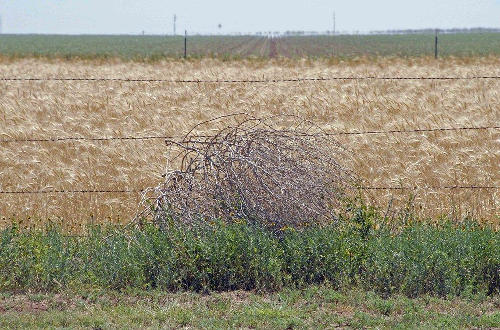 |
Tumbleweeds
When
D. W. Griffith made Birth of a Nation, the first true epic
film, he followed it with a second opus, based on the Texas revolution.
Well, maybe it wasn’t Griffith after all, maybe it was one of his
second-unit people. Anyway, the film wasn’t anywhere near the success
Birth of a Nation was, and for many, many years the film was
considered ‘lost.’ An almost-complete, though somewhat damaged print
was discovered here in Texas in the 1990s. At the beginning of the
climactic battle on the plain of St. Hyacinth—San Jacinto—the film
depicts the Texas Army advancing on the unsuspecting Mexicans, holding
tumbleweeds in front of them for camouflage, much as MacDuff’s soldiers
held fronds from Birnam Wood above their heads in Shakespeare’s version
of the storming of Dunsinane Castle in the final act of MacBeth.
Unfortunately, that’s a little previous and way too far south. The
celebrated Tumblin’ Tumbleweeds didn’t get to the US until
the 1880s, and they really don’t thrive much farther south than San
Angelo and Abilene
in Texas. The tumbleweed—scientific name
amaranthus graecizans—is actually a native of the Eurasian
steppes. How it got here is a story of intrigue.
A
group of Mennonite farmers from Moravia and Bavaria, sometime in the
early 19th Century, moved to the Russian steppes on the promise of
religious toleration. Both Moravia and Bavaria were heavily Catholic,
and they were persecuted for their beliefs in their homeland.
Russia developed, sometime in the late 18th or early 19th Century,
a very hard-hulled, winter-hardy wheat. Russia had a monopoly on this
wheat. Flour made from it could be exported, but there was an absolute
ban on exporting the seed.
The Mennonites didn’t find the religious toleration they were promised
in Russia. In the early 1880s they began to immigrate to the United
States, moving mostly into what is now Minnesota, Nebraska, Kansas,
and the Dakota territory. Inside their clothing, in tiny cloth bags,
they concealed the seeds of the winter-hardy wheat. Unfortunately,
they also picked up another, almost-microscopic seed. It was the seed
of amaranthus graecizans—the tumbleweed.
Tumbleweeds will grow in almost any soil, but seem to prefer dry,
almost arid climates. As the farmers planted the wheat, they unknowingly
sowed tumbleweeds with it. The tumbleweeds took root and grew. In
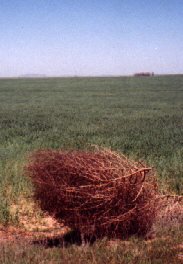
the fall the upper part of the weed—what we know as ‘the tumbleweed’—
dried up and broke away from the root, to roll across the prairies
with the ever-present wind. As each did so, it scattered seeds—from
hundreds of thousands for the smallest to multiple millions for the
largest ones. Each year each root, which survived the winter, produced
a new—and bigger— tumbleweed, which in the fall began to scatter seeds.
By the 1890s tumbleweeds grew from the Texas Panhandle to the Dakotas,
from mid-Kansas and Nebraska to the Rockies.
What is a tumbleweed good for? Not much. If you tie a light string
to one you can often fly it like a kite, and in years past boys were
known to make two-up, four-up, and even six-up hitches of tumbleweeds
and ‘drive’ them with the wind, pretending they were horses. In youth
camps in tumbleweed country, short-sheeting a bed isn’t the preferred
revenge upon the camp bully. A few crumpled tumbleweed fronds in his
bunk will make it uninhabitable. Tumbleweeds have thorns! They’re
very tiny thorns, but they’re very nasty thorns. They tend
to attach themselves to cloth and they’re almost impossible to remove.
Occasionally an artsy-crafty city person will decide that tumbleweeds
can be used in crafts. They get spray-painted silver or gold and used
as decorations. Then they crumble, the tiny thorns get into the carpeting,
and the only solution is to re-carpet.
Tumbleweeds are also a hazard. They pile up against fences, then catch
blowing dust or blowing sand. The result is a buried fence. They’re
fire hazards as well. A dry tumbleweed doesn’t burn quite as fast
as gunpowder, but almost. In many towns tumbleweeds are gathered,
taken to an isolated, barren spot—usually a ravine—and burned each
fall. Tumbleweed-burning day is sometimes celebrated as a holiday.
|
 |
Nutria
You
might be walking along a creek some fine afternoon and see what appears
to be a huge barn rat. It looks like a rat, it has a bare tail like
a rat, but it’s about the size of a Cocker Spaniel and it has webbed
feet.
What you’re seeing is a South American nutria. It’s a rodent, like
a rat, but it also eats fish. It was originally imported as a fur-bearer
to supplant the native beaver, which was becoming endangered because
of the felt trade. Nutria fur can be used for felt, but only if the
nutria has a lush, well-furred coat, which most don’t get in Central
and South Texas streams, the winter weather being too warm for them
to grow the coats needed for felt.
In the 1930s Lakes
Austin and Travis, in Travis
County, were deliberately planted with a stuff called ‘duckweed.’
Allegedly, ducks thrived on this stuff. The hope was that the duckweed
would attract ducks, which would in turn attract duck hunters, which
would in turn boost the Travis
County economy, which wasn’t doing all that well at the time.
The duckweed didn’t attract the ducks, which in turn didn’t attract
the duck hunters. It did clog the shallow parts of the lakes, making
fishing, boating, and swimming almost impossible.
Somebody got a bright idea. Nutrias were imported. They would eat
the duckweed.
The nutrias didn’t eat the duckweed. They chewed on trees, ringing
and killing them, and they ate fish. They also multiplied like—well,
like rats.
The only effective control for nutrias ever found has been teen-age
boys with .22 rifles. So far, this hasn’t drawn any protest from the
animal protectionists. After all, it’s hard to get anyone to be sentimental
about a barn rat the size of a Cocker Spaniel. And if the creek near
your home hasn’t got nutrias in it, just wait. They’ll get there.
|
Egret
There
is a graceful white bird you’ll see following cattle in the pastures.
It’s the African cattle egret. In Africa—and now all across the southern
US—it follows cattle, feeding on the insects and small reptiles the
cattle stir up as they graze.
Apparently sometime during the 1930s a small population of these birds
rode a storm— possibly a hurricane—from the west coast of Africa to
the islands of the Caribbean. There they nested and began to multiply.
By the early 1940s they were established in southern Florida. From
there they began to spread westward. By the ‘60s they were in Louisiana
and East Texas. By the
‘80s they had thoroughly established themselves all across Texas,
about as far west as the Hill
Country.
These are actually beneficial birds—a happy accident. They eat ticks,
fleas, grasshoppers, and similar insect pests. Their rookeries are,
of course, pretty unpleasant places, for they tend to nest in large
colonies. The area gets covered with droppings, which stink pretty
badly. In addition, their young tend to leave the nest before they’re
fully capable of flight, meaning a lot of them get converted to dirty
whitish-gray clumps of feathers on streets and highways.
They also invade back yards, and they are capable of using their long,
sharp beaks as defensive weapons. Dogs quickly learn to leave them
alone. People attempting to ‘rescue’ immature cattle egrets have sustained
painful, though not usually serious, puncture wounds in hands and
arms. The egret doesn’t know it’s being ‘rescued.’ It interprets the
‘rescuer’ as yet another threat, and responds accordingly.
And those are a few of the ‘aliens amongst us.’
© C. F.
Eckhardt
"Charley Eckhardt's Texas"
October
21 , 2007 column |
|
|
 HOME
HOME


