|
| If
you're old enough, you saw the story on Death Valley Days.
Jim Davis, after the demise of Stories of the Century and before
Dallas, played the grieving father, Col. William Butler. The
Colonel's son has been gunned down, in cold blood or so the story
implies, on the streets of Helena,
Texas. Nobody will tell Col. Butler who murdered his son. He says
"This town killed my son, I'll kill this town." He goes to the railroad
that is building toward Helena
and gives land for right-of-way through his ranch on the condition
the railroad miss Helena
by at least twenty miles. The railroad takes the free right-of-way
and misses the town. The town dies. |
It made for
good melodrama on television, but that's not what happened. It's not
even close to what happened. So what did happen?
It
was Christmas Day. Young Emmett Butler and a friend were in Helena,
celebrating in the town's many saloons. Both were drunk. They began
waving their pistols around. Somebody told the sheriff, who went to
disarm the boys before they hurt somebody or themselves. Emmett then
shot the sheriff in the chest at point-blank range. The sheriff said
"He's killed me. Don't let him get away."
Emmett bolted for the door, jumped on his horse, and began to gallop
out of town. Everybody who had a gun-and in the 1880s in Helena,
that was everybody - began to shoot at him. Whose bullet actually
brought him down nobody knew then, and nobody knows now. The whole
town was shooting at him.
Col. Butler was not noted for a great deal of patience or understanding.
The fact that Emmett had just committed a cold-blooded murder didn't
seem to register with him. His son was dead - shot down in the streets
of Helena.
He came to town and collected the body, which he took back to his
ranch. After Emmett's funeral the Colonel came back to Helena.
So the story goes, he had 25 armed cowboys with him. He demanded to
know who killed his son. Nobody would tell him. Of course, nobody
knew for sure who fired the fatal shot. The air was literally full
of bullets, any one of which might well have brought Emmett Butler
down.
That's when the Colonel supposedly said "This town killed my son.
I'll kill this town." Most folks around Helena
don't think he ever said that. He just did it - or came mighty close
to doing it, anyway.
The
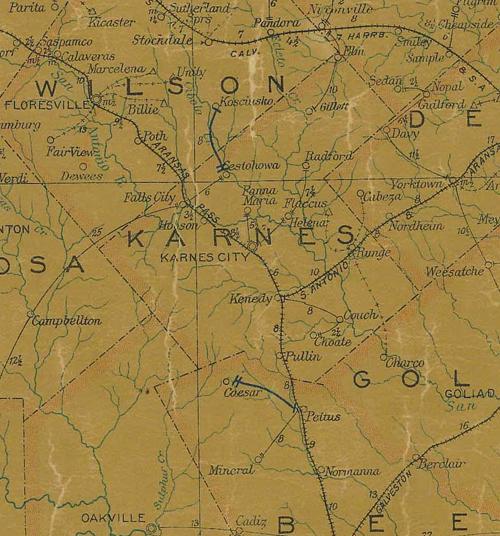
San Antonio & Aransas Pass railroad was building south from San
Antonio to the coast. Helena
was the largest town in Karnes
County at the time, the county seat. Helena
had been raising money to help the railroad, to make sure the rails
came to town. As with being bypassed by Interstate highways in the
20th Century, being bypassed by the railroad in the 19th Century almost
assured that a town would wither, if not die completely.
In most other states west of the Mississippi, the federal government
owned all public land in the state. It granted land to the railroads
to help finance construction-alternating square miles on each side
of the right-of-way. This land the railroads sold to help finance
construction. However, in Texas the state owned all public land-and
there wasn't any public land left south of San
Antonio by the 1880s. That meant the SA&AP-it eventually became
known as 'The Sap Line'- had to buy privately-owned land in order
to have right-of-way. Buying right-of-way was a serious, sometimes
insurmountable problem for railroads building in Texas. |
 |
Col. William
Butler went to the SA&AP offices in San
Antonio and offered to give the line right-of-way across his extensive
ranch, on the condition that the railroad bypass Helena.
He didn't say 'by 20 miles,' and in fact the rails missed Helena
by only about 8 miles. The gift of right-of-way saved the road a great
deal of money - considerably more than Helena
raised to lure the rails to the town. The railroad bypassed Helena,
and eventually the town withered - but never died completely. A new
town - Karnes City
- was built up on the railroad, and eventually became the county seat.
The San Antonio & Aransas Pass railroad is gone now. The rails, except
for a short stretch outside Sinton,
now used by another road to store rolling stock, were taken up in
the 1970s. Karnes
City has had its ups and downs, from the 'uranium sitting' fad
of the 1940s and 1950s to the various oil booms and busts of the 20th
Century. Today it's mostly down, not up, but it's still viable, sitting
as it does astride Texas 123, one of the main routes for southbound
traffic from central Texas to the coast. Kenedy
isn't doing too bad, being astride the intersection of US 181 and
Texas 72, a couple of fairly major traffic arteries.
Helena?
Well, Helena's
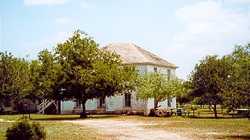
still there, living largely on its past. The old courthouse is now
a museum, and where dozens of saloons once stood there's a single
bar serving beer. Where there was once a college there are only ruins.
Col. William Butler may not actually have said "This town killed my
son. I'll kill this town." What he did was do his best to carry out
the threat he probably never voiced. He very nearly succeeded.
© C. F.
Eckhardt
"Charley Eckhardt's Texas"
July 12, 2006 column |
|
|
 HOME
HOME