|
 |
History in
a Pecan Shell
Helena once held
great promise. It was founded by Lewis Owings and Thomas Ruckman.
The name came from Owings wife Helen. Ownings went on to become the
first Governor of Arizona (Territory). Helena's situation on the San
Antonio River and the Chihuahua Trail guaranteed it would become
a major city.
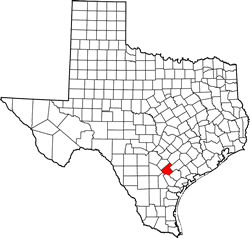
Helena became the first Karnes County Seat when the county
organized in 1854 and during the Civil War it served as a major point
on the "Cotton Road" between Matamoros, Mexico and
Alleyton, Texas (Colorado
County).
(See The
First Karnes County Courthouse )
According to story, the demise of Helena can be traced to one man.
He was a rancher whose son was shot and killed in Helena. He demanded
revenge and when he couldn't find the individual(s) responsible, he
instead swore to kill the entire town. When the San Antonio and Aransas
Pass Railway came through the area, the rancher practically gave the
railroad their right-of-way and we can see the results today.
The other story was that the railroad was demanding a bounty of 35,000
dollars and the town could only come up with 32,000. The railroad
insisted on the full amount and moved on to Karnes
City when the extra money couldn't be raised. The second story
is believable, but doesn't have the pathos of a father's grief.
Helena Historical Marker: |
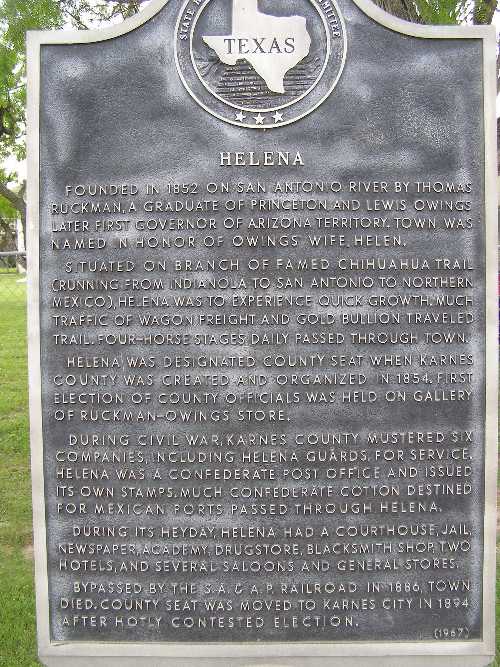 |
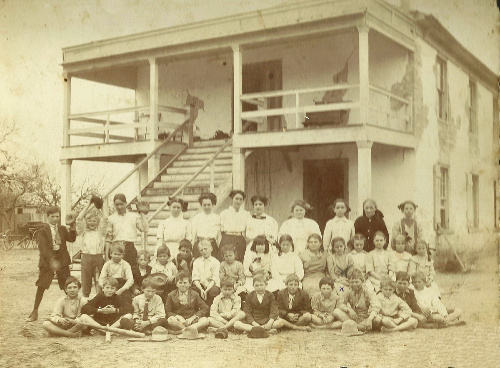
HELENA
Founded in 1852
on San Antonio River by Thomas Ruckman, a graduate of Princeton, and
Lewis Owings, later first governor of Arizona Territory. Town was
named in honor of Owings' wife, Helen.
Situated on branch of famed Chihuahua Trail (running from Indianola
to San Antonio to
Northern Mexico), Helena was to experience quick growth. Much traffic
of wagon freight and gold bullion traveled trail. Four-horse stages
daily passed through town.
Helena was designated county seat when Karnes
County was created and organized in 1854. First election of county
officials was held on gallery of Ruckman-Owings Store.
During Civil War, Karnes
County mustered six companies, including Helena Guards, for service.
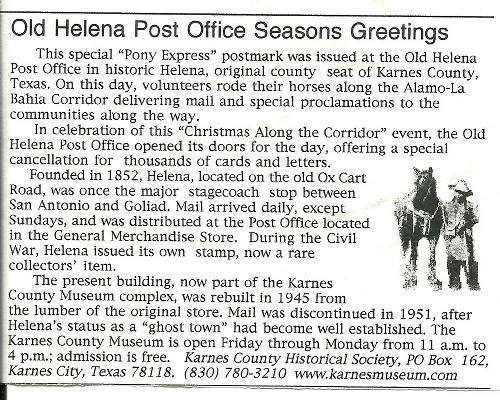
Helena was a Confederate post office and issued its own stamps. Much
Confederate cotton destined for Mexican ports passed through Helena.
During its heyday, Helena had a courthouse,
jail, newspaper, academy, drugstore, blacksmith shop, two hotels,
and several saloons and general stores.
Bypassed by the S.A. & A.P. Railroad in 1886, town died. County seat
was moved to Karnes
City in 1894 after hotly contested election.
1967 |
 |
Karnes County
Museum
8167 N FM 81
Helena, Texas 78118
Phone: 830-780-3210
Friday - Monday, 11 a.m. - 4 p.m.
Free |
|
|
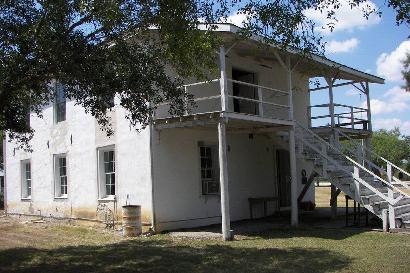
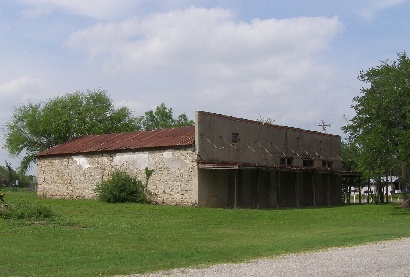
The
Karnes County Museum Complex in Helena
TE Photo,
2001 |
Photographer's
Note -
"The old white Helena house shown was originaly in another Helena
location. Was taken apart, moved to the Courthouse grounds & reassembled.
It was in use for many years till 2008 by the "Happy Helena Quilters".
The house has many interesting community items in it, including the
first electric stove in Karnes
County.
The old house & Post Office are all part of the Museum Complex at
the Courthouse grounds." - William
Beauchamp |
|
Helena, TX 78118
Helena Post Office rebuilt from the lumber of the original store
in 1945.
Now part of the Karnes County Museum Complex
Photo
courtesy William
Beauchamp, April 2012
More Texas
Post Offices
|
| Photographer's
Note - "The little post office building holds Post Office related
items from several of the early small post offices in Karnes
County. The early Helena Post Office was in a store across the
street." - William
Beauchamp |
Helene issued
its own stamp during the Civil War
Photo courtesy William
Beauchamp, April 2012 |
Black Diamond
Elephant Leg
Photographer's Note - "Above photo is of an old "Real" leg of
an elephant in a early traveling circus. It sits now in the corner
of the little Post Office Building on the Courthouse Grounds in Helena.
Story is the Circus Elephant killed someone in Corsicana.
They decided to kill the elephant but wait till there next stop in
Kenedy. It was
killed across the road from were Otto Keiser Hospital now stands and
at the location of the Black Diamond Ranch. It took 170 shots to kill
the big animal. After it was downed it was found the poor creature
had a bad tooth. Probably the reason it went crazy at the stop before."
- William
Beauchamp |
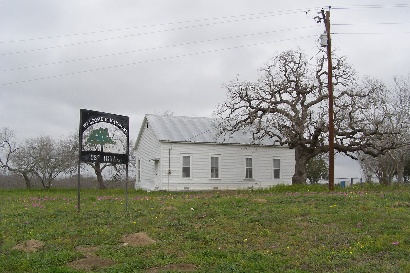
"Old Helena
Union Church Buildt in 1866
Destroyed by a Storm in 1973"
Photo
courtesy William
Beauchamp, April 2012 |
 |
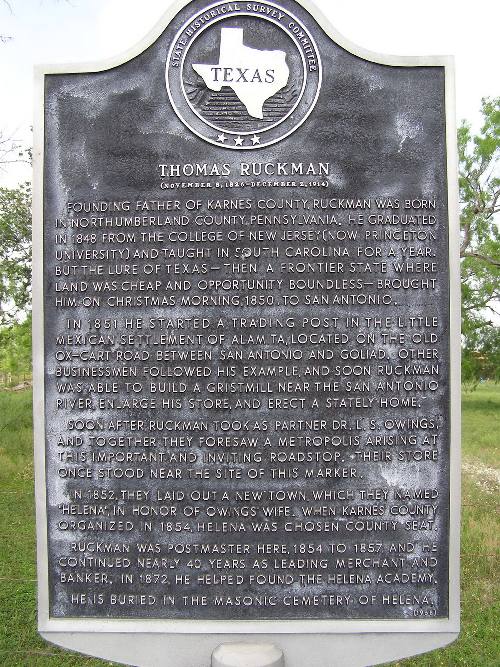 |
Thomas
Ruckman
(November 8, 1826 - December 2, 1914)
Founding father of Karnes
County, Ruckman was born in Northumberland County, Pennsylvania.
He graduated in 1848 from the College of New Jersey (now Princeton
University) and taught in South Carolina for a year. But the lure
of Texas-- then a frontier state where
land was cheap and opportunity boundless-- brought him on Christmas
morning, 1850, to San
Antonio.
In 1851 he started a trading post in the little Mexican settlement
of Alamita, located on the Old Ox-Cart Road
between San Antonio
and Goliad.
Other businessmen followed his example, and soon Ruckman was able
to build a gristmill near the San Antonio River, enlarge his store,
and erect a stately home.
Soon after, Ruckman took as partner Dr. L. S. Owings, and together
they foresaw a metropolis arising at this important and inviting roadstop.
Their store once stood near the site of this marker.
In 1852, they laid out a new town, which they named "Helena", in honor
of Owings' wife. When Karnes
County organized in 1854, Helena was chosen county seat.
Ruckman was postmaster here, 1854 to 1857, and he continued nearly
40 years as leading merchant and banker. In 1872, he helped found
the Helena Academy.
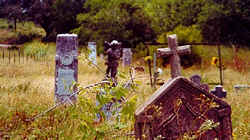
He is buried in the Masonic Cemetery of Helena. |
 |
|
|
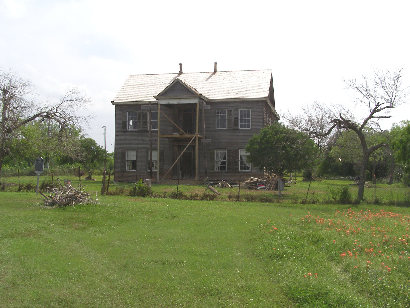
State
Highway 80 through Helena
TE Photo,
2001 |
Ox-Cart Road
Historical Marker
On Old courthouse Square, FM 81
Photo
courtesy William
Beauchamp, April 2012 |
Historical Marker
Text
Ox-Cart Road
(Section
of Chihuahua Road)
After centuries
of use by buffalo
and Indians, this trail from San
Antonio to the Texas
coast gained importance when opened to colonial travel by the
Alarcon Expedition in 1718.
Spanish conquistadores and priests, the Gutierrez-Magee
Expedition (which invaded Spanish Texas in 1812), Stephen F. Austin,
Alamo heroes, Santa
Anna's messenger ordering the death of prisoners at Goliad,
Polish and German settlers of Texas-- all traveled on road.
Rich trade in gold, silver, and leather with Mexico and the West was
conducted along the road from San
Antonio to Powderhorn. The U.S. 2nd Cavalry Forts, established
to protect the Texas frontier, moved men and supplies over it. Materials
were transported in two-wheeled ox-carts, prairie schooners, Wells-Fargo
wagons drawn by sixteen mules, and by pack animals.
In 1852 Helena was founded on road as a midway point between San
Antonio and Goliad;
Lewis S. Owings operated a daily stage line here, 1854. Major incidents
of the Bizarre Cart War of 1857 between Texan and Mexican teamsters
occurred near Helena.
Herds of longhorns
from South Texas crossed
the road here enroute to market. After the railroad came through county
in 1886, the Ox-Cart Road was abandoned.
1967 |
 |
Helena Chronicles:
How
to Kill a Town by Clay Coppedge
"Here's one way to kill a town.
First, you move to a place with a lot of wide open country that
most people think of as worthless. You establish yourself and your
family as upstanding members of a new society you helped create.
You show courage and honesty in all your dealings. Then, when somebody
messes with your family and the town won't offer support, you kill
it.
That's how William G. Butler killed the town of Helena, Texas, or
so the story goes." Read
full article ›
The
Gunfight that Killed Helena by C. F. Eckhardt
"... The railroad bypassed Helena, and eventually the town
withered - but never died completely. A new town - Karnes
City - was built up on the railroad, and eventually became the
county seat.
The San Antonio & Aransas Pass railroad is gone now. The rails,
except for a short stretch outside Sinton,
now used by another road to store rolling stock, were taken up in
the 1970s. Karnes
City has had its ups and downs, from the 'uranium sitting' fad
of the 1940s and 1950s to the various oil booms and busts of the
20th Century. Today it's mostly down, not up, but it's still viable,
sitting as it does astride Texas 123, one of the main routes for
southbound traffic from central Texas to the coast. Kenedy
isn't doing too bad, being astride the intersection of US 181 and
Texas 72, a couple of fairly major traffic arteries.
Helena? Well, Helena's still there, living largely on its past.
The old courthouse is now a museum, and where dozens of saloons
once stood there's a single bar serving beer. Where there was once
a college there are only ruins. Col. William Butler may not actually
have said "This town killed my son. I'll kill this town." What he
did was do his best to carry out the threat he probably never voiced.
He very nearly succeeded." Read
full article ›
|
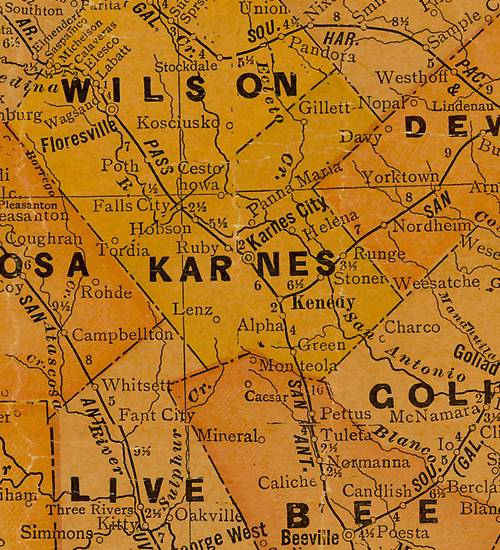 |
Karnes
County 1920s map showing Helena
From Texas state map #10749
Courtesy
Texas General Land Office |
| Texas
Escapes, in its purpose to preserve historic, endangered and vanishing
Texas, asks that anyone wishing to share their local history, stories,
landmarks and recent or vintage photos, please contact
us. |
|
|
 HOME
HOME