|
If
you know Texas history,
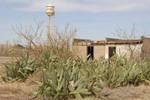
you know the story. At the second
battle of Adobe Walls buffalo shooter Billy Dixon used his Sharps
rifle to shoot a Comanche chief off his horse at about 1000 yards.
With the chief dead, especially at such extreme range, the Comanches
called it quits and left.
Did it happen?
We have two seemingly-related incidents. #!: Billy Dixon fires his
rifle at a group of Comanches atop a knoll nearly 1000 yards away.
#2: One of the Comanches is seen to fall from his horse. For years,
this has been considered proof positive that Dixon shot the Comanche—but
is it?
Let’s ask—and answer to the best of our ability--three questions:
First, could Dixon have done it? Is the shot in the realm of possibility,
given the weapon and the man?
Second, how likely is it that Dixon did it? Given the known abilities
of human beings, is it at all likely that this happened?
Third, did Dixon actually do it?
Question #1—could Dixon have done it? Dixon was shooting a Sharps
long-range single- shot rifle. It was chambered either for Sharps’
famous ‘Big Fifty’ cartridge, a .50 caliber, 500 grain slug with
a cartridge case 3½” long holding about 125 grains of powder, or
for its only slightly smaller brother, the .45x3½, holding the same
amount of powder and using about the same weight bullet, but of
a slightly more ballisticly efficient design. While I don’t have
at hand a ballistic table for either of those cartridges, I have
one for the Big Fifty’s parent cartridge, the US Government Cal.
50 Rifle cartridge—the .50-70-450. The figures mean .50 caliber
(bullet ½” in diameter), 70 grains weight of common rifle powder
(1/100 of a pound of powder), and a bullet weighing 450 grains.
In 1871 the
National Armory at Springfield, Massachusetts, published a 14-page
booklet entitled Description and Rules for the Management of
the Remington Navy Rifle, Model 1870. The last three pages of
the booklet are titled “Memoranda of Trajectory &c.”
The rifle,
a Remington rolling-block Model 1870 chambered for the government’s
.50 caliber cartridge, was fired 1,882 times at ranges of from 200
to 1086 yards. The rifle was, for all but the extreme range tests,
fired from a fixed rest 56” above the ground—the height of the shoulder
of a man standing 5’8” tall (average height for a soldier of the
day). The aiming point was a bullseye target, the center of which
was 34” above the ground—the height of the belt buckle or belly
button of a 5’8” man. The targets were mounted on a frame 12’ wide
and 18’ high.
A total of 102 rounds were fired at 1086 yards. The aiming point
at that range was ‘the center of the target board’—a point about
9 feet off the ground. The rounds actually struck somewhere on the
target board 80% of the time. The answer to question #1, then, is
yes. The rifles of the day, even a rifle of considerably less power
than Dixon’s, were capable of firing and hitting something at ranges
even greater than Dixon’s shot.
Question #2: How likely is it that Dixon actually hit the target
he shot at?
The problem
here is range and human ability to estimate it. The average adult
human being can, with experience and training, learn to estimate
range fairly accurately out to about 500 yards. That’s where binocular
vision fails and everything turns flat like a movie screen. It’s
a function of how far apart the person’s eyes are in the head. Three-dimensional
vision is necessary for accurate estimate of distances. With practice—and
Dixon had lots of practice—a person can train his or her brain to
triangulate and estimate distances out to about 500 yards with an
accuracy of about ±5%. That is, an estimate of 500 yards will be
within 50 yards of being dead on—somewhere between 475 yards (-5%)
and 525 yards (+5%).
The ballistics tables for the .50-70 tell us that at 500 yards,
on the falling end of the trajectory, there was ‘danger space’—that
is, the bullet was low enough to hit a 5’8” man somewhere between
his forehead and his crotch—for a total of 77.5 yards, from 42 yards
in front of him to 35.5 yards behind him. That’s well within the
capability of an experienced shooter to estimate range and hit a
man-sized target.
At double that range?
Beyond 500
yards ‘estimation’ becomes ‘guesstimation.’ We’re reduced to comparing
sizes of objects. On a fairly flat, treeless area like the Adobe
Walls battleground, there’s just not much to compare with.
Still, an experienced
hunter can estimate range with a fair amount of accuracy out to
as much as a mile. The accuracy is nowhere near ±5% though. It’s
more like ±10% at 600 yards to upwards of ±25% at 1000 yards or
more. Still, we’re dealing with a very experienced hunter here.
We’ll give Dixon a margin of error of about ±15%, which is probably
pretty generous. That’s a 300 yard margin of error—the actual range
may be anywhere from 936 yards to 1236 yards.
What margin
of error does our ballistics table allow us at 1086 yards? Our danger
space at that range is only 7 yards—21 feet. The bullet is coming
almost straight down. The maximum height the bullet’s path rises
above the line of sight—known as the ‘maximum ordinate’ in artillerymen’s
terms—at a mere 700 yards is 87 feet. At 1086 yards, though the
table doesn’t give it, the maximum ordinate, if it doesn’t exceed
100 feet, doesn’t miss it by much.
Dixon’s Sharps was considerably more powerful than the .50 Government
cartridge, but it was still a black powder weapon pushing a very
heavy bullet. Like all such, it had a trajectory like a rainbow.
Even if Dixon’s rifle had as much danger space at 1000 yards as
the .50-70 had at 500 yards—and it likely had considerably less—the
danger space would still be less than a third of the margin for
error in the very generous range-estimation ability we’ve given
Dixon.
The answer
to Question #2 must be, then, downright unlikely.
Question #3: Did Billy Dixon, in spite of the odds against it, actually
hit what he shot at?
Well, for a
long time everybody assumed he did. After all, he fired…there was
a wait…and then a Comanche fell off his horse. Shortly afterward
the Comanches quit the field and left. Even with the odds against
him being almost impossibly high, Dixon must have hit the
man.
For a long
time nobody asked the Comanches what happened. When somebody finally
got around to that, the answer was surprising. The Comanches had
been in a pitched battle against forted-up whites for three days,
a condition not to their liking at all. They’d lost a lot of warriors
and all they had to show for it was three scalps taken the first
day, one of them from a dog. They were holding a council of war
on a knoll they considered completely out of range of the white
men’s rifles, deciding whether or not to continue the fight. One
of the chiefs was hit with a nearly- spent bullet that knocked him
off his horse but did not wound him severely. They took this as
a sign it was time to quit, and they did.
Please note—knocked
off his horse by a nearly spent bullet. In our ballistic table
for the .50-70 we find that its 450 grain bullet was capable of
penetrating 5” of seasoned pine lumber at 1086 yards. A bullet that
can penetrate 5” of seasoned pine lumber is capable of doing a lot
more than simply penetrating a human body. It’s capable of killing
the man it hits. Yet by Comanche testimony, their man was knocked
off his horse and bruised by the bullet that hit him, but not severely
injured.
Dixon’s rifle would have had considerably more residual energy at
1000 or so yards than the much-lighter-loaded .50-70. It would have
had the ability to penetrate considerably farther into seasoned
pine than a mere 5”.
Answer to Question #3—no. If the Comanche account of what happened
on the knoll during their council of war is accurate, Dixon did
not hit the man. If he had, the man would have been at the very
least seriously wounded and most likely would have been killed.
Well, Billy
said it was a scratch shot. He was right.
© C. F. Eckhardt
"Charley Eckhardt's Texas"
March
17 , 2008 column
See also:
Battle
of Adobe Walls
Billy
Dixon's Long Shot Analized by Mike Cox
Related Topics:
Columns | People
| Texas Towns | Texas
Counties | Texas
|