|
Woodward
Maurice Ritter—his childhood nickname was ‘Woody’—was
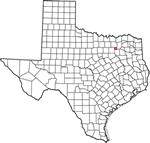
born near Murvaul,
Panola County,
in the piney woods of deep East
Texas in 1907. He grew up on a cotton farm near Beaumont
and graduated as Valedictorian of his high-school class. He enrolled
at what was then the only University of Texas—the one in Austin—in
a pre-Law program.
About 1928 the show-business bug bit him. He was in his high school’s
glee club and also in UT’s, his deep baritone voice having distinguished
him as a singer. He went to New York and joined a theatrical troupe
there. Unfortunately, the troupe collapsed the next year, along
with the national economy. He returned to Texas
and re-enrolled at UT.
In 1931 he was brought back to New York to perform in Lynn Riggs’
stage play, Green Grow The Lilacs, which was the basis for
the highly successful Rogers & Hammerstein musical, Oklahoma!
While he wasn’t the star, his performance led to his hosting NY
area radio programs featuring country and ‘cowboy’ music. They included
Tex Ritter’s Campfire and Cowboy Tom’s Roundup. He
played recordings and sang.
In 1935 he was hired by Art Satherly, a music producer, to record
four songs. As Tex would comment much later, “It was just me and
a guitar, and I ain’t no Chet Atkins on a guitar.” He was paid $100
for the session. There were no residuals, no royalties—just
the $100. In 1935 $100 was a lot of money.
The recordings got him noticed by Edward Finney of Grand National
Pictures. In 1934 Mascot Pictures hired a singer to perform in a
Ken Maynard film called In Old Santa Fe. The singer, who
was at the time headlining the National Barn Dance radio
program out of Chicago, was a young Texan named Gene
Autry. Autry
proved a major success at Mascot and Finney was looking for a singing
cowboy star of his own.
Tex signed with Grand National. His first film, Song of the Gringo,
came out in 1936. He made a total of twelve films with Grand National,
including Trouble in Texas (1937), in which his co-star was
a very young Rita Hayworth. Unfortunately, in 1939 Grand National
went bust.
Tex was immediately signed by Monogram, where he made twenty westerns,
some of them co-starring with Johnny Mack Brown. The stint at Monogram
was followed by contracts at Columbia and Universal. His last film
was a Universal picture, The Texas Rangers, in 1945. In his
film career he starred or co-starred in eighty-five Westerns.
In
1942 Tex Ritter became the very first country-western singer signed
by Capitol Records. Between 1944 and 1950 he had seven chart-toppers—‘I’m
Wastin’ My Tears Over You,’ ‘There’s a New Moon Over My Shoulder,’
‘Jealous Heart,’ ‘You’ve Two-Timed Me One Time Too Often,’ ‘You’ll
Have To Pay,’ ‘Rock and Rye,’ and ‘Daddy’s Last Letter,’ taken from
a letter written by PFC John H. McCormick to his son just before
he was killed in action in Korea. In 1953 he returned to the top
of the charts with the haunting Dimitri Tiompkin song ‘Do Not Forsake
Me,’ the theme of the Gary Cooper/Grace Kelly film High Noon.
That became one of Tex’s most enduring hits. Eleven years later,
in 1964, he returned to the top of the charts with ‘Hillbilly Heaven,’
written by fellow Texan Edgar Dean Glosup, who—as Eddie Dean—was
a highly successful singing movie cowboy in the 1930s and ‘40s.
Dean was a prolific songwriter who wrote over a hundred songs—one
of his many songs, ‘One Has My Name, The Other Has My Heart,’ is
still heard on C&W radio—had an almost operatic-quality baritone
voice. Both Roy Rogers and Gene
Autry agreed Eddie Dean was the best cowboy singer in the movies.
From 1953 until 1961 Tex hosted Town Hall Party, a country
and western music show on TV, and also guest-starred in a number
of TV Westerns, the most notable being The Rebel, starring
Nick Adams. From 1963 until 1965 he served as president of the Country
and Western Music Association. In 1965 he reached country music’s
pinnacle when he was made a member of the Grand Ole Opry in Nashville.
|
 HOME
HOME