|
 |
History in
a Pecan Shell
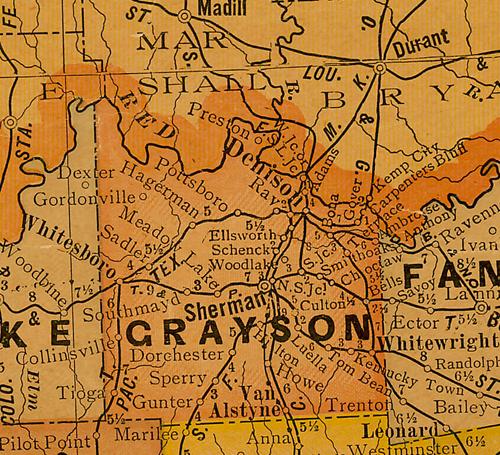
Ambrose was named
after Ambrose Bible, a Tennessean who arrived in 1883. He bought land
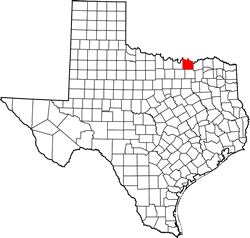
that was in old Fannin County, from which Grayson
County would be cut in 1846. The Denison, Bonham and New Orleans
Railroad attemped to run a spur from the MKT in Denison
but failed.
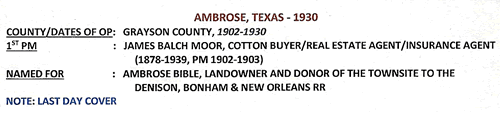
In January 10, 1902, Ambrose was platted and by September a post office
was opened. The following year Bible deeded land for a right-of-way
to the DB and NO railway.
In 1907 a school was built - also on land donated by Ambrose Bible.
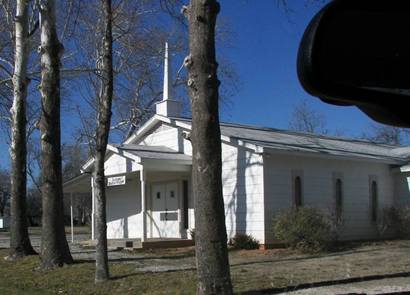
Soon Ambrose had a Methodist, Church of Christ, and Baptist church.
A new school was built in 1917 and the town reached its high-water
mark two years later. Since most people in the area were farmers,
Ambrose never grew past 60 people. The DB&NO railroad went bankrupt
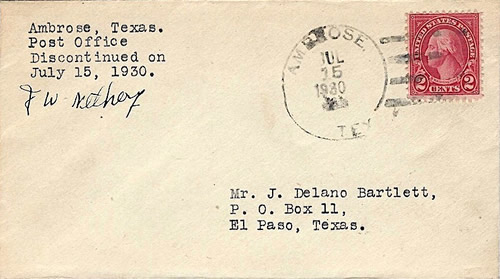
in 1927 and the Ambrose post office moved to Bells
in 1930. From then on, Ambrose's mail was routed through Bells.
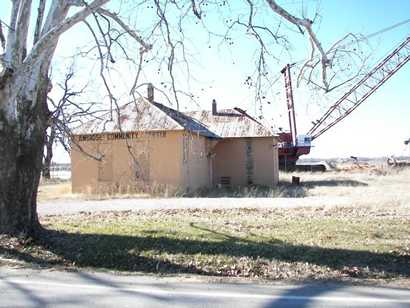
In 1980 the population was estimated at just forty-one. The former
school is now in use as a community center. |
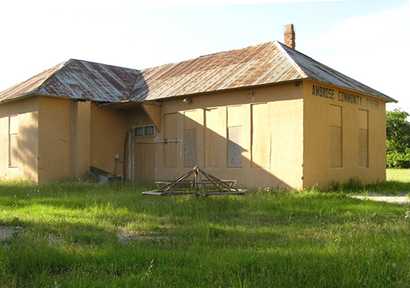 |
"It looks
as though the former schoolhouse was used as a community center for
awhile, but it does not look being maintained at this point."
- Stephen
Taylor. Photo courtesy Elizabeth
Taylor, May 2006 |
Another view
of the Ambrose Community Center
Photo courtesy Barclay
Gibson, February 2007 |
Photographer's
Note:
Ambrose is kind of a strange town. It is located almost due north
of Bells and has some kind
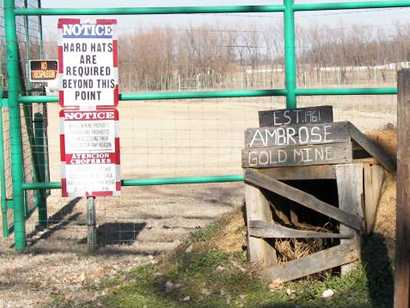
of huge mining operation on at least two sides, north and west. The
road literally dead ends into the entrance to the mine. The Gold Mine
sign is probably somebody's joke. You can see the crane behind the
Community Center. There seems to be only one way out of Ambrose and
that is the way you came. - Barclay
Gibson, February 13, 2007
Subject: Sand mines in Ambrose
The Ambrose gold mine sign is referring to a sand mine. This area
along the red river is extremely rich in sand deposits. And there
are several sand mines in this area. - Daniel Hall, July 12, 2023
|
| Texas
Escapes, in its purpose to preserve historic, endangered and vanishing
Texas, asks that anyone wishing to share their local history, stories,
landmarks and vintage/historic photos, please contact
us. |
|
|
 HOME
HOME