|
 |
History
in a Pecan Shell
Originally named Mound Prairie, the community began life around
1850 on a 100 acre tract of land donated by David Hall Love when the
location was chosen to be the county seat. A post office was granted
in 1851 and by the following year, there were three dry-goods, a grocery,
at least two hotels and a jail.
The first courthouse (of four) was constructed in 1852, and the others
came in 1854-56, 1891-92, and 1919-21. In 1891 and again in 1918 Wortham
and Teague both challenged Fairfield
for the role of county seat but both lost to the established Fairfield.
The towns first paper was the weekly Texas Pioneer, set up
in 1857. In1854 a school for girls opened in the second floor of the
Masonic lodge and two years later a boy’s school opened in another
building. The Fairfield Female College opened in 1859, enrolling over
100 students the first year.
During Reconstruction,
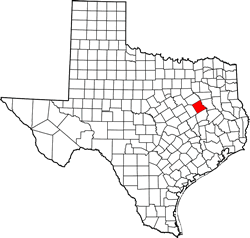
Freestone County
was (briefly) one of four Texas counties placed under martial law.
The town had a population of 500 in the mid 1880s served by four general
stores, five groceries and two hotels. The town enjoyed the 1880s,
unaware of the calamities that were on the way.
A meningitis outbreak in 1890 killed 32, but this was almost forgotten
in 1900 when a 1900 tornado struck. In 1903 the boll
weevil infestation destroyed the cotton
crop and if that wasn’t enough, a fire in 1911 burned much of what
was missed by the tornado.
Despite the serious setbacks, and never having a railroad
connection, Fairfield grew. By 1904 the population was up to 629,
growing slowly but steadily to 1,047 by 1940 and doubling to 2,074
by 1970.
Fairfield never acquired a railroad.
It had been bypassed by the Trinity and Brazos Valley in 1907, but
managed to survive – a most unusual occurance in Texas.
Fairfield got a waterworks and infrastructure in the 30s, although
the town never had a library until the mid 50s.
From 1890 through the early 1930s, Fairfield hosted a 3-day Confederate
reunion of Confederate veterans. In 1951 the town’s centennial celebration
was held on the former reunion campground which morphed into an annual
homecoming festival, and later became the Freestone County Fair. |
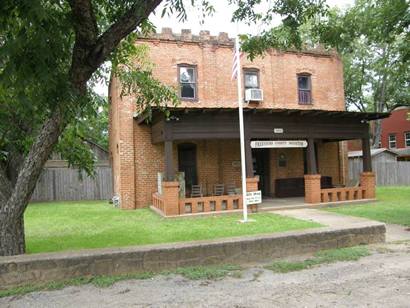
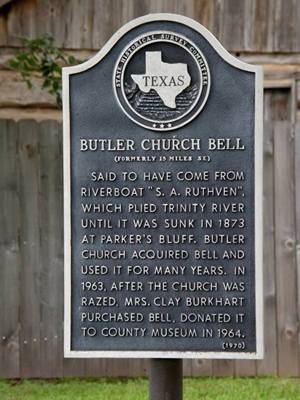
Butler Church
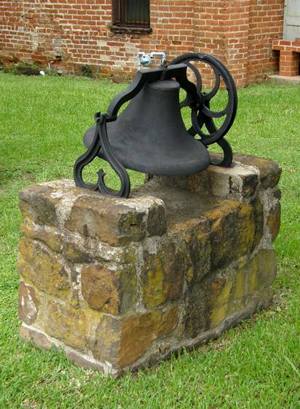
Bell historical marker
Photo courtesy Barclay
Gibson, July 2007 |
| Texas
Escapes, in its purpose to preserve historic, endangered and vanishing
Texas, asks that anyone wishing to share their local history, stories,
landmarks and recent or vintage photos, please contact
us. |
|
|
 HOME
HOME

 Texas
Gulf Coast
Texas
Gulf Coast East
Texas
East
Texas Central
Texas North
Central
Texas North Central
Texas South
Central
Texas South Texas
Panhandle
Texas
Panhandle South
Texas
South
Texas Texas
Hill Country
Texas
Hill Country West
Texas
West
Texas Texas
Ghost Towns
Texas
Ghost Towns Texas
Counties
Texas
Counties