|
|
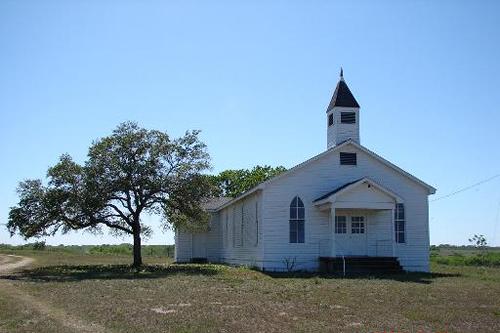
The Cheapside
(interdenominational) Community Church
Photo
Courtesy Margie Warwas, April 2006
More Texas Churches |
History
in a Pecan Shell
The name sounds English, but although the man who named
it (Doctor E.R. Henry) was of English descent, he actually named it
for his hometown of Cheapside, Virginia (which may have been named
for the London neighborhood).
The first permanent settler was former Mississippian Thomas Baker
who built a cabin in the vicinity in 1857. He was soon joined by other
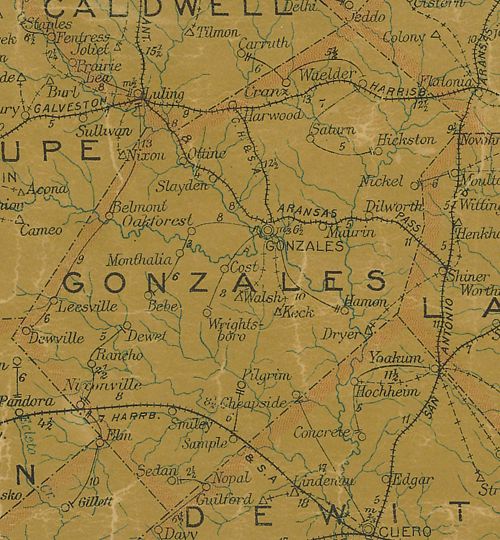
families and the town was platted by one Thomas Carter. Cheapside
was granted a post office in 1882 while it was still technically in
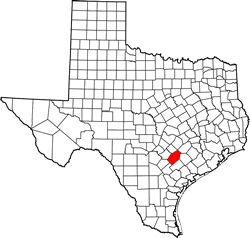
DeWitt County. This
minor descrepancy was cleared up in the early 1890s when it was moved
one mile west - into Gonzales
County. (See Gonzales,
the Gonzales County seat.)
This part of Texas seems to have been popular with former Mississippians
(see the ghost town of Albuquerque,
Texas).
Cheapside's major economic engine was cotton
with poultry, and cattle raising to a lesser degree. A cotton gin
/ gristmill was built in 1889. Cheapside at its zenith had three stores,
a smithy, drugstore, doctor, hotel and two saloons. Order was kept
by a Gonzales County deputy sheriff.
A private school was in operation from 1890 to 1913, and both Masons
and Woodmen of the World maintained lodges
in Cheapside.
A Delco electric generater was installed in the mid 1920s, providing
electricity nearly 15 years before other towns were electrified.
The Cheapside Baptist Church was organized in 1893, joining a Presbyterian
Church that had been organized in Bellevue
in 1874 and then moved to Cheapside. |
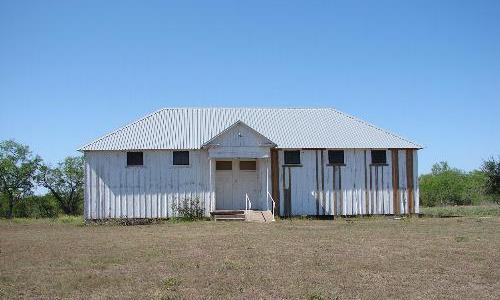 |
Cheapside Community
Center utilizes a former schoolhouse
Photo
Courtesy Margie Warwas, April 2006
More
Texas Schoolhouses |
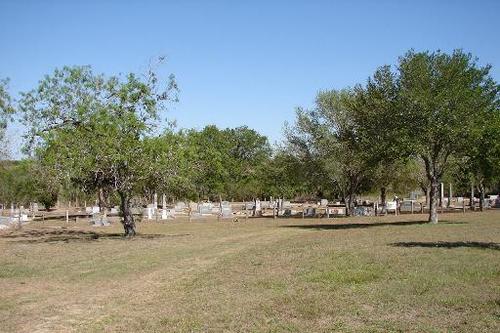
Bellevue Cemetery
Photo
Courtesy Margie Warwas, April 2006
More Texas Cemeteries |
Bellevue Cemetery,
two miles south of the townsite was established in 1876 and is still
maintained by an active association. It is said that among the interred
are veterans from "every declared American war."
When cotton bottomed out and the
Great Depression arrived, the gin closed and cotton fields became
pasture. By the beginning of WWII,
school enrollment was in decline and it merged with Cuero
schools in in the late 40s.
By 1960 all that was left was a store with the post office inside.
Both held on until early 1989. The Cheapside (interdenominational)
Community Church was still holding services in 1990 according to the
Handbook of Texas and the Community Center (a former school)
was still servicing the community.
Former students reportedly held an annual June reunion.
From a population of just over 100 in 1904, it has declined over the
years to 31 - the estimate first used in the early 1970s. |
 |
| Texas
Escapes, in its purpose to preserve historic, endangered and vanishing
Texas, asks that anyone wishing to share their local history, stories,
landmarks and vintage/historic photos, please contact
us. |
|
|
 HOME
HOME

 Texas
Gulf Coast
Texas
Gulf Coast East
Texas
East
Texas Central
Texas North
Central
Texas North Central
Texas South
Central
Texas South Texas
Panhandle
Texas
Panhandle South
Texas
South
Texas Texas
Hill Country
Texas
Hill Country West
Texas
West
Texas Texas
Ghost Towns
Texas
Ghost Towns Texas
Counties
Texas
Counties