|
|
 |
History
in Pecan Shell
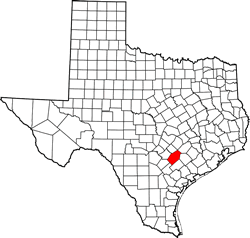
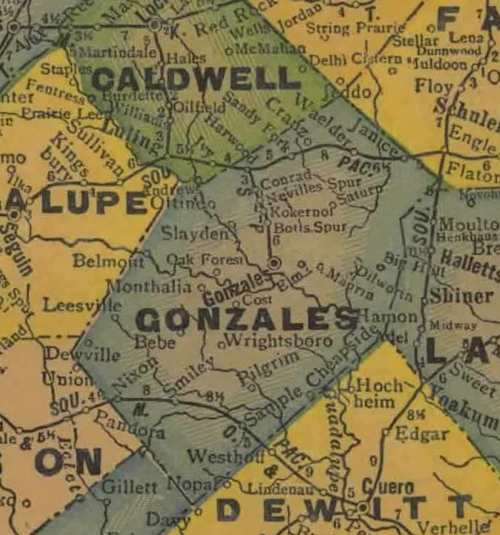
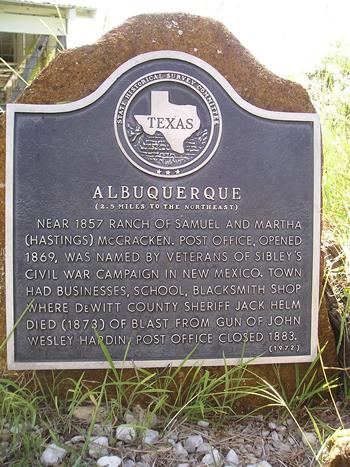
Located on the Clear Fork of Sandies Creek, Albuquerque was once believed
to have been in Wilson
County. The discrepancy was cleared by a survey in 1914.
The town was only two miles south of where Gonzales,
Wilson, and Guadalupe
counties joined. The Handbook of Texas suggests that the name
was "probably" suggested by "South Texans who had fought in New Mexico
under Henry H. Sibley."
Brothers-in-law Henry S. Hastings and Samuel McCracken from Mississippi
are regarded as the town's first settlers. The town began in the early
1870s with official recognition coming with the opening of the post
office in 1870. Thirteen short years later it was already fading into
ghost-town status. The post office closed its doors briefly, reopened
and then closed for good in 1883.
The fledgling town had the basic businesses to survive including a
cotton gin, blacksmith, store, saloon and school, but with no railroad
on the horizon, the odds were stacked against Albuquerque's survival.
It did have it's fifteen minutes of fame when John
Wesley Hardin was involved in not one, but two killings.
Albuquerque's decline was attributed to the growth of nearby Union,
Texas, aka Union
Valley which was two miles south of Albuquerque. Eventually even
the die-hard residents abandoned the town and by 1912 the town was
totally deserted. |
 |
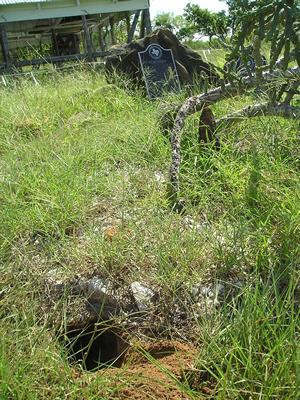
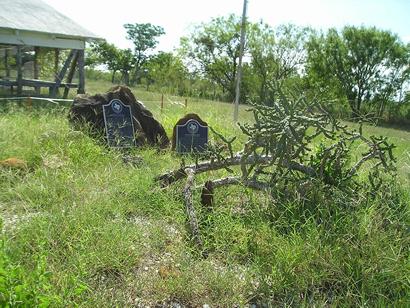
Markers by an
armadillo hole
"I have never seen an armadillo hole that big"
- Sarah
Reveley, 2007 |
30
Minutes of Fame
Albuquerque had it's fifteen minutes of fame (x 2) when famous gunfighter
John Wesley Hardin killed a man there. While one source states the
shooting was the first in the famous Sutton-Taylor (that left bodies
from Columbus
to Victoria
and Indianola)
and that Jack Helms was the victim, actually there were two shootings
- both attended by JWH. Western Historian Charley Eckhard tells the
story:
"[The first killing] was a Black State Policeman who was under
orders to arrest Hardin and "not to treat him gentle." The order had
been given by State Police Captain Jack Helms, "who had already been
responsible for the murders of several of Hardin's kin." Actually,
he shot two [State Police] but only killed one. That shooting took
place in a general store on the site of Albuquerque in 1868. By 1873
the State Police had been disbanded. By that time even [Governor]
E. J. Davis realized they were nothing but a band of crooks and murderers."
"Wes was born in 1853 (which would've made him 15 at the time of the
incident). He went on a cattle drive with Manny Clements (whose name
was Emanuel, not Manning or Mannen) that spring to get out of Texas
for awhile after that [first] shooting."
The Second
Shooting
"Actually, Wes
didn't shoot Helms. He took credit for it after he went to prison
to keep the record of a cousin, who was the actual shooter, clear.
When they finally got Helms, Hardin held the town at bay with a
sixshooter in each hand while his cousin chased Helms around and
around a pot-bellied stove, shooting at him as they went. Believe
me, Helms was no loss to the community. Albuquerque had been there
a while in '68, but it did die for sure in '83, after it became
obvious that it would never get a railroad."
- Charley Eckhardt,
Seguin, Texas,
May 09, 2006
|
|
|
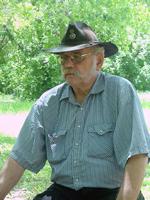
Sequin
Author and Western Historian Charley
Eckhardt, who suggested Albuquerque's inclusion
TE Photo April 2006 |
Albuquerque,
Texas Forum
I read your story
on Union Valley
where it said the population was zero. However, at the time I was
there, about ten years ago, there were still people living in the
town. There may still be. It was not a large population, but still
had a few. Nockenut
is nothing but a cemetery now as is (I think) Mound Creek where John
Wesley Hardin's wife Jane is buried. There is no longer a highway
sign pointing the way to Mound Creek, Sweet
Home in Guadalupe
County or several other places. I guess that makes them officially
ghosts. - Hilda Hilpert, October 31, 2007 |
| Texas
Escapes, in its purpose to preserve historic, endangered and vanishing
Texas, asks that anyone wishing to share their local history
and vintage/historic photos, please contact
us. |
|
|
 HOME
HOME
 Texas
Gulf Coast
Texas
Gulf Coast East
Texas
East
Texas Central
Texas North
Central
Texas North Central
Texas South
Central
Texas South Texas
Panhandle
Texas
Panhandle South
Texas
South
Texas Texas
Hill Country
Texas
Hill Country West
Texas
West
Texas Texas
Ghost Towns
Texas
Ghost Towns Texas
Counties
Texas
Counties