|
Maybe
the historical image of Texas that endures
along with cowboys
and Indians and the Alamo
is the classic gunfight. The showdown at high noon on the dusty main
street of a Western town has its roots in the “gentlemanly” duels
cultivated almost to an art form in the South for decades. Dueling
was a major issue during the Republic of Texas years when the army
tried to crack down on the practice, which usually resulted in the
loss of at least one fighter to what might be called unfriendly friendly
fire.
The editor of the Austin Sentinel newspaper responded to an
1837 duel between two Army officers by writing, “We would opine that
there was enough fighting to be had on the frontier without resorting
to private combats.”
Albert Sidney Johnston, Commander in Chief of the Army following
Sam Houston, was
particularly vexed by duels. He once had to slap the pistol from one
officer’s hand to keep him from shooting another officer. Another
time, a colonel called on Johnston to serve as an impartial judge
in an impending duel with a rival officer. Before Johnston could remind
the colonel that dueling was against army regulations, the other duelist
arrived and opened fire.
Though Johnston was largely responsible for enforcing the Texas Army’s
ban on dueling, he was not one to let a challenge to his own honor
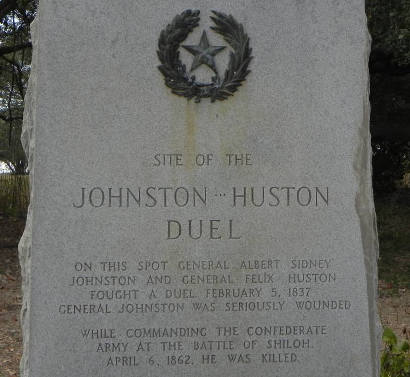
go unanswered. When General Felix Huston challenged Johnston
to a duel, Johnston accepted.
Johnston and Huston could both be termed “Fighting Kentuckians” since
both men hailed for that state. Their duel came on Feb. 5, 1837, not
long after Sam Houston
appointed Johnston as the Texas’s Army’s senior brigadier general,
making him the Army commander. Huston was forced to relinquish command
by becoming a junior brigadier general.
Huston’s foul mood over the matter turned murderous when Johnston
had the general order announcing his appointment read to the assembled
troops. Huston was so offended he challenged Johnston to a duel, and
Johnston accepted.
The duelists met on the Lavaca River in Jackson
County, near a large oak tree that has become known as Dueling
Oak, to settle a matter that, to our eyes now, seems to have already
been settled. In recognition of Huston’s reputation as an expert marksman,
Johnson’s second (sort of a reserve duelist as it were) suggested
that the two men agree to fire at each other from the hip, and that
is how that particular duel was fought.
Johnston intended to wait until Huston took aim before firing his
own pistol, hoping the sound of his gun would upset Huston’s aim and
timing. Johnston and Huston each fired three times at the other until,
on the third exchange, Huston shot Johnston through the hip. The attending
physician, noting that the ball had injured Johnston’s sciatic nerve,
assured Johnston that he was going to die.
Huston approached his fallen foe, offered condolences and said he
would be happy to serve under him. How much comfort this actually
gave Johnston isn’t known, but he never held the duel or its results
against Huston.
Johnston lingered near death for several months and eventually recovered
and resumed command of the Texas troops. He would go on to wider fame
as a Confederate General during the Civil War. Huston soon left the
Army and returned to the United States. |
 |
|
As
was often the case, Sam
Houston was contrary to ordinary when it came to the matter
of dueling. If such records were kept, Houston would certainly be
the hands-down winner for most challenges to a duel declined. He
responded to one challenge by saying, “This is number twenty-four.
The angry gentleman must wait his turn.” He turned down a challenge
from former Texas President David G. Burnett by saying he “never
fought downhill and never will.”
Texas passed a bill that outlawed dueling in 1840, and for the next
99 years all state officials were required to take an oath asserting
that they had never taken part in a duel. By that time the gentlemanly
dueling pistols had been replaced by rapid fire revolvers and eventually
machine guns, which made “duels” more a matter of superior firepower
and a good place to take cover.
Nearsighted W.T. Jack might have actually seen a glimpse of that
future. When he was challenged to a duel he agreed but only if the
duel took place with shotguns across a table. Under those terms,
dueling would never have been much of a problem in the Texas or
any other army.
© Clay Coppedge
"Letters from Central Texas" February
24, 2010 Column
|
|
|
 HOME
HOME


