|
|
 |
Ghost
Town without a Trace
by Mike Cox
The Texana story.
“Never will this town amount to anything. I curse it. You people…within
the sound of my voice will live to see rabbits… inhabiting its streets.”...
more
History in a Pecan Shell
One of Texas’ oldest ghost
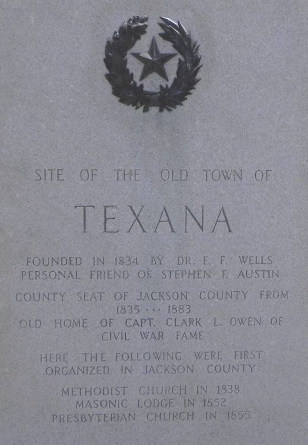
towns, the community that was formed here in 1832 was without
population by 1884. It had originally been named Santa Anna,
after you-know-who, but in 1835 as war clouds formed, the community
was renamed Texana. During the Texas Revolution Texana became
a port of entry for American volunteers. Shackelford's company of
Alabama Red Rovers bivouacked here before marching to their fate at
Goliad/Fannin.
The town was abandoned (the first time) as part of the “Runaway
Scrape” when Anglos fled in fear of Santa Anna’s advancing armies.
Texana became the county seat when Jackson
County was formed after the Revolution. The Army of the Republic
of Texas established Camp Independence near Texana in 1836. The camp
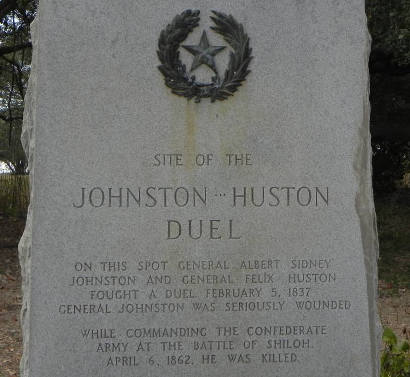
was the scene for one of Texas’ most celebrated duels – involving
Felix Huston and Albert Sidney Johnston.
Appointed as Commanding
General of the Army, and authorized to take command from Huston, the
two men quarreled, resulting in the duel in which Johnston was shot
through his hip. He survived to serve as secretary of war for the
Republic, and a Colonel in the Mexican War. He later commanded a (Union)
Cavalry regiment and resigned to join the Confederacy when the Civil
War began. He was appointed to the rank of general by Jefferson Davis.
On April 6, 1862, he was killed while leading his forces at the battle
of Shiloh. He was temporarily buried at New Orleans. By special appropriation
of the Texas Legislature, in January 1867, his remains were exhumed
from a temporary grave in New Orleans and transferred to the State
Cemetery at Austin.
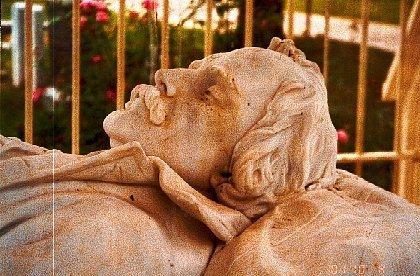
In 1905 famed sculptress Elisabet
Ney carved the recumbent statue which has become something of
a centerpiece at the cemetery. |
 |
Texana was thriving
in the 1880s and was a hub for stage lines. It remained a port for
steamships – and it was reported that as many as 20 ships arrived
each week.
But the town was hit by a double-whammy in the mid 1880s when it was
first bypassed by Count Teleferner’s New York, Texas and Mexican Railroad
in 1883, and shortly thereafter, lost an election to Edna
for the Jackson County seat of government. |
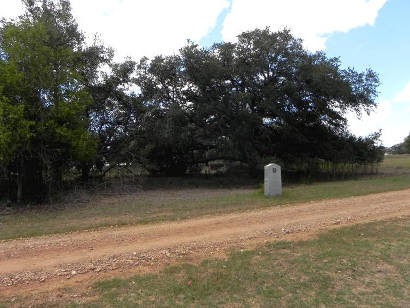
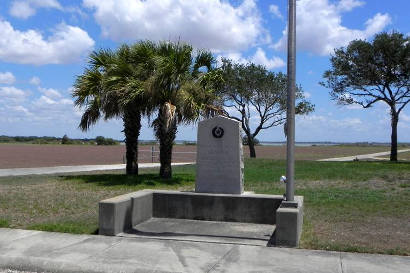
Site of Johnston-Huston
Duel Texas Centennial Marker
Photo courtesy Barclay
Gibson, August 2011 |
Johnston-Huston
Duel Marker close-up
Photo courtesy Barclay
Gibson, August 2011 |
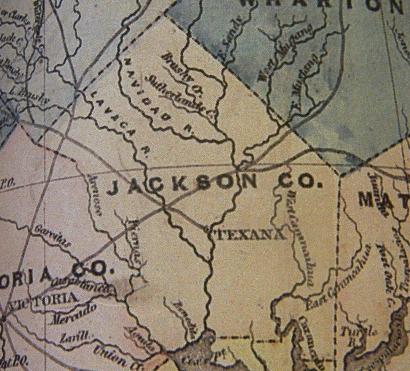
1856 Jackson
County TX Map showing Texana
Courtesy Texas General Land Office |
| Texas
Escapes, in its purpose to preserve historic, endangered and vanishing
Texas, asks that anyone wishing to share their local history, stories,
landmarks and vintage/historic photos, please contact
us. |
|
|
 HOME
HOME

 Texas
Gulf Coast
Texas
Gulf Coast East
Texas
East
Texas Central
Texas North
Central
Texas North Central
Texas South
Central
Texas South Texas
Panhandle
Texas
Panhandle South
Texas
South
Texas Texas
Hill Country
Texas
Hill Country West
Texas
West
Texas Texas
Ghost Towns
Texas
Ghost Towns Texas
Counties
Texas
Counties