|
|
While
it might be a stretch to think of corn as a native Texas plant, it
comes close. At the very least, corn is a naturalized native plant.
The early Spanish explorers found Indians growing corn here in the
early 1500s, and it became a staple in the Texas
missions where it was used in tortillas, tamales, posole and atole.
It has always done well in Central
Texas, where early settlers depended on it almost to a fault.
Cows,
horses,
mules,
pigs
and children - they all ate corn, except for those years when it didn't
rain enough to make a corn crop. In those dry years, which come at
least once every decade, the people and animals were a lot hungrier
than they were during years of normal rainfall.
With good soil and decent rain, some good mules
and a strong work ethic, corn was easy enough to grow. Once harvested,
it proved to be among the most versatile of plants. |
 |
People ate corn
on the cob, creamed corn and boiled corn. They took off the hulls
and made it into hominy and hominy grits. They made parched corn,
dodgers, corn pone, hoecakes, corn pudding, porridge, popcorn and
fritters.
Modern day nutritionists would be horrified by such a starchy diet,
but the settlers ate what they could grow. There weren't any health
food stores. Supplements? Well, you could mix corn meal with milk
and make mush.
With a couple of stiff swallows of corn liquor, it wasn't half bad.
Like the Indians with their buffalo,
the early settlers didn't let any part of the corn plant go to waste.
Corn shucks were stuffed into pillows and mattresses.
Corncobs were used as jug and bottle stoppers, corncob pipes, back
scratchers, fishing floats, firewood and sometimes as paper. Tamales,
sausages, cakes and fruits were wrapped with corn shucks.
Then
there was the Old Corn Road, which, like most early roads,
was an old buffalo
trail used by the Indians. In an attempt to get rid of said Indians,
a string of forts was built across the western frontier. The road
was used to get provisions to the forts, including Fort Gates near
Gatesville,
from the main supply depot in San
Antonio.
Farmers at Little River and one near Mound in Coryell County contracted
with the Army to sell corn for the West
Texas forts. In the course of delivery, kernels of corn would
shake loose and fall to the ground, where they took hold and grew.
As mentioned earlier, corn grew easily and well in Central
Texas; the road was soon defined by the stalks of corn growing
along its route. Though the road was known officially as the Old Military
Road, most people called it the Old Corn Road.
Early settler J.H. Chrisman wrote of the road: "We could trace the
trail in advance as far as the eye could see by the row of corn. It
was strange to see corn growing in the open prairie 50 miles from
any inhabitant and where the farmers plows had never penetrated the
soil."
Today,
corn is more versatile than ever. According to the Texas Corn Producers
Association, the typical grocery stores carries about 4,000 products
with corn ingredients. We have corn chips, cornstarch, corn syrup
and corn oil, to name a few.
Texas Cooperative Extension estimates that Texas harvests about two
million acres of corn a year with a cash value to farmers of $514
million, which generates $1.7 billion for the Texas economy.
And now, as gasoline prices soar and supplies dwindle, corn, used
to make ethanol, is touted as a viable, long-term alternative to gasoline.
There will come a time when all the oil and natural gas reserves in
the world are depleted but we suspect that corn will be growing here
long after that day arrives.
© Clay Coppedge
"Letters from Central Texas"
Augsut
22 , 2006 column |
 |
|
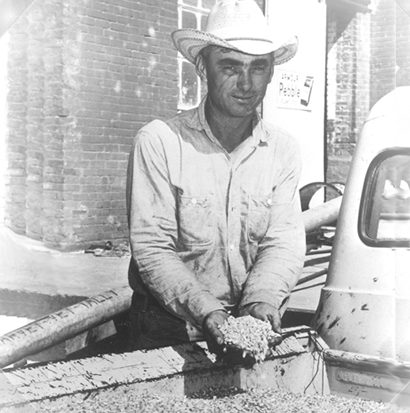
Emil Skupin
with First Load of Corn Shelled in Field
|
|
|
 HOME
HOME


