|
|
Corn,
(or maize when it’s grown for cattle feed) has been grown in Texas
for hundreds of years and predates Spanish rule. Telltale cobs have
been found in caves as far west as the Hueco Mountains of West
Texas and it was corn that made possible the operation of the
Spanish Missions.
While Texas was still under Mexican rule,
Austin’s Colony levied a tax (paid in grain) to cover the expenses
of their emissary to Mexico City.
The agricultural model of America’s deep South had been “corn, hogs,
and cotton” and as Southern farmers migrated west to Texas,
they brought this well-honed plan with them. |
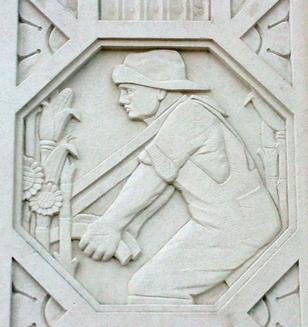
Farmer
plowing corn.
Beaumont Architectural
Detail.
TE photo |
Production
Corn had been primarily
grown in the eastern part of the State for the favorable soil and
the abundant rainfall. In the ten years between 1849 and 1859, corn
production jumped from six million bushels to 16 million bushels,
almost all of it grown in East
Texas.
During the Civil War, the Confederate government encouraged corn production
over that of cotton since the Army
desperately needed the food and cotton
had to run the Union blockade – which left payment in doubt.
Today, most of Texas’
corn crop goes to livestock consumption. |
 |
Genetically
Improved
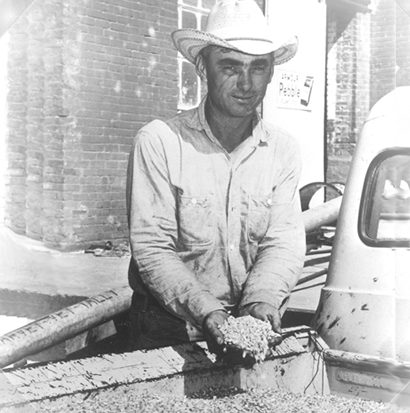
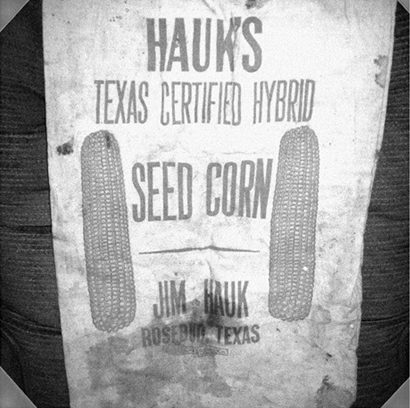
Genetically improved
strains and scientific fertilization, combined with increased irrigation
have increased yields of corn in Texas
from a mere 10 to 25 bushels per acre (in the late 19th Century) to
120 bushels per acre in the 1970s.
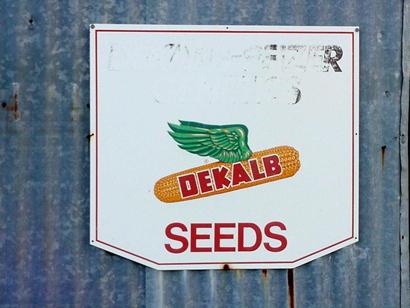
Genetically designed corn dates to the early 20th Century but it wasn’t
until 1923 when Henry Wallace, the sitting Secretary of Agriculture
gave a speech on hybrid corn at a Farm Bureau picnic. The speech inspired
Tom Roberts, Sr., the manager of the Dekalb, (Illinois) Agricultural
Association (later known as Dekalb AgResearch). It took 12 years to
perfect the strain and it wasn’t marketed until 1935.
(In 1998 Dekalb was totally bought out by Monsanto, the agricultural
giant who had previously bought 40% of the company stock.) |
 |
Non-food Uses
of Corn Byproducts
The uses of
corn’s byproducts shows the both the versatility of the plant and
man’s genius for improvisation.
Cobs formed an air-tight seal for stopping jugs and bottles. They
provided bowls for pipes, handles for files and other tools and
cobs and sucks were burned in smoke houses to flavor the meat. In
cash-strapped regions, corn, (or in it’s easier to carry liquid
form of whiskey) provided a medium of exchange.
Corn shucks were used to wrap tamales, stuff mattress and insulate
houses. Little girls had corn-shuck dolls, little boys threw cobs
at one another and during harvest time, many couples were introduced
at social gatherings known as “shucking bees.”
Corn stalks were used to control erosion, fill in wagon ruts and
were used in rude fences. |
Architectural
Detail - Corn ears decorate the entrance to the Chickasaw, Oklahoma
Courthouse.
TE photo 2008
|
Counties of
Corn
Collin,
Williamson,
Fannin, and Guadalupe
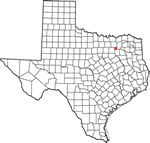
counties produced most of Texas’ corn in the 1930s and 40s. Later,
in the 60s and 70s the leading counties were Bell,
Collin, Falls,
Lavaca, and Williamson.
By the1980s, with the help of irrigation, the Panhandle’s
High Plains took the lead with Castro, Deaf
Smith, Hale, Lamb,
and Parmer counties
surpassing all others.
From third place in the 1970s, corn fell to fourth place in the
80s (after cotton, wheat, and
sorghum).
Corn farming, like cotton farming
has reduced the number of farms, even while acreage has increased.
Many farmers lease acreage from landowners too small to run a profitable
operation.
|
|
|
 HOME
HOME