|
Kit
Carson grew up in the Western wilderness and was a bona fide mountain
man before he was 21 years old. He served as a guide and hunter
for John C. Fremont’s initial explorations of the country and it
was through Fremont’s published journal that Carson became famous
as the quintessential mountain man. The government hired him as
an Indian agent for a while – he had both married and killed Indians
and so seemed a natural choice – but he disliked the bureaucracy
of the job and resigned to serve with the First New Mexico volunteers.
In that capacity he was sent to Texas
in 1864 to find and punish, with extreme prejudice, the Comanche
and Kiowa who were making life miserable and death a real possibility
for wagon trains on the Santa Fe Trail. Carson followed the Canadian
River onto the Llano Estacado, or Staked Plains, where no one,
not even the Texas Rangers, had ever ventured in pursuit of Comanches,
the fear being that they might actually find them.
Carson took on the task as a practical matter and employed Navajo
and Apache scouts as he followed the Canadian
River in search of marauders. Such an expedition, under most
any other commander of the day, would have been an abject and bloody
failure. Even with Carson in charge it almost turned out that way
anyway.
One advantage that Carson had on this expedition was a pair of howitzers,
large caliber cannons that worked essentially like a huge sawed-off
shotgun, spraying hundreds of .69 caliber cannon balls with each
shot. Howitzers could turn a large crowd of warriors into a small
gathering of survivors in a matter of minutes. The Comanche would
call it “the gun that shoots twice.”
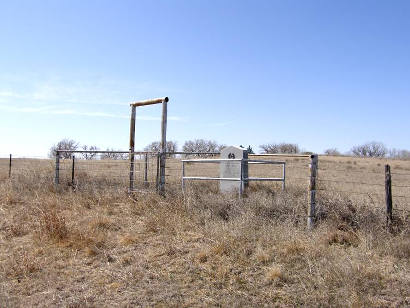
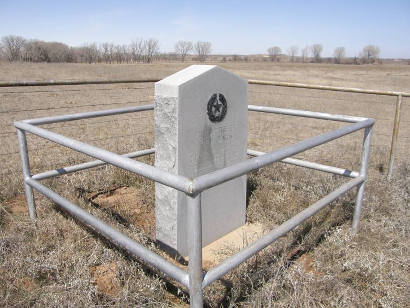
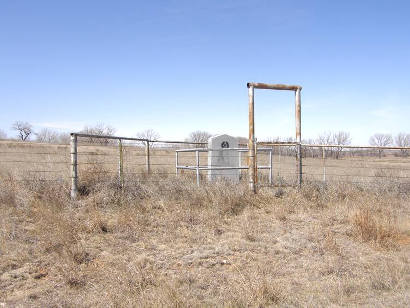
After routing a Kiowa village on the banks of the river, Carson
and his men moved to a large Comanche village and wheeled the howitzers
into place. When the inevitable Comanche charge came, the howitzers
gave the warriors a cause for pause before they embarked on a full-scale
retreat and a change of strategy. When they attacked a second time
they spread out in order to make the howitzers much less effective.
Between attacks, the U.S. soldiers heard the sound of a bugle being
played with considerable skill from somewhere within the enemy ranks.
When the U.S. bugler sounded “charge,” the Comanche bugler – perhaps
chief Santanta – would play “retreat” and visa versa. It was a bit
of comic relief in what turned out to be a bloody battle.
The subsequent Comanche attack was relentless and, Carson noticed,
aided in no small part by a steady stream of reinforcements riding
into the fray from a much larger Comanche village that he and his
scouts could now see clearly. By afternoon, some 3,000 warriors
had joined the battle.
This was similar to the blunder that George Armstrong Custer would
later make at the Little Big Horn, the difference being that when
Carson’s scouts told him he should leave that place or die there,
he listened. The troops retreated but the Comanches now outnumbered
Carson and his men by 10-1. Carson again unleashed the howitzers,
and that weapon alone allowed Carson and his soldiers to make good
their escape under cover of darkness.
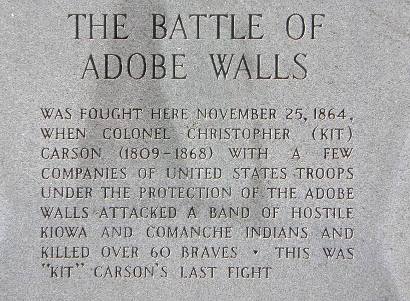
The U.S. military claimed the battle as a rousing victory but Carson
didn’t quite agree. Without the howitzers, he said, “few would have
been left to tell the tale.” This was to be the last battle Kit
Carson would ever fight. Despite what the official report said,
Carson would say, “The Indians whipped me in this fight.” As usual,
he was right.
|
 HOME
HOME