|
|
| Because
it occurred before petulant females -- and later males -- lent their
names to hurricanes, this one will always be known simply as the Galveston
storm, or hurricane. Galveston
has been the bullseye for many of them, but the one that struck on
September 8, 1900, still reigns as the worst natural disaster in United
States history because an estimated 10,000 people lost their lives. |
|
|
Statue
in memory of the victims of the 1900 Storm
Photo courtesy Lou Ann Herda |
Residents of
the island city first read about a disturbance in the Gulf of Mexico
in their newspapers on September 4. They knew that the storm had caused
damaged on the Mississippi and Louisiana coasts but paid little heed
because such storms occurred frequently. And the Weather Bureau lacked
the ability then to determine that the storm had strengthened or to
communicate such findings with sufficient urgency.
The night before a moon shown brightly over the Gulf, but the day
began with rain and a wind. Even a rising tide failed to alarm the
38,000 Galvestonians, except for Weather Bureau official Isaac M.
Cline, who inspected water levels in lower sites and began to warn
residents to evacuate to higher ground. Then the wind and the water
came in greater volume than anyone there had ever seen.
Steady winds of 84 mph with gusts up to 100 mph were recorded before
a nemomember was blown away; survivors estimated that the wind eventually
reached at least 120 mph. A sudden water rise in the Gulf rushed in,
covering the island to a depth of fifteen feet. Every building sustained
damage and a great many were destroyed when the giant wave crushed
one against the other.
The Galveston storm of 1900 left a significant legacy. Though Galveston
was no longer Texas' largest city -- it ranked fourth in 1900 -- it
still enjoyed considerable importance in trade and transportation.
Such was interrupted with negative consequences for islanders.
Amid such destruction, the city's government, under an alderman system,
ceased to function. It was replaced by an appointed commission, with
each commissioner responsible for a city service such as the police
department, fire departments, or sanitation. This worked so well that
Galvestonians, plus the citizens of over 600 other cities, adopted
it, changing over to elected rather than appointed commissioners.
|
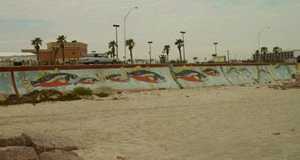 |
The Seawall
Built in 1902 to prevent the tidal surge of the 1900 disaster.
First section was 3.3 miles
Photo courtesy Lou Ann Herda |
A seawall was
constructed on the city's beachfront, and salvageable buildings were
raised on jacks and sand was filled under them to raise the level
of the island to that of the seawall, approximately seventeen feet.
Galveston
and East Texas has
experienced other storms, notably Hurricane Carla, but none has matched
the granddaddy of them all, the storm of 1900.
All Things Historical
August
19-25, 2001 column
A syndicated column in over 40 East Texas newspapers
(Archie P. McDonald is Director of the East Texas Historical Association
and author or editor of over 20 books on Texas) |
Related Articles:
Galveston
1900
by Mike Cox
( "Texas
Tales" Column)
An important coastal city is devastated by a powerful hurricane.
Thousands are believed dead. Bewildered survivors are left with
no water, food, electricity, transportation or communication. Looters
prowl the ruined community, stealing anything they can carry away.
Fires rage out of control, frustrated firefighters helpless to put
them out. Survivors swelter in the heat and humidity as they slosh
through mosquito-infested quagmires. Local officials plead for assistance
as those who can leave town.
New Orleans, Biloxi, or Gulfport? No, Galveston in the days immediately
after Sept. 8-9, 1900, when a powerful hurricane left the city in
ruin. more
Bolivar
Peninsula: Scene of Slaving, Smuggling, Filibustering and Farms
by W. T. Block
("Cannonball's
Tales" Column)
Very few areas of Texas can claim a longer time span of written
history than can that thirty-mile sliver of sand known as Bolivar
Peninsula... more
|
|
|
 HOME
HOME