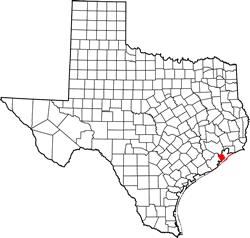
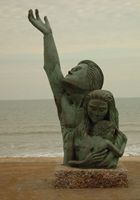
|
| Very
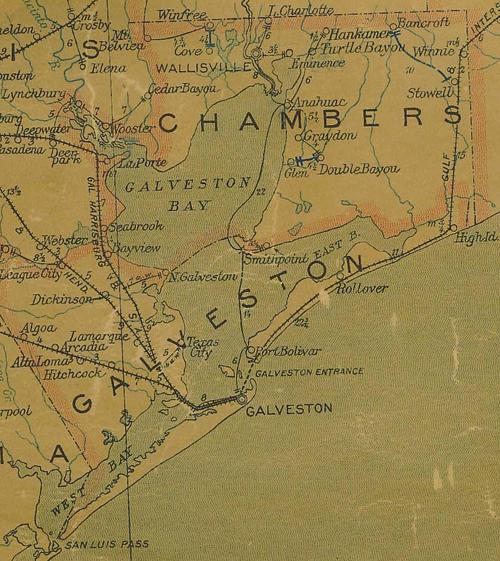
few areas of Texas can claim a longer
time span of written history than can that thirty-mile sliver of sand
known as Bolivar Peninsula. Even its very name is written in man's
love of freedom for Simon Bolivar was the hero of the earliest filibusterers,
Xavier Mina, James
Long, and Warren D. C. Hall, to reside within its confines. But
long before the first European ever visited there, it was also the
gateway to Galveston
Island for the East Texas
Indian tribes, some of whom left its sands strewn with their arrow
heads, pottery shards, and the bones of their dead. |
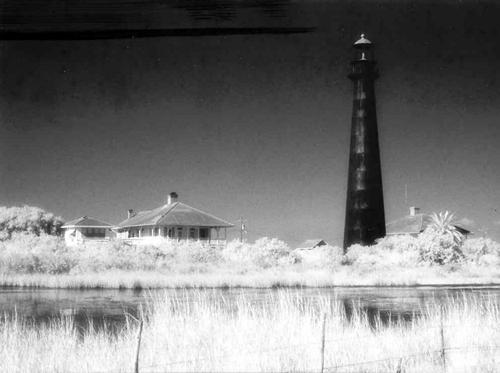
Bolivar Lighthouse
- 6 miles SW of Crystal
Beach near Hwy 87
"Waiting for Rita" - Infra-red photography by Robert Vahle,
September 2005 |
The first European
visitor there was probably Cabeza
de Vaca, who in November, 1528, was washed ashore on Galveston
Island and who later traveled extensively on the mainland. In
1719, the Orcoquisa Indians captured Simars de Belle Isle, a French
naval officer who had been accidentally marooned on Galveston
Island. Perhaps the peninsula was also the scene of cannibalistic
ritualism, for both of its stone-age tribes, the Orcoquisas and Karankawas,
stand accused by Belle Isle as being practitioners of anthropophagy.
However, many objective historians reject Belle Isle's accounts of
cannibalism.
Between 1816 and 1822, that coastal extremity, being one of a string
of barrier reefs protecting the Texas
Coast, became notorious as a base for filibuster activities against
Spain, and hence, its name. At that moment, General Simon Bolivar
was the leader of almost all the republican revolts against Spain
then in progress in Central and South America, and the special hero
of the American filibusterers of Texas
who sought to free Mexico from the Spanish yoke.
In 1816, two Spanish rebels, Gen. Xavier Mina and Don Luis de Aury,
began using Galveston
Island as a base of operations in their private war against Spain,
and the ranks included many Anglo republicans from Louisiana. In that
year, Mina sent 100 of his men under Colonel Warren D. C. Hall to
occupy Bolivar Point. Hall erected a fort there, of log and sand embankments,
where his small garrison remained for the next six months.
After Mina's expedition abandoned the area, a second filibustering
expedition, under General James Long, occupied Bolivar point in 1820,
and once more, Hall was one of the leaders of that group. In February,
1821, when Long's forces departed for Goliad,
he left his wife, Jane Long, his infant daughter Ann, and servant
Kian at the fort under the protection of a few soldiers.
As their supplies dwindled away and their position became increasingly
untenable and indefensible against the local Indians or the Spanish,
the small garrison deserted, leaving Jane and her charges to fend
for themselves. While at Bolivar, Mrs. Long gave birth to a second
daughter, reputedly the first child of Anglo origin to be born in
Texas. Jane's 11-month vigil, awaiting
her husband's return, survives as the outstanding act of feminine
heroism in early-day Texas.
During
the epoch of filibustering and piracy, the peninsula became an instrument
in the overland slave trade between Galveston
and Louisiana. The memoirs of Mary Campbell tell of her and her husband's
(Capt. Jim Campbell) arrival at Bolivar Point in their wagon, accompanied
by a herd of swine and 300 cattle, in April, 1817. The Campbells had
come from Crow's Ferry on the Sabine
River to join Jean
Lafitte's pirate commune, where they lived for the next four years.
Beginning in 1818, Lafitte
and the Bowie brothers often moved coffles of African slaves over
that natural highway to the Sabine
River, where the sugar planters of Louisiana came to buy slaves
at $1 a pound. In turn, other residents of the notorious "Neutral
Strip" of Louisiana traveled that same highway of sand in order to
reach Galveston
and join the ranks of the buccaneers. In fact, since Mary Campbell's
first child was born on Galveston Island in 1818, there is ample room
for doubt about Jane Long's child being the first Anglo child born
in Texas.
For
the first fifteen years after 1822, Bolivar Peninsula probably reverted
to a habitat for the herds of deer and the nomad Orcoquisa Indians.
On August 5, 1838, the peninsula's first settler, Samuel D. Parr,
claimed a league of land, beginning at its point on the bay and extending
five miles to the east. He was later granted a patent to it by the
Republic of Texas. In the same year, he sold the first 960 acres to
Archibald Wynn and William Lawrence, who in 1839 surveyed the townsite
of Ismail into lots and blocks and offered them for sale to the public.
Altogether, the town at the tip of the peninsula has been known by
four different names -- Ismail,
Parrsville, Gabion, and Port Bolivar. For a time, the proprietors
touted Ismail as the "future seaport of Texas," but as the years passed,
the new townsite sprouted only prairie grasses to be treaded upon
by the hooves of countless cattle herds, whereas the new seaport of
Galveston
quickly flourished.
Under
the Texas Republic, the site of Rollover, where the peninsula is only
about 600 yards wide, won notoriety as the "rolling over place" for
smugglers. In 1843, Texas tariffs were so high that goods smuggled
across the Sabine
River could be sold at cheaper prices in such places as Crockett
and Palestine
than could legal wares imported through the port of Galveston.
Hence, smugglers rolled their barrels of wares and freight across
the peninsula at Rollover and later reloaded them in East Bay.
During
the 1840s, only a handful of farmers had settled at Bolivar. In September,
1847, three of them discovered a unique way to supplement their meager
incomes when a 70-foot sperm whale washed up on the beach, 10 miles
east of the point. The is the first historical account of a whale
along the Texas coast,
and according to the Galveston "Civilian," none of the sailors then
in port had ever seen a whale previously in the Gulf of Mexico. In
a week's time, the three farmers had extracted 200 barrels of whale
oil from the blubber, as well as 25 barrels of sperm oil. The value
of the whale oil would have been about equal to two years' cotton
crops for each farmer.
By
1850, fifteen families, half of them English immigrants, lived along
the thirty mile stretch of land between High
island and Bolivar Point. The earliest settlers included Martin
Dunman of High Island, S. D. Parr, John G. Simpton, J. H. Fredenberg,
William Reeves, William Allen, Solomon Bryan, Joseph Atkins, William
Dorsett, William Holbrook, Thomas Bostick, and J. B. Benjamin. The
census indicates that most of them were subsistence sodbusters, for
only two of them, Parr and Dunman, owned a total of five slaves. On
March 2, 1836, Joseph Dunman had carried a copy of William Barret
Travis' last plea from the Alamo
from Harrisburg to Liberty.
Also during the 1830s, Capt. Simpton had been master of the Republic
of Texas revenue cutter "Santa Anna," which cruised regularly in Sabine
Lake and Galveston Bay.
During
the Civil War, the peninsula was patrolled eastward to High
island by Confederate cavalrymen, because the Union blockade fleet
offshore often sent raiding parties ashore to slaughter cattle. During
the four years of war, a number of blockade-runners ran aground on
the beaches while being pursued by Union gunboats. On one occasion,
a Confederate schooner ran aground and was burned at High
island after jettisoning 200 kegs of gunpowder in an futile attempt
to outsail its pursuer.
During the three decades prior to 1880, many new settlers came to
the coastal extremity to live until, by 1885, the population had increased
to eighty families, numbering nearly 500 persons. Some of the later
arrivals included A. J. Johnson, C. W. Kahla, John Crainer, Frank
Crainer, Willie Patton, John Strathan, James A. Crenshaw, Vincent
Linder, Jacob Hampshire, R. C. Nuckles, Fred Schneider, R. H. Slaughter,
Oscar Flake, F. M. Roberson, George Simpton, W. H. Dailey, and five
Shaw families.
For
a few years after 1865, the Bolivar farmers turned to sea island cotton
as their principal cash crop. At its peak, the silky staple brought
as much as $1.10 a pound on the English market, where it was interwoven
with the product of the silk worm, after which the finished cloth
was exported to America as "Pure Silk."
When that commodity dropped extensively in price, the peninsula pioneers
began growing produce for the Galveston
and Houston markets, and
by 1880, Bolivar had already become the watermelon capital of Texas.
In 1881 the farmers began shipping melons by box car from Galveston,
and in 1883, 137 cars, totaling 205,000 watermelons went to northern
markets, increasing annually for many decades thereafter. In time,
about 1,000 Bolivar acres were fenced off from the cow pastures for
watermelon culture, with similar acreage devoted to tomatoes, cantaloupes,
and other produce. Bolivar's supremacy as the watermelon capital lasted
until the middle 1930s.
By 1885, Bolivar Peninsula was also commanding attention as a livestock
region, with its single cross fence at Rollover dividing the peninsula
into two cow pastures. In the west, or "18-mile," pasture, 10,000
heads of cattle and 2,000 sheep, belonging to the Johnson, Nuckles,
Kahla, and Atkins families grazed. The east pasture, to a point beyond
High island,
belonged to C. T. Cade and Co. of Iberville Parish, Louisiana, and
contained 12,000 steers. Until 1880, Cade regularly moved large trail
herds of cattle from High
island to Louisiana, crossing the Neches
River with them at Beaumont.
|
|
|
|
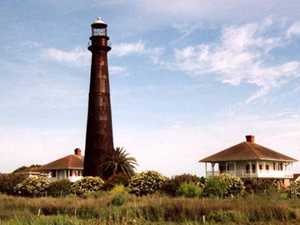
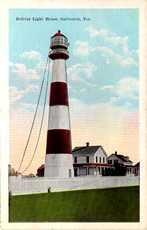
Bolivar
Lighthouse - 6 miles SW of Crystal
Beach near Hwy 87
Photo courtesy Barclay
Gibson, 2005
Postcard courtesy www.rootsweb.com/ %7Etxpstcrd/ |
In
1872, Port
Bolivar acquired its most familiar landmark when the lighthouse
was completed. And for the next eighty years, its well-known beacon
guided thousands of mariners into port in Galveston Bay. In 1952,
when better navigational aids were available and its old beacon was
obsolete, the Bolivar lighthouse became only one of many Gulf Coast
light facilities whose beacons were extinguished for all time.
After
the Civil War, the protruding salt dome of High
island also acquired a few settlers, who promptly covered much
of its square-mile surface with flourishing peach and plum orchards.
On the farm of George E. Smith, there were two or three ice-cold springs,
whose tart waters tasted of iron and sulphur. And if a nearby hole
were bored only a few feet deep, a strong flow of methane gas rushed
forth, which burned with a bluish flame if ignited. Some predicted
that, at some future date, the town would become one of the great
mineral water spas (or "watering places" as such spas were then popularly
called) of Texas.
In time, High
island did acquire some fame, but not as a health resort for the
infirm. It was its oil field, Seaview Hotel, and its offshore bathing
facilities and fishing which attracted tourists. After the building
of the Gulf and Interstate line in 1896, High
island became a favorite winter playground for the affluent lumber
families of Beaumont.
In 1885, Bolivar also produced one-half of all the oysters consumed
by the Texas market. A fifteen-mile oyster reef, from Parr's Grove
to Marsh Point, extended along the south shore of East Bay, and during
the slack months of the planting season, many farm families supplemented
their livelihoods by raking and shucking oysters from the reef.
The event which gave Port
Bolivar its greatest commercial promise came in 1894 when the
Galveston and Interstate Railroad to Beaumont
was chartered. Headed by L. P. Featherstone and Fox Winnie, the new
rail line became a reality in November, 1896, after Beaumonters pledged
$35,000 to finance a depot and the necessary right-of-way within that
city.
Featherstone
had great plans for development of the port of Bolivar into a great
shipping center. But only four years after the line's completion,
a massive
hurricane struck the central Texas coast on September 8, 1900,
totally destroying Galveston
and killing 6,000 persons there. Fortunately, 125 persons at Bolivar
had sought refuge in the light house, and all of them were saved.
But the volume of death and destruction everywhere on the peninsula
was nonetheless staggering. Almost every home was destroyed or washed
away. Forty-one persons, mostly from Crenshaw's, Patton, and Rollover,
had drowned, including three entire families, those of William Strathan,
Charles Atkins, and Franz Vincent.
Over three hundred bodies floated up on the beaches, water supplies
were contaminated, and the rapid putrefaction of hundreds of dead
cattle forced the human survivors to abandon the peninsula immediately.
Damage was also severe at Fort Travis, a coast artillery post
near the lighthouse which had been built at Bolivar Point as part
of the Fort Crockett coastal defense reservation during the
Spanish-American War. |
In dollar values
apart from human life, the greatest loss had been sustained by the
railroad. The forty miles of trackage to High
island were totally destroyed, and depots and rolling stock were
washed away. And a passenger train which had just arrived at Bolivar
from Beaumont
before the storm was inundated by a mountain of sand. When the trackage
was rebuilt and the locomotive and cars returned to Beaumont
in 1904, they were publicized as the "train which ran three and one-half
years behind schedule." For a time the railroad's directors considered
abandoning the line, but like the nucleus of nestors who returned
to rebuild their homes, they too finally gave in and began seeking
the financing needed to rebuild.
Bolivar's
recovery was painfully slow, and five years transpired before the
peninsula regained its pre-hurricane status. During that period of
years, the Army's Corps of Engineers spent about $1,000,000 to rebuild
Fort Travis, provided needed seawall protection, and deep channelization
to Port Bolivar.
Perhaps it was Col. Featherstone who contributed the most to the peninsula's
recovery, for he continued his dream to build a great lumber and iron
ore export terminal. The Galveston and Interstate line soon became
a part of the Sante Fe rail system, and its eventual link-up with
the Gulf, Beaumont and Kansas City Railroad constituted a continuous
line extending to Longview,
Texas. The Port Bolivar Iron Ore Railroad, to connect Longview
with the ferrous mines at Ore
City, Texas, was then in the planning stages.
Featherstone soon organized and headed the Port Bolivar City Company
and helped organize the Sante Fe Dock and Channel Company, which in
1908 spent a half-million dollars to build piers, rail sidings, and
warehouses. On June 9, 1909, the first deep-sea vessel, the "Margaret
M. Ford," docked at Bolivar to unload granite for the seawall. And
two weeks later, an English steamer, the "Penrith Castle," arrived
and loaded aboard the port's first lumber shipment.
In 1912, the ore dock there was completed. And lumber shipments quickly
mushroomed, increasing to 15,000,000 feet in 1911 and 23.8 million
feet in 1912. For a few years, especially during World
War I, the new port of Bolivar prospered, but soon after, a number
of items would account for its eventual demise. Completion of the
Houston Ship Channel diverted much of its traffic, and the demand
for East Texas iron ore,
a greatly inferior grade, quickly plummeted. Eventually, the deep
channelization of the Sabine and Neches Rivers to Beaumont
and Orange would
end the lumber trade to Bolivar as well.
Rather than another great hurricane, it was the receding financial
tides, the throes of the Great Depression, which would sound the eventual
death knell of Port
Bolivar. Passenger train service from Beaumont
to Bolivar was soon suspended, and a few years later, about 1932,
the thirty miles of peninsula rail trackage beyond High
island was abandoned entirely.
But unwittingly, the Gulf and Interstate Railroad had already shaped
Bolivar Peninsula's future. With the building of the Sea View Hotel,
High Island,
Rollover, Crystal
Beach, and other peninsular resorts quickly became the year-round
playground for the families of both Beaumont
and Galveston,
not to mention more distant points. And the passage of time has altered
that seashore panorama but slightly. Despite the continuing threat
of high winds and high tides during the hurricane season, the popularity
of sea bathing, boating, beach cabins, bay fishing, or just a place
to lay on the beach and soak up some sun, combine to guarantee the
peninsula's continuance as a tourist mecca for decades to come.
© W.
T. Block, Jr.
"Cannonball's
Tales" September
4, 2006 column
Reprinted from Beaumont ENTERPRISE, February 5, 1984, p. 1cc. Sources:
Principally from "On Bolivar Peninsula," Galveston DAILY NEWS, July
25, 1886; various census lists; and other DAILY NEWS articles between
1895 and 1912. |
 |
Related Stories
& Texas Storms:
Remembering
When it Really Got Cold by Mike Cox
The first known Galveston Bay freeze came during the winter of 1821,
when Jane Long, the wife of then-absent filibusterer Dr. James Long,
was alone on Bolivar Peninsula with her five-year-old daughter and
a slave girl. Oh, and Mrs. Long was just about to have her second
baby.
The
Longest Train Ride by C. F. Eckhardt
"Train #1 of the Gulf & Interstate Railroad, which left Beaumont,
Texas, at 7:00 AM on September 8, 1900, to make the run to Port
Bolivar, about 85 miles away by modern highway, arrived at Port
Bolivar at 11:10 AM, September 24, 1903—three years, sixteen
days, and ten minutes late. Some of the original passengers were
still aboard..."
Galveston
1900 by Mike Cox
The
Galveston Storm by Archie P. McDonald, PhD
The hurricane that struck Galveston on September 8, 1900, still
reigns as the worst natural disaster in United States history because
an estimated 10,000 people lost their lives.
Hurricane
1900 Cartoon by Roger T. Moore
Hurricane
Carla by N. Ray Maxie
She was ferocious, deadly and destructive; a Category 5 hurricane
at one time, with 175 MPH winds. She slowly came ashore September
11, 1961
Indianola
A poem by Jeff McLemore published in 1904.
Indianola
"Queen city of the West" turned ghost town, devastated
by storms
The
Story of Indianola by Maggie Van Ostrand
Indianola
Remnants by Mike Cox
|
|
|
 HOME
HOME