|
Black
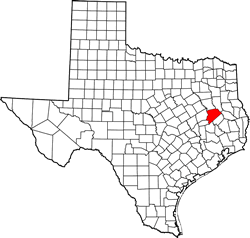
history has deep roots in the first county in Texas.
East Texas has produced
some of the darkest black history in the state and has proven the
strength of racism’s grip. Houston
County, along with the rest of the 300-mile stretch known as East
Texas, has lot more in common with the South than the rest of
the state, or any place west of it. Culturally and economically, East
Texas has segregated itself from the Lone Star State.
Researching the area’s black
history proved to be a chore. In a county where the ratio of blacks
and whites is about 50-50, black
history is not exactly on tap, but it is there. It is buried deep
within the county and much deeper in resident’s memories. It is not
often shared or even talked about, and its remains are crumbling. |
 |
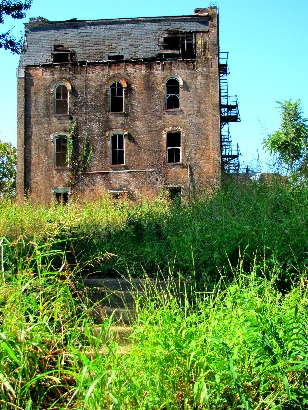 |
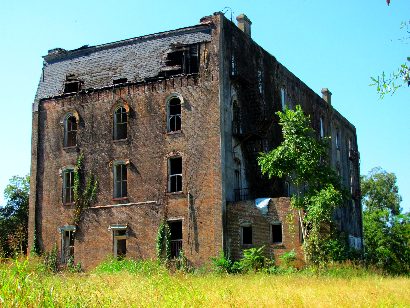
The
Mary
Allen Seminary for black girls sits atop a hill about a mile north
of the courthouse.
Crumbling and far from its original glory, the historic school was
unearthed from the briars and over growth of the Piney Woods. Having
lived in Houston County
my entire life it has only been in recent years that I discovered
the magnificent old building. For many years, the site was buried
in briars and hidden from view. Constructed in 1886, the Mary
Allen Seminary for black girls still stands today as one of the
oldest structures in the county. It is now a visible reminder of the
growth and decline of black education in the area. The school evolved
from an all-white into an all-black administration and from a female
seminary to a four-year coeducational college. Then it was closed
and sold off to meet debts that had risen from lawsuits. According
to the Texas State Historical Association, in 1942 the Crockett Chamber
of Commerce proposed that the property of Mary Allen Junior College
be donated toward a four-year state college for black students and
was approved by the Board of National Missions of the Presbyterian
Church, U.S.A. The following year World
War II prevented the Texas legislature from acting on the proposal
and the school was closed and the property sold.
The
Colored Farmers National Alliance and Cooperative Union were also
founded in Houston
County in 1886. The union was formed on the farm of white Alliance
member and Baptist missionary R.M. Humphrey, and the alliance elected
J. J. Shuffer as their first president. Although the orders' charter
barred whites from obtaining membership, Humphrey was elected as an
honorary superintendent. As increasingly repressive Black Codes were
enacted, Humphrey's role was to serve as the group’s white spokesman.
Humphrey could openly express militancy and gain access that would
have been denied to blacks. |
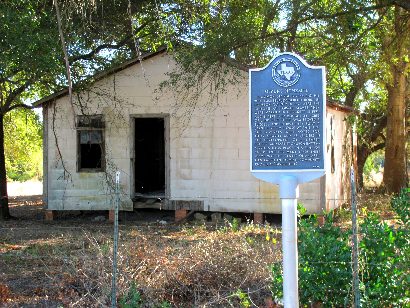 |
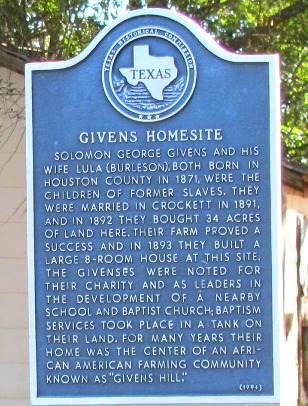
Givens Homesite
Historical Marker
Photo by Dana Goolsby,
October 2010 |
The
Givens Hill home site also still stands in Crockett,
just south of the loop on Highway 19 South. Solomen George Givens
and his wife Lula Burleson Givens were both born in 1871 in Houston
County. Both Solomen and Lula were the children of slaves. They
were married in 1891 and in 1892 they purchased 34 acres of land at
the top of a hill south of Crockett,
known today as Given’s Hill. The Givens farm found success on top
of the hill and in 1893; they constructed an eight-room house. Solomen
and Lula Givens were known for their acts of charity. They were also
leaders of a nearby school and Baptist church. The Givenses often
hosted baptismal in a tank on their land. For many years Solomen and
Lula’s home was the center of an African American farming community.
A
success story that emerged from Houston
County is that of Ruth Simmons. Simmons, born in Grapeland,
spent countless hours listening to her mother share stories about
people who lived life the right way and others who did not. Simmons’
mother passed down family values and oral history while shelling peas
and shucking corn, all the while never knowing that one day those
values would be shared with thousands of other women—black and white.
Simmons went on to make history as the first Black woman (Third woman
ever) to be named president of Smith College, one of the prestigious,
all-women’s colleges that make up the Seven-Sister schools, and the
nation’s largest private undergraduate institution for women. |
 |
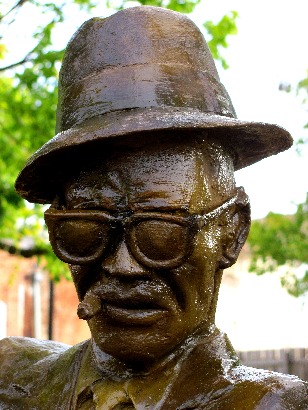 |
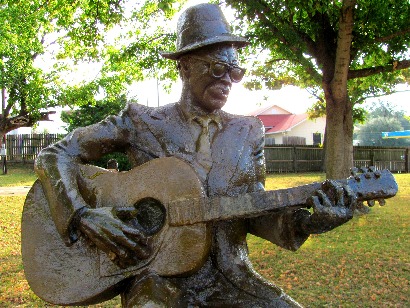
Bluesman
Sam Lightnin’
Hopkins also had ties to Houston
County. A statue was erected in his memory across from Camp
Street Café in Crockett.
Locals say Hopkins played on the street and in establishments along
Camp Street in his youth. Camp Street was in the center of the Black
Business District in Houston
County. Hopkins music was heard from Camp Street all the way to
Carnegie Hall. Lightnin’ Hopkins recalled Houston County, none too
fondly, and mentions it in his music. Hopkins sang about serving on
a chain gang for the county. Hopkins told Andy Silverman of the Swarthmore
College Phoenix in 1963, “I was in trouble. I had a hundred days down
on the chain gang.” Later, while being taped in a recording studio,
Hopkins said “Man come to me; put me in jail in Crockett.
I did pretty good and I runned off. I hit the road, Jack. They come
to the Trinity, got me out of the Trinity [river]. I wore a ball and
chain. Man, I can show you a scar on my leg. You see that? There?
That’s from wearing that man’s outfit.” According to Timothy J. O'Brien,
PhD who has authored a book about Hopkins, there is no evidence remaining
that would confirm Hopkins ever served on a chain gang in Houston
County despite his mentioning it many, many times throughout his
life. O’Brien emphasizes that Hopkins was a storyteller, poet and
songwriter. According to the city of Crockett’s
website, the blues singer was once arrested in Crockett
but makes no mention of charges or time served.
Other
black history that is rarely, if ever, discussed in the county includes
the lynching of a black man who white locals said frightened a white
woman. According to “Blacks in the American West and Beyond” by George
H. June, in June of 1932 a black man named Dave Tillis was accused
of frightening a white woman and lynched in Crockett.
The Slocum Race Riot is also said to have begun at the hands of Houston
County men. Lynchings, riots, and mass murders are no strangers
to Houston County.
Many white residents still proudly fly the confederate flag, and graveyards
are dappled with confederate flags. |
| Today
the county, particularly the county seat in Crockett,
is still wrought with the effects of racism. Law suits against the
county, the city of Crockett, and individuals employed by the city
or county alleging racism total upwards of $100 million or more, just
within the last few years. Crockett I. S. D is also engaged multiple
law suits where alleged racism is a factor. |
|
| Texas
Escapes, in its purpose to preserve historic, endangered and vanishing
Texas, asks that anyone wishing to share their local history, stories,
landmarks and vintage or recent photos, please contact
us. |
|
|
 HOME
HOME