|
Sunday,
Oct. 2, the descendants of the Caddo Indian tribe that once thrived
on the prairies of East Texas
returned to the home land of their ancestors at the Caddo Mounds State
Historic Site, located just east of Weches, TX off State Highway 21
west.
An estimated 300 visitors, from various regions of the state, took
part in the celebration of the Caddoan culture, according to Michelle
Ivie, an employee at the Mounds.
Onlookers watched as the Caddo Indians performed their traditional
cultural dances and music. Visitors also had the opportunity to experience
life as the Caddo Indians once did by engaging in a spear throwing
contest, flintknapping, hot rock cooking, and pottery making and decorating.
A mock archeological dig was also an activity that guest were able
to participate in. October is Texas Archeology Month.
Though tourism to the site has decreased in recent years, Ivie said
the Historic Site sees approximately 300 visitors per month, not including
special events. |
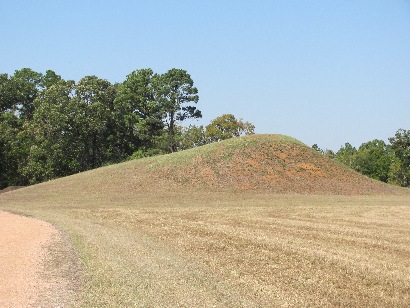 |
Caddo Burial
Mound
Photo courtesy Dana Goolsby, October 2010 |
More than 1,200
years ago, a group of Caddo Indians known as the Hasinai built a village
and ceremonial center just east of Weches. Today, three earthen mounds
still rise from the Neches River valley which was the southwestern-most
ceremonial center for the great Mound Builder culture. The Caddoan
culture thrived in the eastern North America woodlands for more than
2,500 years.
In 1834, according to the Texas Parks and Wildlife Department (TPWD)
booklet, the Caddoan Mounds: Temples and Tombs of an Ancient People,
an American traveler along the
old Camino Real came across the protruding earthen mounds. Amos
Andrew Parker paused to investigate the mounds and made an entry in
his journal about his observation.
“I have seen no satisfactory explanation given of the origin and use
of these mounds… and, at this late stage of the world, their origin
and use may never be fully and satisfactorily explained,” Parker noted
in his journal.
Parker’s statement has so far proved true, leaving many mysteries
and questions surrounding the mounds, despite archeological digs at
the site.
In 1919 the Bureau of Ethnology, a federal agency created to study
native American cultures, sent the first professional archeologist,
J.E. Pearce to record the site. By 1933 E.B. Sayles, an Arizona archeologist,
had made the journey to the mysterious mounds to collect surface artifacts.
The first systematic excavations of the Coaddoan Mounds were not conducted
until 1939, and lasted until 1941. The University of Texas sent H.
Perry Newell to East Texas
under a grant from the Works Projects Administrations. Newell and
his team excavated over half of the High Temple Mound. The university
concluded that the site had been an important Caddoan community for
several centuries. |
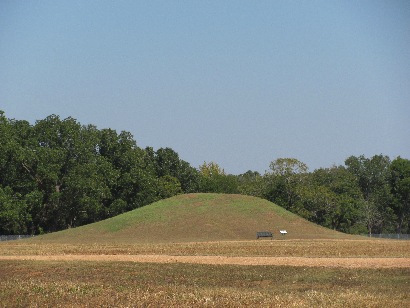 |
Caddo Burial
Mound
Photo courtesy Dana Goolsby, October 2010 |
In 1968 an excavation
of the Low Temple Mound, the Burial Mound, and portions
of the village area began under the supervision of University of Texas
Professor, Dee Ann Story. Story lead the dig, utilizing more refined
excavating and analytical techniques, including radio carbon dating.
Story’s investigation produced evidence that the Early Caddos had
occupied the site from about 800 A.D. to 1300 A.D.
The largest mound, at the southern edge of the site, known as Mound
A, is thought to be the earliest and most significant mound. Mound
A is the High Temple Mound, and was used for ceremonial purposes.
Approximately 40 houses were built around it, but not all were in
use at the same time. Less than half of the original mound was preserved
after the first archeological dig.
Mound B, located near the center of the state park, is the Low
Temple Mound. The mound dates from around 1100 to 1300. This rectangular
platform mound measures roughly 175 feet north to south, and 115 feet
east to west. The Low Temple Mound is presumed to be where tribal
chiefs lived.
The northernmost mound, known as Mound C, was used as a ceremonial
elite burial mound for most of the time the site was occupied. Six
different levels containing the remains of approximately 90 Caddo
Indians that once inhabited the region are buried there.
A large hole in the earth’s surface, north of the site, called the
Borrow Pit is where dirt was removed with pointed sticks, and
transferred to mounds by baskets.
The Caddos lived in thatch dwellings that were designed to be warm
in the winter and cool in the summer. The dwellings were large structures,
shaped like a bee hive, and made from native grasses. |
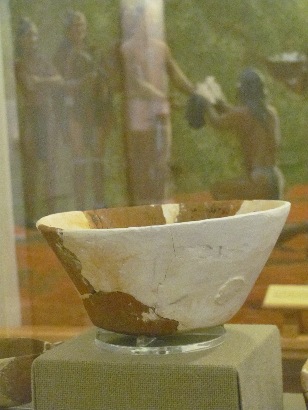 |
Caddo
Pottery
Photo courtesy Dana Goolsby, October 2010 |
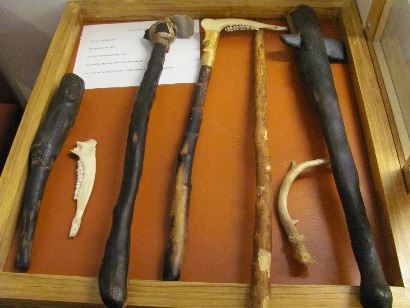
Caddo Tools
Photo courtesy Dana Goolsby, October 2010 |
Caddo Indians
brought a way of life including, agriculture, a stable political system,
and rich religious ceremonies to East
Texas. The Caddos dominated the Piney Woods of East
Texas, until their fate was sealed when the first French and Spanish
explorers arrived, followed by American settlers.
In 1857 the Caddos were driven from their homeland, and moved to a
reservation on the Brazos River. Many Caddo Indians starved and died
on the reservations, while being harassed by hostile Plains tribes
with whom they were made to share the reservation with. Two years
later the United States government transferred them to a Indian Territory
in Oklahoma, where they shared a reservation with the Wichita tribe.
Texas takes its name from the Caddo word tejas, meaning friend, despite
the harsh feelings between the severed Caddo nation and the state.
The Caddo descendants still live on allotted land around Anadarko
and Binger, Oklahoma. |
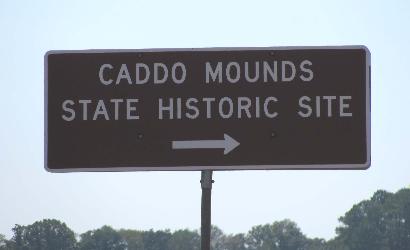 |
Caddo Mounds
State Historic Site Sign
Photo courtesy Dana Goolsby, October 2010 |
The
Texas Parks and Wildlife Department established a historic park in
1974, and another twenty-three acres was added to the park in 1981,
along with an interpretive visitors center. In 2008 control of the
property was transferred to the Texas Historical Commission (THC).
THC purchased the Texas Forest Service (TFS) operated Indian Mound
Nursery site adjacent to the Caddo Mounds State Historic Site in May
of 2010. The addition of this property expanded the Caddo Mounds State
Historic Site from 93 acres to 397 acres, and now virtually the entire
site is protected through state ownership.
THC is collaborating with multiple partners in an effort to expand
the interpretation of the site. The Caddo Mounds contains resources
related to the El Camino Real de los Tejas National Historic Trail,
which runs from Louisiana to Mexico. New exhibits at the site will
emphasize the impact and influence this corridor had on the development
of the area and Texas.
The THC also continues to work with the Caddo Nation on improving
and expanding public education about the culture and customs of the
Caddo people.
More is unknown of this robust culture of people than is known.
Caddoan Mounds State Historical Park is open to the public 9 a.m.-4
p.m. Thursday-Monday. It features an interpretive center with audio-visual
presentations, plus a self-guided trail to the mounds.
The Historic Site is a fun and educational source of entertainment
for the entire family. Walk the site where an ancient civilization
thrived for centuries, view artifacts collected from the site, and
learn about the Caddo Indian culture to preserve an important piece
of Prehistoric Texas History. Currently there are no upcoming events
posted, however Ivie said she anticipated a star viewing party would
be the next event held at the historic site.
Log on to www.visit caddomounds.com to learn more about the site,
or call (936) 858-3218.
© Dana
Goolsby
Guest
Column, November 8, 2010
First Published in The Grapeland Messenger |
|
|
 HOME
HOME