|
|
In
2004, Senator Kay Bailey Hutchison succeeded in persuading Congress
to designate El Camino Real, at least the Texas and Louisiana
portions, a national historic corridor. We Texans, especially we East
Texans, knew it all along.
El Camino Real, or King's Highway, or Royal Road,
designates an official thoroughfare, much as we would refer to
I-20 or US 59 today. It began in 1690 when Alonzo DeLeon crossed
Texas on a northeastern course previously
untroubled by Europeans to establish Mission
San Francisco de las Tejas near the Neches
River so France would understand that the territory belonged to
Spain.
In 1691, Domingo Teran de los Rios used much the same route to bring
supplies to the mission, which was abandoned in 1693. In 1714 the
French began to threaten Spanish interests in East
Texas, so Spaniard missionaries and presidio soldiers used
the route to establish and sustain six missions until 1773. El
Camino Real, by then also known as Old San Antonio Road,
if still just a trail, could be called "established."
Actually, Old San Antonio Road had many routes that came together
at San Antonio and
Nacogdoches,
the only two population clusters along the 540-mile trace. Sometimes
routes varied because of flooding or dangers from Indians, but they
all focused on these settlements.
Spain's thrust had been northeastward, but by the 1820s Anglo immigrants
had reversed the predominant direction of the flow as they passed
through Nacogdoches
to new settlements further west.
In 1915, our legislature wanted to honor the Old San Antonio Road,
so they appropriated $5,000 so V.N. Zivley could conduct a survey
and tell them its exact route. The Daughters of the American Revolution
provided funds to erect pink granite markers, according to Zivley's
designation. |
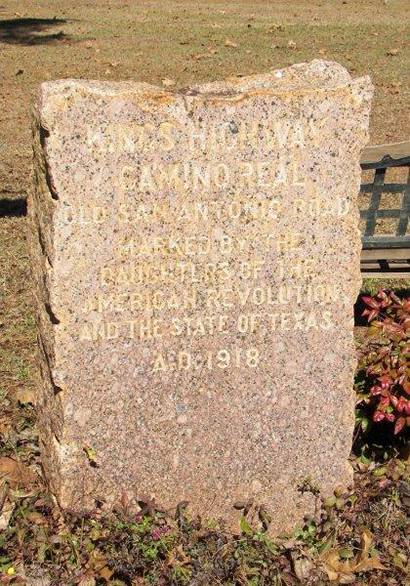 |
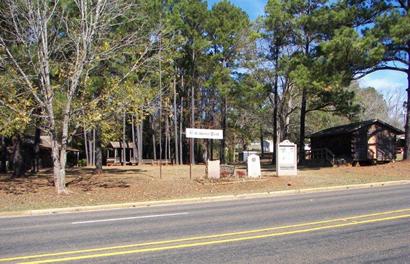
Marker for the
Camino Real (King's Highway) that passes through Milam.
Photo courtesy Terry
Jeanson, December, 2007 |
The 8 feet tall
El
Camino Real Centennial Monument
"The marker is on SH 21 (OSR) just west of SH 39 in Normangee.
It is on the south side of the road."
Photo courtey Kathy Toalson Staples, October 2010
Click on image to enlarge |
In
1989, a subsequent legislature created the Old San Antonio Road Commission
to commemorate the 300th anniversary of the founding of the road,
and for some reason Governor William P. Clements asked me to serve
on it. I can immodestly say that Senator Hutchison completed, as only
she could do, that for which we worked a decade and half ago.
And this: that blamed Commission just laughed at me when I moved that
we change the road's name to the Old Nacogdoches Road because San
Antonio was only a stop over on the way to Nacogdoches.
© Archie
P. McDonald
All
Things Historical
>
July 30, 2006 column
A syndicated column in over 70 East Texas newspapers
This column is provided as a public service by the East Texas Historical
Association. Archie P. McDonald is director of the Association and
author of more than 20 books on Texas. |
El Camino
Real
From "Holiday
Day Trips" by Bob Bowman:
"If
you're into road trips, take a drive down East
Texas' oldest highway. The King's Highway (Texas 21) stretches
from Toledo Bend Reservoir
near Milam to San
Antonio. It is also one of our most scenic roadways. The route
was used by Indians and traveled by Spanish missionaries in 1791.
It is also known as El Camino Real,
the Old Spanish Trail, and the Old San Antonio Road." |
|
|
 HOME
HOME