|
History in
a Pecan Shell
The community was
named in honor of Capt.
London Daingerfield who was killed in an 1830 battle with Indians
on the site that became the town in the1840s.
A timeline of selected or significant dates in Daingerfield history:
1846: Post Office granted
1877: Titus County divided forming Morris
County and Daingerfield became county seat.
The Louisiana, Arkansas and Texas came within a half-mile of the town.
1879: A disastrous fire destroys most of town, prompting relocation
of town to the railroad
1904: Population reaches 699
1931: Population reaches 818
Lone Star Steel and the United States Navy Ordnance Aerophysics Lab
open shortly after WWII. |
Daingerfield
Outdoor Attractions
Daingerfield
State Park
2 miles east off Hwy 11
Lake O' the
Pines - On Big Cypress Creek
http://www.tpwd.state.tx.us
|
Daingerfield,
Texas Chronicles
|
The Mystery
Man by Bob
Bowman
Captain London Daingerfield
Daingerfield, the county seat of Morris County, was named for Captain
London Daingerfield, supposedly a native of Nova Scotia, but beyond
that and a few other facts, Captain Daingerfield remains a mystery
man.
Morris County pioneers told stories of finding Daingefield’s millstone
and water well, which pre-dated local Anglo-American history. These
items were likely made by Acadian settlers from Louisiana Territory,
but they returned to the territory because of Indian hostilities
in what became Texas.
A spring known locally as Daingerfield Spring was once a popular
camp used by Indians such as the Choctaws and Caddoes. Around 1830,
Captain Daingerfield and a company of 100 men attacked an Indian
village at the spring and, after a long, bloody fight, the Indians
were driven away.
Local history says Captain Daingerfield then settled his family
around the spring, but the Indians retaliated, killing Daingerfield,
his wife and children.
The Captain and his family were likely buried nearby with large
flat rocks marking their graves. But as the years passed, the cemetery
and rocks were moved as new homes were built in the area.
In those days, it was the custom of settlers to plant cedar trees
around the graves of their loved ones. Near the spot where the Daingerfields
were buried, large cedars are now growing.
The problem of finding more about Captain Daingerfield is compounded
by the fact that Morris and the surrounding counties were once a
part of Arkansas.
Army records in Washington have no record of Daingerfield and, despite
the efforts of several historians to unearth more details about
the captain, his family and his fellow soldiers, his disappearance
remains one of the legendary stories of East
Texas.
Some early visitors were not kind to the early town of Daingerfield.
William A. McClintock, who passed through the area in 1846, noted
in his diary that the town consisted of "three or four cabins scarcely
fit for pigsties."
But by the early 1850s the town began to grow. Sylvia Academy, a
private school for girls, opened around 1850, and in 1852 the Marshall
Presbytery of the Cumberland Presbyterian Church founded Chapel
Hill College.
From Bob Bowman's
East Texas
A weekly column syndicated in 109 East Texas newspapers
The
Poison Spring by Mike
Cox
On the road leading from Jefferson to Daingerfield there is a spring
known by the old settlers as ‘the poison spring,’” the Texas Republican
reported on June 12, 1852...
|
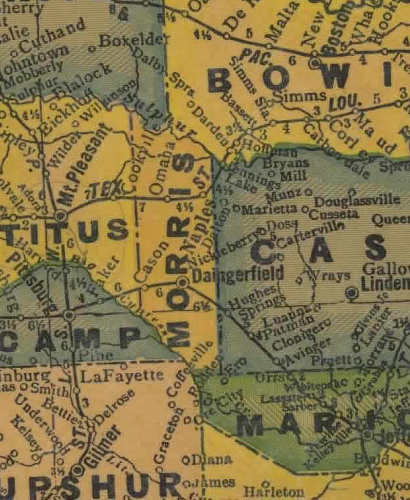 |
Morris
County 1940s map
From Texas state map #4335
Courtesy
Texas General Land Office |
| Texas
Escapes, in its purpose to preserve historic, endangered and vanishing
Texas, asks that anyone wishing to share their local history, stories,
landmarks and recent or vintage photos, please contact
us. |
|
|
 HOME
HOME