|
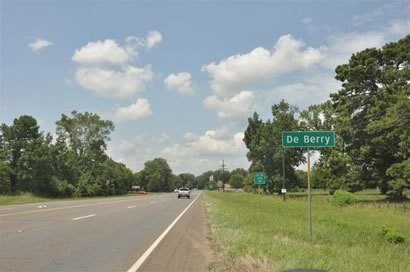
DE BERRY, TEXAS
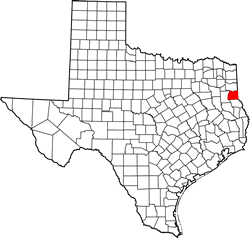
Panola
County, East Texas
32°18'12"N 94°10'00"W (32.3032138, -94.1665797)
U.S. Highway 79, FM 31 and FM 1794
14 Miles NE of Carthage the county
seat
Population: 200 Est. (2019)
191 Est. (2010, 2000, 1990)
De Berry, Texas Area Hotels › Carthage
Hotels |
 |
History
in a Pecan Shell
Named
after Texas legislator Alfred Wesley De Berry, the community had
previously been known as Evergreen, Texas. Settlement had
occurred before the Civil War.
The town was granted a post office in 1874. The population rose
to 150 by the mid 1880s when the town could boast of eight general
stores, two churches and three schools.
By the early 1890s, the population had doubled to 300 but by 1914
that number had fallen to just 50.
Oil was discovered in the 1920s but the boom was about as big as
it was brief.
The population had risen to 250 in 1929 and the town maintained
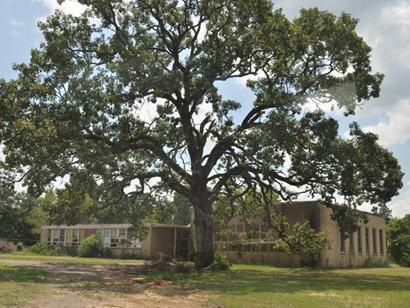
233 people through the Great Depression. De Berry schools merged
with those in nearby Carthage after WWII.
The 1990 Census showed nearly 200 residents.
|
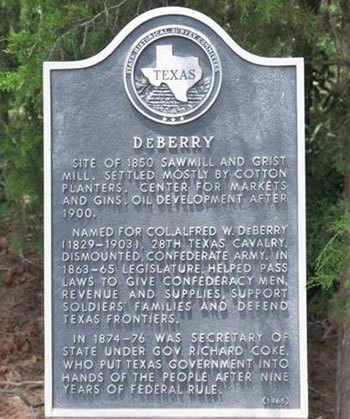
DeBerry
Historical Marker
On FM 31 north of US 79
Photo courtesy Gerald
Massey |
Historical Marker
DeBerry
Site of 1850 sawmill
and grist mill. Settled mostly by cotton planters. Center for markets
and gins. Oil development after 1900. Named for Col. Alfred W. DeBerry
(1829-1903), 28th Texas cavalry, dismounted, Confederate army. In
1863-65 legislature, helped pass laws to give confederacy men, revenue
and supplies, support soldiers' families and defend Texas frontiers.
In 1874-76 was Secretary of State under Gov. Richard Coke, who put
Texas government into the hands of the people after nine years of
federal rule. |
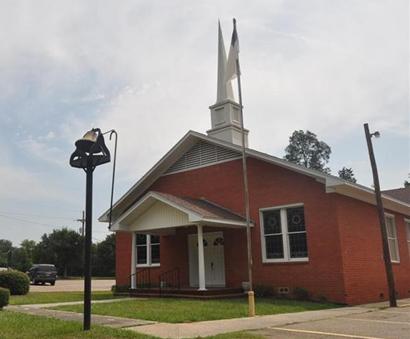
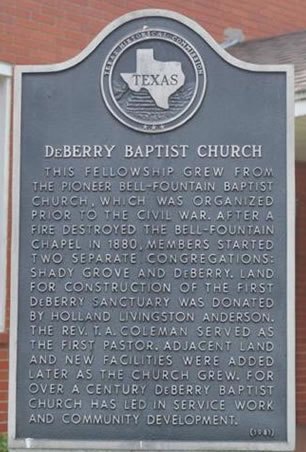
DeBerry
Baptist Church Historical Marker
Photo courtesy Gerald
Massey |
Historical
Marker
DeBerry Baptist
Church
This fellowship
grew from the pioneer Bell-Fountain Baptist Church, which was organized
prior to the Civil War. After a fire destroyed the Bell-Fountain Chapel
in 1880, members started two separate congregations: Shady Grove and
DeBerry. Land for construction of the first DeBerry sanctuary was
donated by Holland Livingston Anderson. The Rev. T. A. Coleman served
as the first pastor. Adjacent land and new facilities were added later
as the church grew. For over a century DeBerry Baptist Church has
led in service work and community development. |
Carthage
: Music from two country masters
(Excerpted from "THE EAST TEXAS SUNDAY DRIVE BOOK"
by Bob Bowman)
"... From Carthage, head east
on U.S. 79. Four miles out of the town, on the right side of the highway,
stop at the Jim Reeves Memorial, a tribute to the country singer known
as "Gentleman Jim". Reeves was born near here in l924 and grew up
around DeBerry. He was killed in an airplane crash in l964. At the
peak of his career, Reeves recorded a number of successful songs,
including "Bimbo," "He'll Have To Go" and "Four Walls." He also starred
in a film, "Kimberly Jim."
Panola County is also the birthplace of another famous musician, Tex
Ritter, who was elected to the Country Music Hall of Fame in l964.
Ritter, christened Woodward Maurice Riter, was born here in l907 and
intended to be a lawyer. He made his first recording, "Rye Whiskey,"
in l931 and became the first artist signed by Capitol Records in the
l940s. He made more than 80 western films before he died in l974 at
Nashville, Tennessee. Ritter is the father of another movie and television
star, John Ritter. ( See Tenaha,
Timpson, Bobo, and Blair by Archie P. McDonald )
At DeBerry, turn north on Farm Road 31, go through the settlement
of Elysian Fields (which means
"a heavenly place"), and continue until the highway intersects with
Farm Road 2625. Follow it in a westerly direction until you arrive
at the intersection with Texas 43. Turn south here and proceed through
the town of Tatum. ..."
more |
| Texas
Escapes, in its purpose to preserve historic, endangered and vanishing
Texas, asks that anyone wishing to share their local history, stories,
landmarks and recent or vintage photos, please contact
us. |
|
|
 HOME
HOME