|
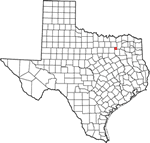
Trinity County
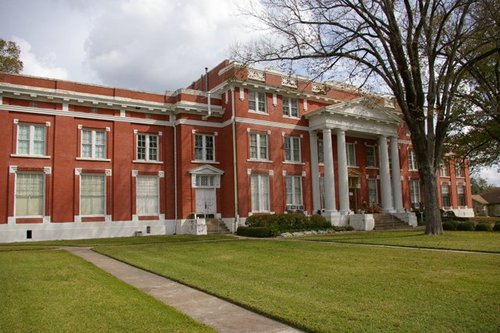
Courthouse
Recorded Texas Historic Landmark
Photo
courtesy Jim
King, September 2008 |
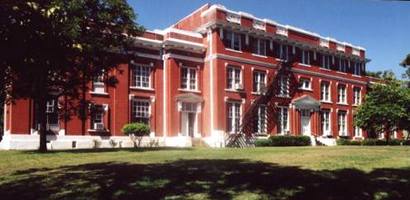
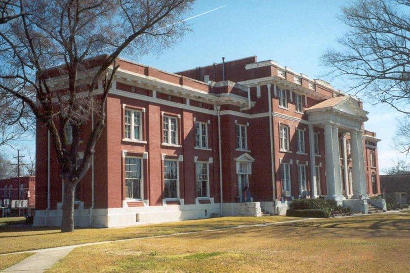
The Present
Trinity County Courthouse
- Groveton, Texas
Date - 1914
Architect - C. H. Page & Brother
Style - Classical Revival
Material - Brick
Texas Historic Landmark
Trinity County Courthouse
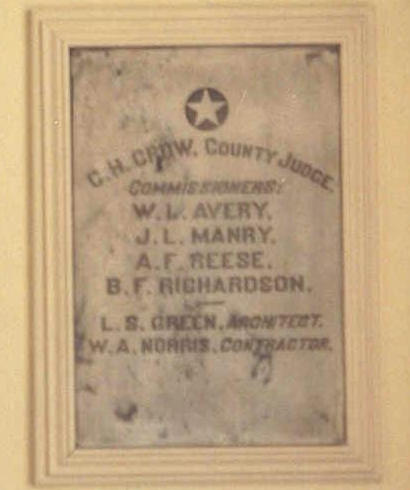
"I noticed that you have the architect listed for our courthouse
as L. S. Green. That is right and wrong. Our courthouse was built
in two phases. The east wing (Records Building) was built in 1908,
and was designed by L. S. Green. It was initially built as the county
records building and is an exact replica of the Polk County Records
Building, built in 1905, and designed by L. S. Green. In 1914, the
Trinity County Commissioners hired C. H. Page and Brother to design
a new courthouse that was to incorporate the existing records building
into the new courthouse.
The old
courthouse, built in 1884, which you have pictured, was later
demolished." - Susanne Waller, December 02, 2004
Photographer's Note:
"In January of 2008, Trinity
County received a grant from the Texas Historical Commission
for $5 million towards the restoration of their courthouse. After
seeing the condition of the building during my initial visit in
2006, they will need every penny." - Terry
Jeanson
Historical
Markers:
Trinity
County Courthouse Historical Marker
Trinity
County Seats Historical Marker
|
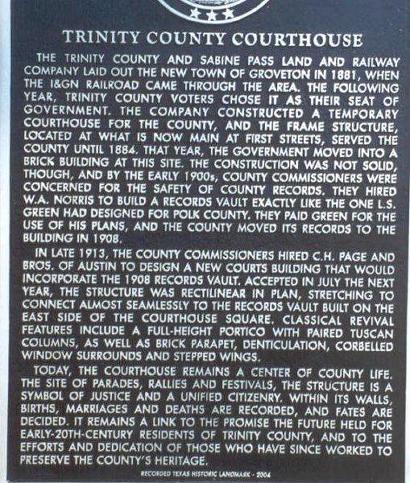 |
Trinity
County Courthouse Historical Marker
Photo
courtesy Terry
Jeanson, 2006 |
Historical
Marker Text
TRINITY
COUNTY COURTHOUSE
The Trinity County
and Sabine Pass Land and Railway Company laid out the new town of
Groveton in 1881, when the I&GN Railroad
came through the area. The following year, Trinity
County voters chose it as their seat of government. The company
constructed a temporary courthouse for the county, and the fram structure,
located at what is now Main at First streets, served the county until
1884. That year, the government moved into a brick building at this
site. The construction was not solid, though, and by the early 1900s,
county commissioners were concerned for the safety of county records.
They hired W.A. Norris to build a records vault exactly like the one
L.S. Green had designed for Polk
County. They paid Green for the use of his plans, and the county
moved its records to the building
in 1908.
In late 1913, the county commissioners hired C.H. Page and Bros. of
Austin to design a new courts
building that would incorporate the 1908 records vault. Accepted in
July the next year, the structure was rectilinear in plan, stretching
to connect almost seamlessly to the records vault built on the east
side of the courthouse square. Classical Revival features include
a full-height portico with paired Tuscan columns, as well as brick
parapet, denticulation, corbelled window surrounds and stepped wings.
Today, the courthouse remains a center of county life. The site of
parades, rallies and festivals, the structure is a symbol of justice
and a unified citizenry. Within its walls, births, marriages and deaths
are recorded, and fates are decided. It remains a link to the promise
the future held for early-20th century residents of Trinity
County, and to the efforts and dedication of those who have since
worked to preserve the county's heritage.
Recorded Texas Historic Landmark - 2004 |
 |
The
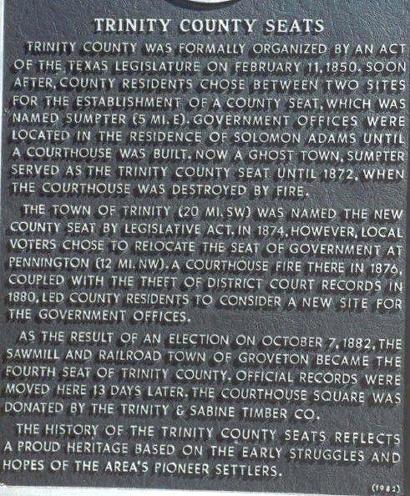
1914 Trinity County Courthouse today
Photo
courtesy Terry
Jeanson, 2006 |
The 1914 Trinity
County Courthouse as it appeared in 1917
Photo courtesy THC |
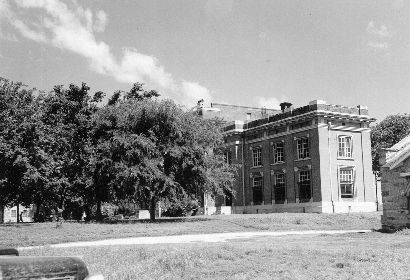
The 1914 Trinity
County Courthouse as it appeared in 1939
Photo courtesy TxDoT |
Trinity
County Seats Historical Marker
Photo
courtesy Terry
Jeanson, 2006 |
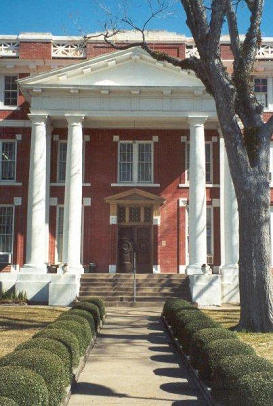
Another view
of the Trinity County Courthouse
Photo courtesy Barclay
Gibson, July 2003 |
|
|
The Courthouse Cornerstone
Photo courtesy Trinity County Historical Commission. |
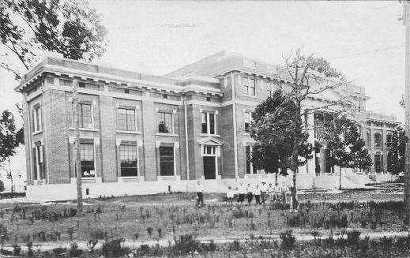
The Original
Trinity County Records Building
|
|
|
Built
in 1908.
Designed by L.S. Green.
In 1914 C. H. Page designed the Trinity County Courthouse incorporating
this original "Records Building."
Photo
courtesy Trinity County Historical Commission. |
The
1884 Trinity County Courthouse
|
Date - 1884
Architect - Eugene T. Heiner
Style - Second Empire
Material - Brick |
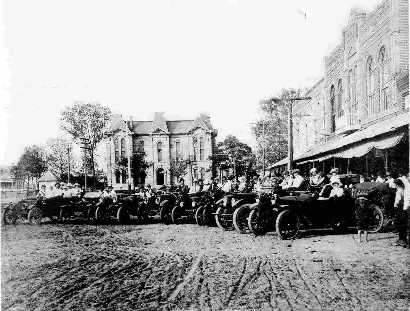
Early Trinity
County motorists lined up for a photo in Groveton.
1884 Courthouse in background. The same vintage picture is hanging
inside the current courthouse at the front entrance.
Photo courtesy THC |
Two
Courthouse Fires
by Bob Bowman ("All Things Historical")
Some of the most delectable historical desserts of East
Texas are found in the yellowed documents of the thirty-plus county
courthouses scattered across the pineywoods.
One such morsel is the little-known story of two courthouse fires
in Trinity County,
one of the rowdiest of our early counties. From Anna Hester of Groveton
comes a pair of old affidavits by J.P. Stevenson, a frontier lawyer,
and J.B. Gipson, the son of a county surveyor. Both lived in the turbulent
1870s.
Their affidavits were transcribed in 1909, apparently in an effort
to clarify property deed records which may have been in dispute.
Stevenson and Gipson recalled a November, 1, 1872, fire which destroyed
most of the county records at the first county seat at Sumpter.
The only surviving documents were some criminal records of a peace
justice and the surveyor’s records of properties in the county.
At the time, Gipson’s father, George, was the county surveyor and
was holding the survey records at his home in Trinity,
about twenty miles west of Sumpter.
Stevenson had a good reason to remember the fire. As a lawyer in Trinity
and Walker counties
since l868, his life revolved around the courthouse
and the records lost in the fire.
Why and how the courthouse burned is not clear, but Sumpter
was a hotbed of violence during the l860s and early l870s when federal
reconstruction gripped the South in the aftermath of the Civil War.
Out of this violent era came a Sumpter
preacher’s son, John
Wesley Hardin, who killed three Union soldiers near Sumpter
in 1868, and went on to become Texas’ most notorious gunfighter.
When the Sumpter courthouse burned, the county seat was located at
Trinity in 1873. It remained
there only until 1874 when it was relocated at Pennington,
where, according to Stevenson, another courthouse was burned in 1876,
again destroying some county records.
The county’s land records and criminal documents, however, were saved.
J.T. Evans, the clerk of the local district court, kept the criminal
records in an iron safe, which survived the fire.
Evans also carried the property deed records to his home the night
of the fire after “a number of bad parties had been indicted” and
he became “fearful they would undertake to destroy their indictments”
by burning the courthouse.
Gipson said his surveyor father saved the land surveys at Pennington
by entrusting them to deputy W.M. Freeman who kept them “in a safe
place not in the courthouse.”
“By reason of this fact, they were again saved from fire at the burning
of the courthouse at Pennington,”
wrote J.B. Gipson in his affidavit.
Although the Trinity
County survey records were saved from two fires, the records of
the district clerk were stolen on the night of March 5, 1880, and
Gipson said other documents were later partially destroyed “by rough,
bad handling by parties who had access to them.”
Trinity County
moved its courthouse from Pennington
to Groveton
in 1882, not only because it was a cental location, but Trinity County
Lumber Company donated the site for a town square and materials for
a new courthouse.
It remains there today.
All
Things Historical
September 5, 2005 Column |
|
|
 HOME
HOME