|
|
KOUNTZE, TEXAS
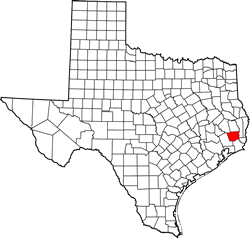
Hardin
County Seat, East Texas
30° 22' 36" N, 94° 18' 55" W (30.376667, -94.315278)
FMs 418 and 1293
Highways 326, and 69/287
23 miles NW of Beaumont
10 miles W of Silsbee
31 miles S of Woodville
Population: 2,099 Est. (2016)
2,123 (2010) 2,115 (2000) 2,056 (1990)
|
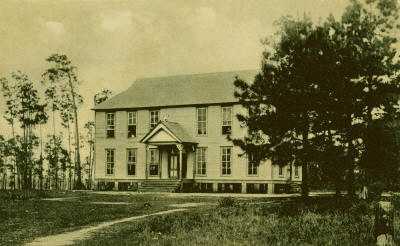
Kountze High
School in the 1910s
Photo
courtesy texasoldphotos.com
More Texas
Schoolhouses |
History
in a Pecan Shell
The town was named for the Kounte Brothers, Herman and Augustus -
railroad investors in the Sabine and East Texas Railroad. The railroad
served a string of lumber towns, most of which have faded into oblivion.
A post office was granted in 1882 and although Kountz was defeated
in an election for county seat, a courthouse fire in 1886 made the
voters rethink their decision. Kountze became the county seat in 1886.
The year 1902 saw the arrival of the Gulf, Colorado and Santa Fe Railway
– making Kountze a railroad crossroads.
The population in 1910 was over three times the 1890 population and
Kountze was wired for electricity while much of Hardin
County remained in the dark.
The town suffered a fire in 1916 just as the forests were thinning
out. Silsbee grew as Kountze’s rival, preventing Kountze from an economic
dominance.
Archer Fullingim, a newspaperman who started the Kountze News on a
hand-fed press in the 50s, became a self-appointed spokesperson, and
champion of Hardin County
and the Big Thicket in the 1960s. |
 |
Kountze, Texas
Stories
The
Legend of the Olive Ghost Train by W. T. Block Jr.
"... It was a bright moonlight night that October
30th when Tim Hargraves reached Beaumont, and he went straight to
a booth and asked for a ticket to Olive, north of Kountze. The ticket
master inquired, "A ticket to Olive? Why, that's a ghost town, and
all the houses except 2 or 3 are gone. The East Texas Railroad passes
nearby, but are you sure that's where you want to go?..."
Olive,
Hardin County, Texas
An Extinct Sawmill Town and the Olive-Sternenberg Partnership That
Built It by W. T. Block
Three miles north of Kountze, in Hardin County, Texas, where once
the burly and towering pine trees shaded the forest floors beneath
them, the town of Olive thrived between 1881 and 1912.
|
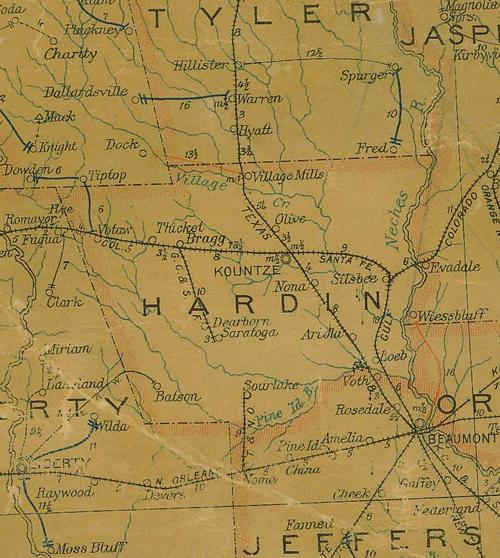
Hardin
County 1907 postal map showing
the Gulf, Colorado and Santa Fe Railway & Kountze
From Texas
state map #2090
Courtesy
Texas General Land Office |
| Texas
Escapes, in its purpose to preserve historic, endangered and vanishing
Texas, asks that anyone wishing to share their local history
and vintage/historic photos, please contact
us. |
|
|
 HOME
HOME
 Texas
Gulf Coast
Texas
Gulf Coast East
Texas
East
Texas Central
Texas North
Central
Texas North Central
Texas South
Central
Texas South Texas
Panhandle
Texas
Panhandle South
Texas
South
Texas Texas
Hill Country
Texas
Hill Country West
Texas
West
Texas Texas
Ghost Towns
Texas
Ghost Towns Texas
Counties
Texas
Counties