|
NEW WAVERLY,
TEXAS
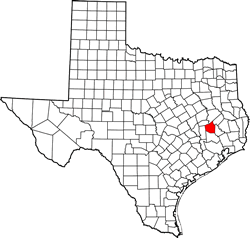
Walker County, East
Texas
30°32'21"N 95°28'48"W (30.539226, -95.479862)
Hwy 75 and I-45
13 miles S of Huntsville the county
seat
17 miles N of Conroe
55 miles N of Houston
ZIP code 77358
Area code 936
Population: 1,142 (2020)
1,032 (2010) 950 (2000) 936 (1990)
Book Hotel Here › Huntsville
Hotels |
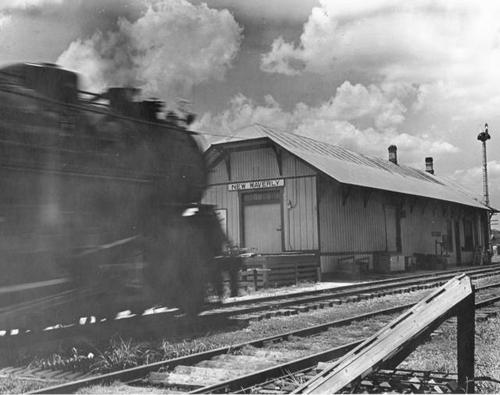
New Waverly Depot
Vintage
photo courtesy Library of Congress
More Texas Depots
|
History in
a Pecan Shell
In an old familiar
story, Waverly, Texas was once
content being simply Waverly, Texas.
Then came the railroad.
The Houston and Great Northern Railroad Company came through the area
and in those times railroads
didn’t have the best of reputations. Locals thought twice about granting
a right-of-way and turned the railroad's offer down.
In the second act of the old familiar story, the railroad came through
ten miles west of town and established “Waverly Station" in 1870.
Naturally the people in business and other residents were drawn to
the new town to maintain contact with the rest of the world. The station
became “New Waverly.”
In the late 1800s Polish families were recruited from Europe and became
tenant farmers in the region. Poles also settled in towns like Brenham,
Thurber,
Malakoff , Palestine
and a cluster of communities around Panna
Maria SE of San Antonio.
An abbreviated timeline of significant events:
In 1873 a post office was granted.
In 1884 the town had 150 residents.
By 1896 the population had reached 250.
In 1900 the town had a healthy population of 500.
By mid-century it had declined somewhat to just over 400.
The population was about 600 in the 60s – 700 in the 70s, 800 in the
80s, and 900 in the 90s.
The economy is still driven by lumber – an industry that has influenced
New and Waverly, Texas, and
Elmira for over 100 years. |
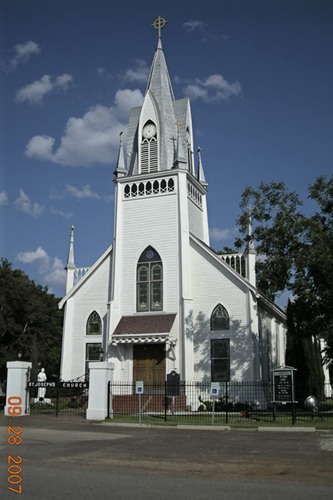
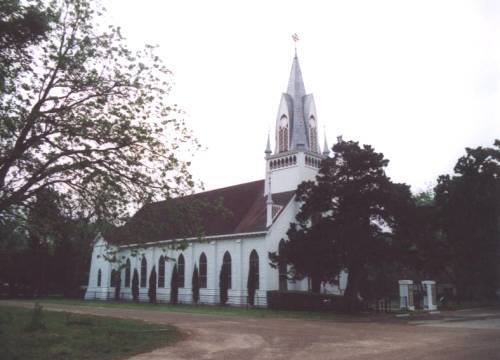
St Joseph's
Catholic Church
Recorded Texas
Historic Landmark
101 Elmore St
New Waverly |
| Photo
courtesy Mildred L. Brown, September 2007 |
Historical Marker:
St Joseph's
Catholic Church
The Rev. Felix
Orzechowski, who came to Texas in 1866 to answer an appeal for Polish
missionaries, organized St. Joseph's Parish in 1869. The first Catholic
church in Walker County,
it served the many Polish families who settled this area in the 1870s.
Church tradition often sustained the immigrants until they adjusted
to life in a new country. Services were held outdoors or in private
homes during Father Orzechowski's pastorate. Soon after leaving this
parish in 1876, he returned to Poland and was imprisoned by ruling
Russian officials for advocating democratic ideals.
A frame church building was erected in 1877 under the direction of
the Rev. Victor Justiana Linicki, who was a Polish baron before he
became a priest. A larger edifice, designed by Tom Lavandoski, was
built in 1897, and the original structure was used as a school. The
present church was begun in 1905 and dedicated on the feast of St.
Joseph, March 19, 1908, during the pastorate of the Rev. Thomas Aloysius
Bily (1859-1921). The stately Gothic-style structure, designed by
L.S. Green, reflects the European heritage of the parishioners.
The parish school was operated until 1951. St. Joseph's Catholic Church
continues to minister to descendants of New Waverly's historic Polish
community.
Recorded Texas Historic Landmark - 1975 |
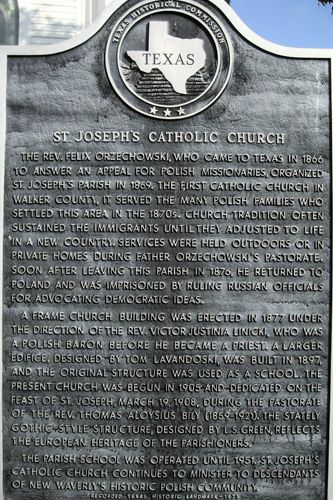 |
St
Joseph's Catholic Church historical marker
Photo courtesy Mildred L. Brown, September 2007 |
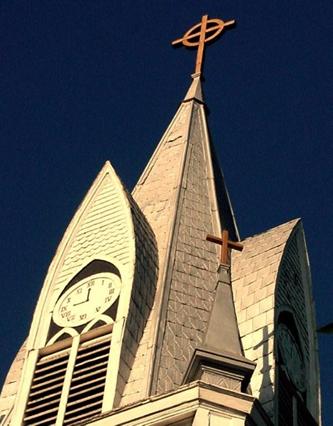
St
Josephs Catholic Church steeple
TE photo, January 2005 |
Old Waverly’s fade
into oblivion may be short of tragic elements, but two separate stories
were enough to have it included in the late Ed Sayer’s Ghosts of
Texas. When one considers the cottage industry that spooks and
spirits have become in recent years, it’s an accomplishment to be
included as one of the fifty-odd stories in what is considered to
be the first volume written on Texas Ghosts.
The sites of the stories are several miles apart in what remains today
of the dense forest that was laboriously pushed back by slave labor
to plant cotton.
Click here for the stories › |
| Texas
Escapes, in its purpose to preserve historic, endangered and vanishing
Texas, asks that anyone wishing to share their local history, stories,
landmarks and vintage/historic photos, please contact
us. |
|
|
 HOME
HOME