|
History in
a Pecan Shell
Settlement was
before 1840 when the Trinity
River was called the Trinidad River. A ferry crossing here
was managed by one O. M. Airhart and another ferry operated four miles
N of present-day Trinidad.
By the mid 1840s the site had a store and a saloon. In 1880 it became
known as Trinity Switch, for its station on the St. Louis Southwestern
Railroad. That year when the town applied for a post office the word
switch was removed and the post office opened under the name Trinidad.
Other sources suggest that that it opened in 1891.
In 1910 the community reported a population of 70 served by 5 businesses.
The population underwent huge growth when a power plant and fertilizer
plant opened here.
From a population of 750 in 1930, it declined to 550 for the 1940
census. The 1990 population was reported as 1,056 residents, growing
slightly to 1,091 for 2000. |
Historical Marker
- In Trinidad - On Hwy 31, W of Hwy 274
The Trinity
River
Three main tributaries--
the West, Elm, and East forks-- feed the Trinity from headwaters in
North Texas.
Discovery of prehistoric Malakoff Man carved stone heads near this
site in the 20th century revealed that humans inhabited the Trinity
valley thousands of years ago. Indian villages dotted the river banks
when European exploration began. French explorer Robert
Cavelier Sieur de La Salle called this waterway the River of Canoes
in 1687. Spaniard Alonso de Leon is credited with first using the
name "Trinity" in 1690. The fertile Trinity floodplain drew Anglo-American
settlers to this area during the Republic of Texas. Buffalo,
first Henderson County Seat, was founded a few miles upstream at a
ferry crossing.
Navigation of the Trinity has been proposed in a number of ambitious
plans since the 1850s. Steamboats plied the river carrying cotton,
cattle, and lumber
to Galveston
and other Gulf of Mexico ports until the 1870s. Arrival of the railroad
ended the era of riverboat trade.
Founded in 1881 on the St. Louis Southwestern Railroad, also known
as the Cotton Belt, the town of Trinidad had a pump station to draw
water for the boilers of steam locomotives. A ferry crossed the Trinity
here until a bridge was erected in 1900. |
| Texas
Escapes, in its purpose to preserve historic, endangered and vanishing
Texas, asks that anyone wishing to share Trinidad's history, stories,
landmarks and recent or vintage photos, please contact
us. |
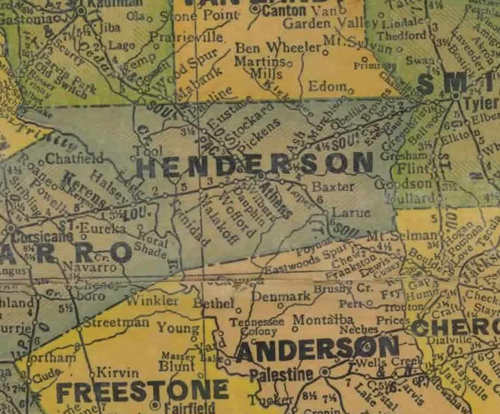
1940s Henderson
County map showing Trinity River and Trinidad
(Below "HE" in "HENDERSON")
From Texas state map #4335
Courtesy
Texas General Land Office |
|
|
 HOME
HOME