|
|
The
signposts up and down the Sabine River valley of East
Texas read like a roster of sawmills that once cut the great virgin
pines from the valley's verdant hills: Haslam, Fawil,
Logtown, Steep Creek, Trotti, Yellow Pine.
These and a hundred more boom towns prospered here in lumbering's
golden era between the 1880s and 1920s.
But when the timber played out, the sawmills closed or moved on, leaving
behind cutover forests, clusters of clapboard buildings, and remnants
of concrete and steel.
Some of the towns, however, overcame the loss and still cling to life
in the pineywoods, supported by a smaller sawmill or some other form
of economic activity.
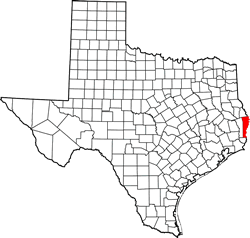
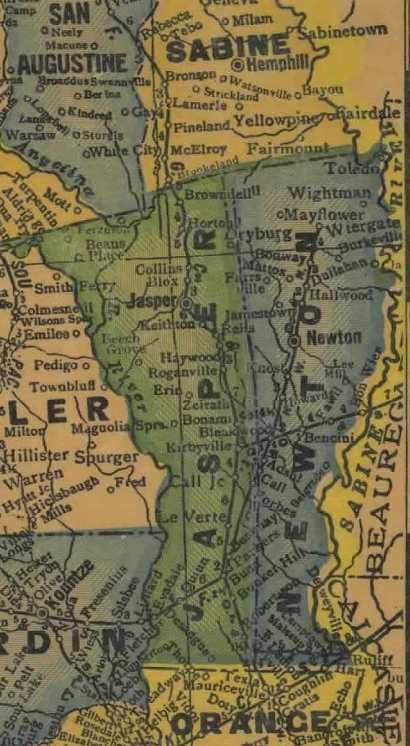
One such survivor is Wiergate -- the one-time home of Wier Long Leaf
Lumber Company -- in northern Newton County.
Grass grows over the ground where more than 550 homes once stood and
bitterweeds cover the site of the town's business district. But Wiergate,
somehow, lives on as many of the community's 300 or so residents still
make their living from working in the woods.
The town's real tenacity, however, comes from a strong sense of pride
anchored in the days when living in Wiergate was a distinction among
East Texas sawmillers.
At its height, the town of 2,500 was one of the most progressive of
the old lumbering era. Its sawmill was the largest in East
Texas (with an hourly capacity of 20,000 board feet) and its high-roofed
commissary store, the forerunner of today's department stores, stocked
everything from pins to caskets.
There were also schools, churches, a community center, a movie theater,
two swimming pools, two doctors, and other niceties seldom found in
sawmill settlements.
Wiergate was born in 1917 when brothers Bob and Tom Wier built a sawmill
on Little Cow Creek and surrounded it with a post office, barber shop
and doctor's office to serve the millhands. A year later, the Orange
and Northwestern Railroad ran a line from Newton
to ship out the Wier's lumber. The Wiers also worked a turpentine
camp in the virgin longleaf forests around Wiergate, collecting gum
three years ahead of their logging crews. The sawmill began gasping
its last breaths in the 1940's when it became apparent the Wiers'
timber holdings -- which had not been replanted or regenerated following
harvest -- would not last long. On Christmas Day, 1942, the mill's
giant saws were stilled and Wiergate's people began to drift away.
But today many of the town's old residents wander back for occasional
homecomings. One of their steps is invariably the Wiergate Post Office,
where a collection of photographs from the town's past is displayed.
Former Wiergaters linger for hours over the photos, trying to pick
out familiar faces and places.
A former postmaster, Doyle Smith, felt Wiergate's durability came
from the close-knit fraternity of its old sawmill families.
"There's something about Wiergate's people you don't find in a lot
of other places. I can't describe it. But I can see it in the faces
of the old-timers when they come back. They talk like they left behind
an awful big hunk of their lives."
And perhaps they did.
© Bob
Bowman
"All
Things Historical"
June 13 , 2004 Column
This column is provided as a public service by the East Texas Historical
Association. Bob Bowman is a former president of the Association and
author of 30 books on East Texas. |
Burr’s Ferry
Several old ferry
cables can still be seen at Burr’s Ferry, which also crossed the Sabine
between Wiergate, TX and Leesville, LA.
(From Ferries
in East Texas by Bob Bowman) |
| Texas
Escapes, in its purpose to preserve historic, endangered and vanishing
Texas, asks that anyone wishing to share their local history, stories,
landmarks and recent or vintage photos, please contact
us. |
|
|
 HOME
HOME

 Texas
Gulf Coast
Texas
Gulf Coast East
Texas
East
Texas Central
Texas North
Central
Texas North Central
Texas South
Central
Texas South Texas
Panhandle
Texas
Panhandle South
Texas
South
Texas Texas
Hill Country
Texas
Hill Country West
Texas
West
Texas Texas
Ghost Towns
Texas
Ghost Towns Texas
Counties
Texas
Counties