|
Los
Ebanos
by Lydia
Solis & Benjamin Cardenas |
|
|
Los
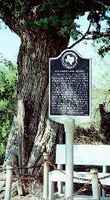
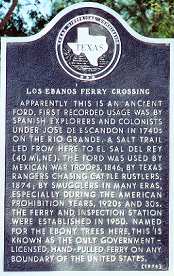
Ebanos Ferry Crossing Historical Marker
Photo
Courtesy of Lydia Solis |
|
When you drive
down the curving old highway that leads to Los Ebanos, it is like
driving into a land that time forgot. On either side of this rural
road, native greenery such as a wide variety of cacti and mesquite
trees thrive. The chains of rolling, pebbly hills which come to
an abrupt end at the rusty, railroad tracks have yielded numerous
legends of lost buried treasure and several ghost sightings, unique
to the area.
Situated in an obscure southwestern corner of Hidalgo
County, Texas, three miles south of Expressway 83 near Sullivan
City on FM 886, this picturesque small village is home to several
hundred residents who live a quiet, slow-paced existence much like
their ancestors before them. Originally known as Las Cuevas Crossing
because of numerous caves in the nearby hills, Los Ebanos was an
ancient ford used by Indians and by early Spanish colonists
in the late 17th century. American troops used the ford during the
Mexican War in 1846.
In 1852, Las
Cuevas Ferry was licensed by the county for $5 a month. Later,
in the 1870s it was used by cattle rustlers. One famous skirmish
took place in 1874 when Captain L.H. McNelly's Texas Rangers recovered
stolen cattle taken to General Juan Flores Salinas' Las Cuevas
Ranch. The General was killed and his citizens erected a monument
to his memory in San Miguel de Camargo (present day Díaz-Ordaz).
|
|
|
Los
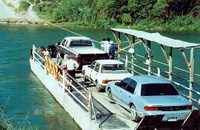
Ebanos hand-operated ferry
Photo
Courtesy of Lydia Solis |
|
In 1913,
Dr. A.A.J. Austin (1843-1933), a pharmacist and physician established
a ranch, brickyard, gravel pit and drugstore at Los Ebanos. Dr.
Austin, former alcalde (mayor) of Mier, was known as el
doctor paloma (Dr. Dove) because he always wore white suits
and rode a white horse. Mrs. Pedro Barrera (Elena) of Mission, granddaughter
of Dr. Austin, says the property belonged to the Austin family,
particularly Sara and Miguel Carrizales. The Austins lived at Los
Ebanos until 1915, then moved to Mission.
In the early
1900s, local dances and large fiestas to celebrate special occasions
were about the only forms of entertainment available at the time.
The plazitas were where most social events took place. In
September, ferias (fairs) were held in which people could purchase
tacos and fruit at concession stands and young girls could always
check out the local boys at the baseball games.
During the Prohibition
Era in the 1920s and 1930s, the ford was known as "Smuggler's
Crossing". Then, tequiladores brought in bootleg liquor from
Mexico. Some mules were so well trained that their drivers left
them on the U.S. bank and the packtrain continued unescorted to
its destination. In later years, contraband TVs and refrigerators
"went across" from here.
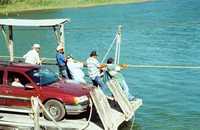
In 1950, a U.S. Inspection Station and a hand-drawn automobile
ferry was established. The ferry named "Victoria" and
operated by the Beto Reyna family is said to be the only
government licensed hand-pulled ferry on any U.S. boundary. It is
still in operation today and crosses three vehicles at a time to
and from neighboring Diaz-Ordaz.
|
|
|
Men
pulling ferry
Photo
Courtesy of Lydia Solis |
|
The Rio Grande
River lazily winds its way around Los Ebanos. Many times it has
overflowed its banks and has flooded the area. In September 1967,
heavy rainfall from Hurricane Beulah forced many of the residents
to evacuate the village. They sought shelter in Sullivan City.
Their relatives who chose to remain behind, made their way out of
Los Ebanos to see them on foot in waist-deep water.
Although many
of its former residents have long since moved out and new residents,
mainly from Díaz-Ordaz, have taken their place, life in Los
Ebanos hasn't changed much. Several of the older houses have been
torn down and replaced by new ones. Two lonely walls of the old
elementary school still stand as a silent reminder of an unsophisticated,
gone-by era. Four of the last mom-and-pop stores to conduct business
there also stand, but they have long since shut their doors to patrons.
A new dance hall was built in the middle of one of the plazas and
that is where all social events take place today.
As you drive down
the long stretch of curving highway leading to Los Ebanos today, the
same lonely hills that held so many stories and memories for people
of past generations are there, still faithfully embracing and guarding
this land that time seems to have forgotten. They greet you like a
good friend as you come in and bid you farewell on your way out.
© Lydia Solis & Benjamin Cardenas
January 2001 |
|
|
Los
Ebanos Ferry Crossing Historical Plaque
Photo
Courtesy of Lydia Solis |
| Texas
Escapes, in its purpose to preserve historic, endangered and vanishing
Texas, asks that anyone wishing to share their local history, stories,
landmarks and recent or vintage photos, please contact
us. |
|
|
 HOME
HOME

 Texas
Gulf Coast
Texas
Gulf Coast East
Texas
East
Texas Central
Texas North
Central
Texas North Central
Texas South
Central
Texas South Texas
Panhandle
Texas
Panhandle South
Texas
South
Texas Texas
Hill Country
Texas
Hill Country West
Texas
West
Texas Texas
Ghost Towns
Texas
Ghost Towns Texas
Counties
Texas
Counties