|
|
 |
THE COURTHOUSES
OF HARRIS COUNTY
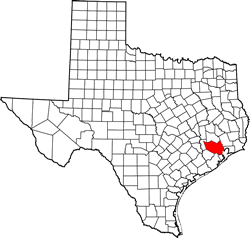
Harrisburg County
was formed in December of 1836, the same year that brothers Augustus
C. and John K. Allen founded the city of Houston.
The county seat was moved to Houston
from Harrisburg, a small settlement east of Houston
at the junction of the Bray and Buffalo Bayous, in 1837. In 1839,
the name of the county was changed to Harris
County in honor of early settler and the founder of Harrisburg,
John Richardson Harris.
The first five Harris County courthouses all occupied the same plot
of land, set aside by the Allen brothers specifically for the courthouse.
The first, built in 1838, was a two-story pine log building
built by Maurice I. Birdsall, who also built a log jail on the northeast
corner of the courthouse square. This courthouse was enlarged in 1841,
but by 1844 its deterioration led to its sale at auction. Claiming
the building as their personal property, the Allen brothers had it
moved across the street for a short time for use as a post office.
The building was moved yet again to Washington Road for use as a store
and a home. From 1844 until 1851, court sessions were held in various
hotels around the square.
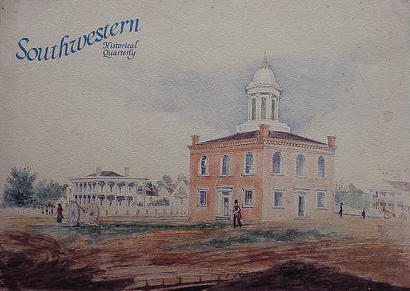
In October of 1851, a second courthouse was completed and dedicated.
Costing $15,000 and designed by F.J. Rothaas, it was a two-story brick
building with central entrances on each side and a central domed cupola.
Unfortunately, the walls and foundation developed cracks and the building
had to be demolished in 1860. The county’s third courthouse
was to be built that year. With an estimated cost of $25,000 and design
by N. DeChaumes, the courthouse was intended to be a two-story Greek
Revival style building with Classical style porticoes and a large
central cupola, but by the start of the Civil War, only the walls,
floors and roof had been completed. During the war, the courthouse
was used as a cartridge factory, officer’s quarters and a hospital
for Confederate soldiers and the basement was used to house Union
prisoners. This building also deteriorated rapidly and was demolished
in 1869.* Its bricks were sold and used to construct the Annunciation
Roman Catholic Church on Texas Avenue. The courthouse square was used
as a municipal park until the construction of a fourth courthouse
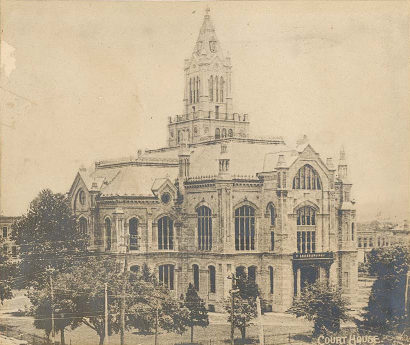
began in 1883 and was completed by 1884. Designed by
Galveston architect Edward J. Duhamel, who had won a contest in 1878
to design Houston’s new City Hall and Market House, the county’s fourth
courthouse was a grand three-story Victorian style building with projecting
bays on a cruciform floor plan and a central spire. The cost of the
building was $100,000. Sometime later, the tower was removed and by
the early twentieth century the building was condemned due to its
deterioration.
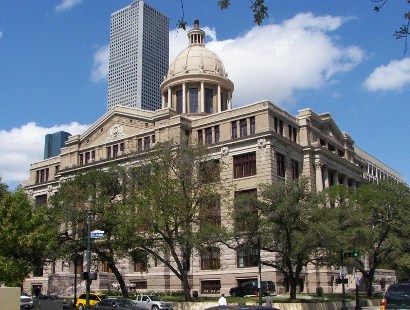
Plans to build a fifth courthouse were underway in 1907. Construction
began in 1909 and was completed by late 1910, but the courthouse
was not dedicated until March 2, 1911 in observance of the 75th anniversary
of Texas independence. The courthouse was designed by Charles Erwin
Barglebaugh of the Dallas
architectural firm of Lang and Witchell, who had designed courthouses
for Howard, Nacogdoches, Scurry, Cooke and Johnson counties around
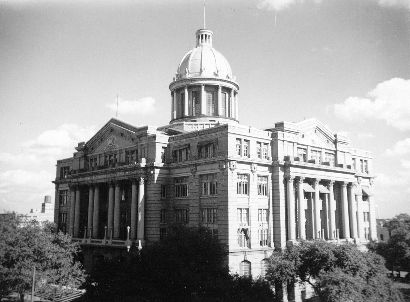
the same time. The $500,000 Beaux-Arts style (also referred to as
Neo-Classical Revival,) six-story courthouse was built primarily of
rough cut pink Texas granite and light brown St. Louis pressed brick
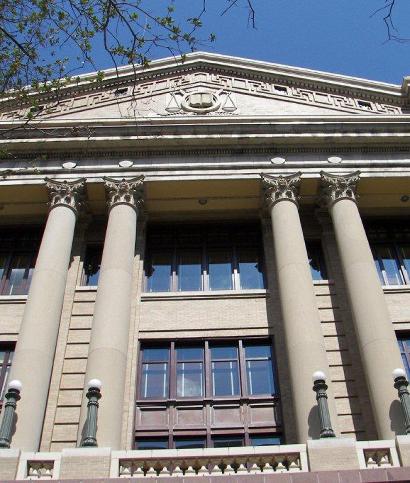
with terra-cotta, limestone and masonry ornamentation. Each side consisted
of raised, projecting porticoes with Corinthian columns and the building
was crowned with a central dome with supporting columns around the
drum and a ring of eagles around the base of the dome. The top had
a Doric lantern with a cap that looked like a chess pawn. The lantern
cap was removed not long afterwards. A defeated bond issue for a new
courthouse in 1938 saved the 1910 building from demolition. The county
quickly ran out of space in this courthouse and a new modern style
courthouse was built to the east across San Jacinto Street in 1952.
Built of marble and granite, the 1952 courthouse was designed by architects
George W. Rustay and Joseph Finger, who designed Houston’s
1938-39 City Hall. Finger died during the construction of the new
courthouse.
The firm of Finger and Rustay also remodeled the 1910 courthouse in
1954 which became the Harris County Civil Courts Building upon its
completion in 1956. The interior plaster ornamentation, marble walls
and dome skylight were ripped out or covered up and the rotunda was
sealed to add more office space on each floor as were the courtroom
balconies. The wood frame windows were replaced with metal ones and
the exterior stairs on the east and west side were also demolished,
switching the entrances from the second to the first floor. In 2003,
plans began for the restoration of the 1910 courthouse. The building
was closed in 2006 and construction began in 2009. The restoration
of the exterior and public areas on the interior to their 1910 condition
was completed in 2011.
The growing needs of the Harris
County court system led to the building of the Family Law Center
in 1969, north of the 1910 courthouse across Congress Street, and
the County Administration Building in 1979, west of the 1910
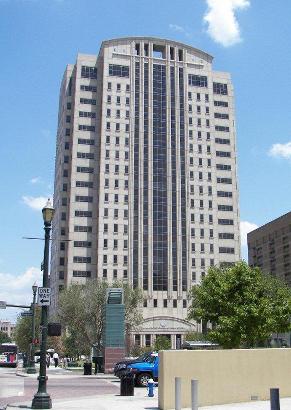
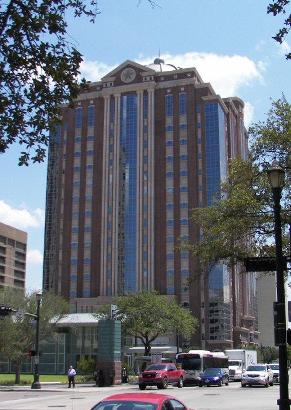
courthouse across Fannin Street. More recently, a twenty story Criminal
Justice Center was built, dedicated in 1999, and a seventeen story
Civil Courthouse was built, dedicated in 2006. When the new
Civil Courthouse was opened, the 1952 courthouse was rededicated as
the Harris County Juvenile Justice Center. In July of 2011, the Jury
Assembly Center was opened, north across Congress Street from
the 1952 courthouse. The Jury Assembly Center’s above ground entrance
leads to underground assembly rooms that connect to a tunnel system
that links all of the other court buildings in the area.
- Terry
Jeanson, August 28, 2011
*Note - The Harris County Historical Commission
does not mention the demolition of the 1860 courthouse in 1869 and
states that, “following the war and for the next fifteen years, renovations
were undertaken annually of the court building.”
Sources:
Texas Historical Commission County Atlas at http://atlas.thc.state.tx.us/shell-desig.htm,
National Register of Historic Places and the Harris County Historical
Commission at http://www.historicalcommission.hctx.net.
County history and biographical information from the Handbook of Texas
Online.
Houston
Hotels > Book Here |
Present Harris
County Courthouse
|
Present Harris
County Courthouse Includes:
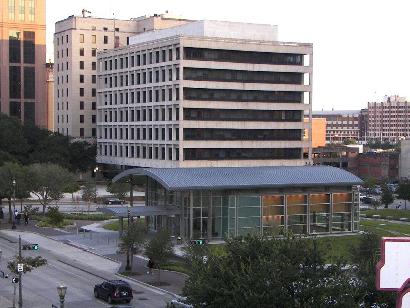
The Family Law Center in 1969
The County Administration Building in 1979
The Criminal Justice Center in 1999
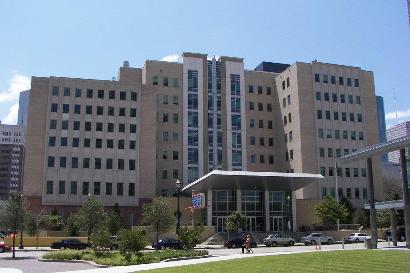
The Civil Courthouse in 2006.
The Jury Assembly Center in 2011 |
The Harris
County Criminal Justice Center
Photo courtesy Terry
Jeanson, August 2011 |
The Harris
County Civil Courthouse
Photo courtesy Terry
Jeanson, August 2011
|
The Jury
Assembly Center in the foreground with
the Family Law Center behind it.
Photo courtesy Terry
Jeanson, August 2011
|
The 1952
Harris County courthouse
Now the Harris County Juvenile Justice Center
Photo courtesy Terry
Jeanson, August 2011
|
The 1952 Harris
County Courthouse
Style - Modern
Material - Marble and granite |
The 1910
Harris County Courthouse
|
Architect -
Lang, Witchell & Barglebaugh
Style - Beaux-Arts
Material - Granite and brick
National Register Property
Corner of Congress and San Jacinto Streets
One postcard caption for the 1910 building states: "The Largest
Courthouse in the State of Texas." The figure that once stood
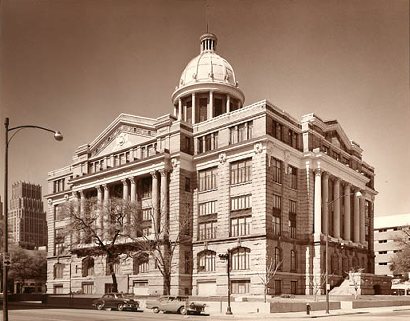
atop the building disappeared sometime before 1939. |
The 1910 Harris
County Courthouse as it appeared in 1939
Photo courtesy TXDoT |
RESTORATION
OF THE 1910 HARRIS COUNTY COURTHOUSE
Photographer's
Note:
On August 23, 2011, I was pleased to be able to attend to rededication
ceremony of the 1910 Harris County courthouse. This was the culmination
of what began in March of 2003 when the master preservation plan was
presented to the Texas Historical Commission. The cost, nearly $65
million with $5.5 million from the Texas Historical Commission, seemed
exorbitant to many and the effort to restore the public parts of the
interior to its 1910 condition was going to be difficult because the
inside was so completely changed during the 1950s remodeling. Marble
walls and plaster ornamentation were ripped out and covered up, the
rotunda was sealed off and the glass skylight at the bottom of the
dome was removed. On the exterior, the dome’s lantern cap went missing
and the massive staircases on the east and west sides that led up
to a second story entrance were removed and the entrances were moved
to the first floor. To restore the interior, historic preservationists
had to rely on remnants found from the original building, historic
photographs, of which there were few, recollections of county residents
who worked or visited the courthouse before the remodeling and examples
of the original architects other work for reference. The 1910 courthouse
closed in 2006 and the actual construction phase began in February
of 2009. The result of their efforts is nothing short of miraculous
which I am unable to fully convey in these photos. It is something
that needs to be seen in person.
During my visit, I received a pamphlet called “A Self-Guided Tour
of the Harris County 1910 Courthouse.” Most of the information in
the photo captions come from this pamphlet.
- Terry
Jeanson, August 28, 2011 |
 |
|
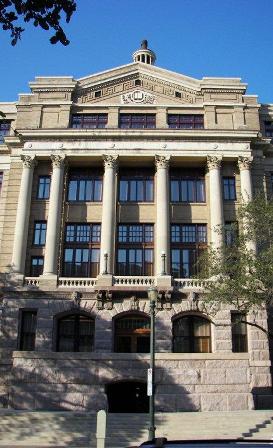
1910 Harris
County courthouse north entrance facing Congress Street
Photo courtesy Terry
Jeanson, August 2011
|
1910 Harris County
courthouse east portico facing San Jacinto Street
Photo courtesy Terry
Jeanson, August 2011 |
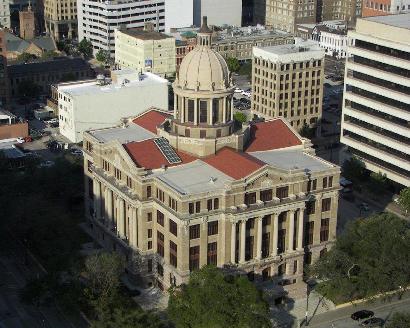
The restored
1910 Harris County courthouse
(Seen from the 20th story of the Criminal Justice Center.)
Photo courtesy Terry
Jeanson, August 2011
|
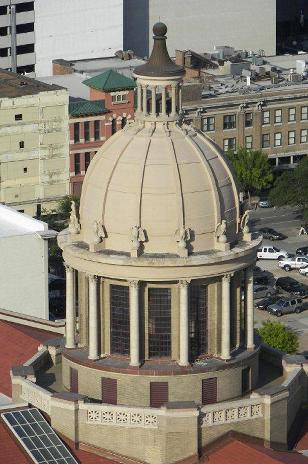
"The courthouse
dome seen from the 20th floor of the Criminal Justice Building. The
exact color of the roof's red clay tile was not known until photos
of them surfaced on the internet in 1992."
Photo courtesy Terry
Jeanson, August 2011 |
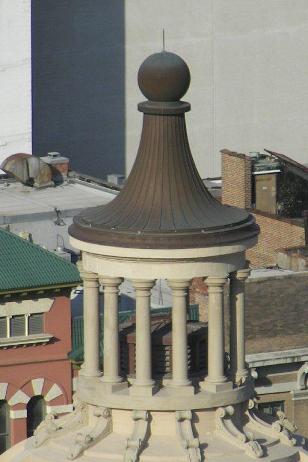
| "The building's
original lantern cap was removed in the 1920's. This fifteen foot,
$54,000 copper replica was built in 1993 for an earlier preservation
effort. It was finally installed on top of the dome on March 14, 2010."
- Terry
Jeanson |
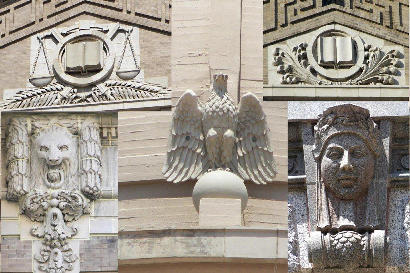
A collage of
the building's exterior details.
Photo courtesy Terry
Jeanson, August 2011 |
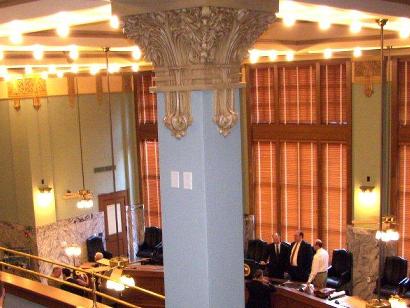
| "The north
side courtroom seen from the restored balcony. It will be housing
the First State Court of Appeals. The restored south side courtroom
will be housing the Fourteenth State Court of Appeals. The south side
courtroom is similar in appearance, but the balcony seating area is
a conference room with windows looking out into the courtroom. There
were three original courtrooms on the fifth floor that were not restored
because they didn't need them and were turned into offices instead."
- Terry
Jeanson |
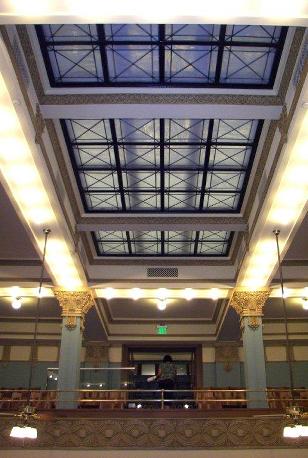
| "Ceiling
skylight and balcony in the north side courtroom. The plaster patterns
in the bow-front balcony were recreated from historical photographs."
- Terry
Jeanson |
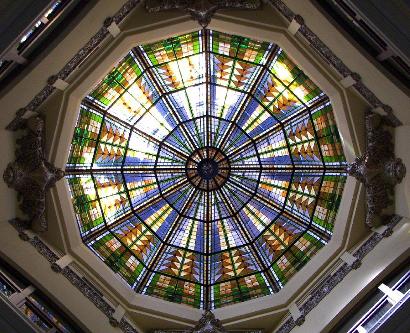
| "Since no
photographs or drawings of the original dome skylight were ever found,
the design was based on similar skylight designs of the period and
uses the colors from the tile floor patterns. The large plaster capital
moldings seen on each side of the skylight were recreated using motifs
found in the adjacent wall moldings." - Terry
Jeanson |
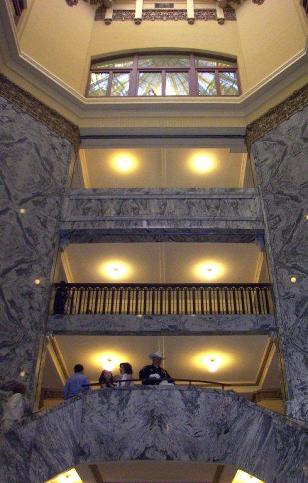
| "Marble
in the rotunda. Replacement marble for the interior came from the
same quarry near Tate, Georgia that supplied the marble for the construction
in 1909-10. Cherokee marble was used on the stair treads and Creole
marble was used on vertical surfaces, such as walls, columns and stair
risers." - Terry
Jeanson |
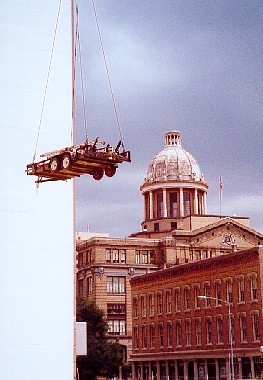
Courthouse View
during Main Street Construction
TE Photo 2002 |
The 1910 Harris
County Courthouse as it appeared in 1955
Photo courtesy THC |
|
|
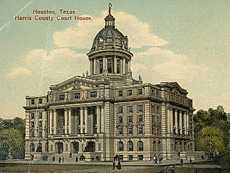
Postcard
dated 1921
TE Postcard Archives |
|
|
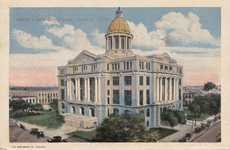
Another
postcard of the 1910 courthouse
TE Postcard Archives |
|
|
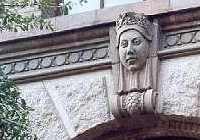
A
detail repeated above many entrances
TE Photo 6-01 |
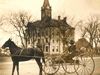
The 1884
Harris County Courthouse
|
| "[The]
fourth courthouse began in 1883 and was completed by 1884. Designed
by Galveston architect Edward J. Duhamel..., the county’s fourth courthouse
was a grand three-story Victorian style building with projecting bays
on a cruciform floor plan and a central spire. The cost of the building
was $100,000. Sometime later, the tower was removed and by the early
twentieth century the building was condemned due to its deterioration."
- Terry
Jeanson |
The 1884 Harris
County Courthouse
Courtesy THC |
| The
1851 Harris County Courthouse |
| "In October
of 1851, [the] second courthouse was completed and dedicated. Costing
$15,000 and designed by F.J. Rothaas, it was a two-story brick building
with central entrances on each side and a central domed cupola. Unfortunately,
the walls and foundation developed cracks and the building had to
be demolished in 1860." - Terry
Jeanson |
The 1851 Harris
County Courthouse
Courtesy THC |
|
|
 HOME
HOME