|
Books by
Jeffery Robenalt
|
|
|
Alvar
Nunez Cabeza de Vaca’s epic journey as the first European to explore
the interior of Texas began when he
was appointed treasurer and second in command of an expedition to
the New World led by Panfilo Narvaez. Narvaez secured a commission
from King Carlos I of Spain that gave him the right to conquer and
colonize all the land between Florida and the Rio de Las Palmas
in eastern Mexico. In June 1527, the expedition, consisting of five
ships loaded with 600 soldiers and colonists, set sail with high
expectations of gold and glory.
After making their initial landfall in the West Indies to take on
supplies, the Narvaez expedition suffered the first of many setbacks
when 140 men deserted the ships to settle in the colony of Santo
Domingo on the island of Hispaniola. The small fleet next
landed on the island of Cuba where two ships and sixty more
men were lost in a fierce hurricane. Even though Narvaez purchased
additional ships and recruited more men, the expedition totaled
only 400 souls when it finally set sail from Cuba.
|
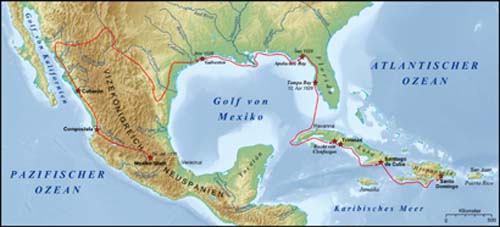 |
Journey
of Cabeza de Vaca from th island of Hispaniola to Mexico
Photo www.wikipedia.org |
Misfortune continued
to plague Narvaez when a severe tropical storm battered his ships
on the short voyage to Florida, but the expedition managed
to reach a safe harbor near present day Tampa Bay. There Narvaez’s
shortcomings as a leader were exposed when he decided, against the
advice of Cabeza de Vaca and others, to disembark the men and horses
upon the land and send the ships off on their own. How else was he
to find the gold he sought, Narvaez argued, or prime locations for
settlement, unless he conducted a search of the interior?
Narvaez’s plan called for the men to travel overland and eventually
rejoin the ships, which carried most of the expedition's supplies,
at a point further up the Gulf Coast. Of the nearly 300 men who disembarked
that fateful day in 1528 near Tampa Bay, only four would survive to
reach civilization some eight years and many thousands of miles later.
Hacking
their way through countless miles of tangled and treacherous jungle
terrain, the Spanish soldiers fought their way from one Native American
village to the next, each time expecting to find the gold they so
desperately sought. However, instead of riches, at every turn they
found primitive grass huts and war-like natives, their anger already
stirred against the Spanish by the cruelties of Ponce de Leon during
an earlier expedition in 1513. Constantly attacked and harassed by
hostile savages, and by now starving and desperate, the men finally
struggled back to the coast, but the ships were nowhere in sight.
Narvaez found himself trapped between the natives of the forest and
the waters of the Gulf with no choice except to reach Mexico by sea.
Lacking craftsmen with sufficient skill to build boats, he ordered
the men, who now numbered less than 300, to construct five large rafts.
However, even this task proved to be impossible without tools, so
the Spaniards were forced to improvise by smelting their armor and
many of their weapons into the axes and nails they required. The men
even used the shirts off their backs to fashion makeshift sails and
the hides of the horses, after they had been slaughtered and eaten,
to make containers for the water that would be required to keep them
alive during the long sea voyage. Five rafts were eventually constructed,
each overloaded with more than 50 men when Narvaez finally put to
sea.
Soon the luckless expedition ran out of provisions, and much worse,
lost their fresh water when the horsehide containers quickly rotted.
Unfortunately, some of the men resorted to drinking seawater which
sealed their fate. To make matters worse, strong offshore currents
kept the rafts from landing, and the crude vessels became separated
and tossed by an early November hurricane. Huge waves drowned many
of the men at sea, including Narvaez, but the storm eventually cast
the survivors of the expedition up on the shore of an island that
Cabeza de Vaca named the Isle of Misfortune. The location was
probably present day Galveston
Island, Texas, and the date was November 6, 1528. |
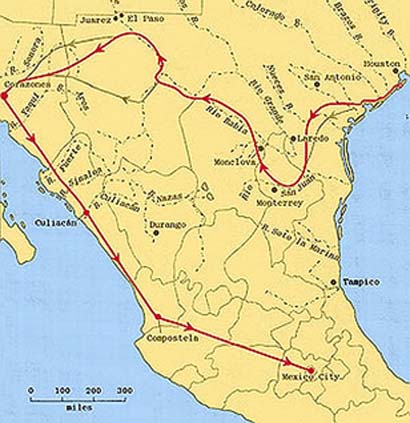 |
Journey of Cabeza
de Vaca in Texas and Mexico
Photo www.sagaofatexasranger.com
|
De
Vaca and the small band of survivors who washed ashore with him were
suffering from severe cold and hunger, and would have certainly perished
had they been left to their own devices. Fortunately, they were discovered
by a small hunting party of Native Texans, most likely Karankawa,
and taken to the natives’ camp where they were fed and treated kindly
until they recovered from their ordeal. After their recovery, the
survivors were enslaved and divided among the various groups of Karankawa.
For more than a year, Cabeza de Vaca lived on the Isle of Misfortune
as a lowly slave, forced to join the women in gathering underwater
roots from the shallow shoals that surrounded the island. From the
months of October through February, the roots served as the staple
diet of the Karankawa. De Vaca’s small primitive band then moved to
a place where they survived on oysters for a few months, and then
to a location where most of their diet consisted of blackberries.
There was also a time of the year when the Karankawa lived mainly
on the fruit of the prickly pear cactus. Not only was the diet monotonous,
de Vaca wrote in the narrative he was later to compose, but often
there was “not even enough of that to eat, and we would go hungry
for several days.”
After more than a year as a slave on the Isle of Misfortune, Cabeza
de Vaca escaped to the mainland. There he was also enslaved, but his
new situation was much improved because he was able to engage in trade
among the various tribes that lived throughout the south Texas
coastal area. As an outsider, he could even trade between tribes who
were bitter enemies and remained in a perpetual state of war. De Vaca
participated in this activity for five years, all the while working
to convince a few of his fellow survivors to escape and try and reach
New Spain.
During this period, the natives, thinking that De Vaca would be a
good faith healer because of his ability to speak an alien tongue,
encouraged the Spaniard to become a medicine man. When tending to
a sick native, De Vaca included rituals he was able to recall from
the Catholic Church along with various medicinal herbs he had leaned
of in his travels. The natives he cured gave him generous gifts, but
more importantly, working as a medicine man, in addition to his activities
as a trader, provided De Vaca with more freedom to move among the
various bands and tribes, while he continued to speak with his fellow
castaways of his desire to escape.
Since each of the survivors was held by a different band, any escape
attempt necessarily had to coincide with one of the few times a year
when their captors assembled at the same place to gather food, such
as when the prickly pear cactus bore fruit. Plans were made, and when
the cactus fruit next ripened, four captives successfully made their
escape after six years of enslavement. In addition to De Vaca, the
escapees included Alonzo Del Castillo of Salamanca, Andres
Dorantes of Bejar, and Estevancio, an African Moorish slave.
The men were now free, but gaining their freedom was only the beginning
of a long and epic journey across the interior of Texas. |
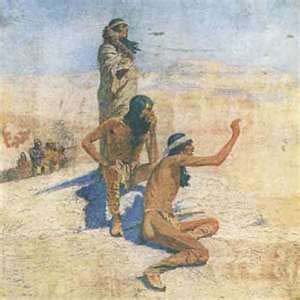 |
| Cabeza de Vaca
Painting by Frederic Remington |
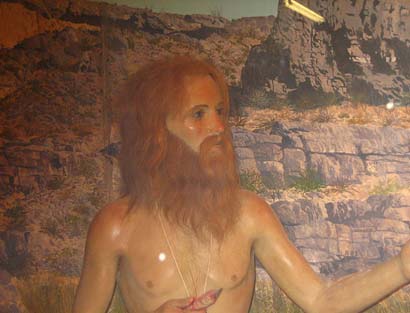
Sculpture of
thinly clad Cabeza de Vaca on display at Whitehead Memorial Museum
in Del Rio, Texas
Photo www.wikipedia.org |
|
Hoping
to reach the settlements of New Spain, the Spaniards wandered into
the desert-like lands of south Texas. The sparse terrain
held little but thorny brush and cactus, however their escape was
aided because the ripened fruit of the prickly pear was available
as a food supply. Native Texans, like the primitive Coahuiltecan,
also assisted the Spanish and welcomed them as honored guests because
their reputation as faith healers preceded them. When Cabeza de
Vaca successfully removed an arrow from a Coahuiltecan warrior’s
shoulder and sewed up the wound with deerskin gut, he became an
instant celebrity.
Upon reaching what is known as today as the Rio Grande River,
the Spaniards were told of a tribe far to the west called the Jumano
who dwelt in permanent adobe structures. They decided to set out
in search of them. As the Spaniards followed the course of the river
towards the setting sun, Cabeza de Vaca practiced his faith healing
among the native Texans he encountered along the way. The more he
practiced, the more his reputation grew. The inhabitants of each
new village became more generous than the last, giving up nearly
all they possessed to please this man they believed to be the recipient
of great spiritual power. Cabeza de Vaca, a man who had lived by
the sword, was slowly being transformed into a holy man.
Somewhere west of present day Big Bend, the Spaniards came
across the Jumano. They found these Native Texans to be the
most civilized tribe encountered to date; their apartment-like adobe
homes well constructed, and their farming practices and irrigation
techniques far beyond anything the Europeans had yet seen. The Jumano
also told the Spanish tales of great golden cities far to the north,
and of men on strange animals who attacked their villages and took
away many of the men and boys. Cabeza de Vaca was sure these men
were Spanish slave traders, so he and the others set out in search
of them.
Over the years much historical controversy has surrounded the precise
course the four castaways traveled on their journey to civilization,
and differences over route interpretations continue to this day.
Suffice it to say that the four struck a general course across southern
and far west Texas and northern Mexico, all the while
healing and introducing the Native Americans to Christianity until
they had a large following who regarded them as “children of the
sun,” endowed with the power to both heal and destroy.
The weary castaways finally emerged from the wilderness in what
is now the northwestern Mexican state of Sinaloa at the settlement
of Cuiliacan, arriving in early 1536. After a brief period
of recovery, the Spaniards traveled to Guadalajara and from
there to Mexico City where they met with Viceroy Mendoza
and related the tales told to them by the Jumano of fabulously rich
cities far to the north; tales that would eventually led to Francisco
Coronado's search for the fabled Seven Cities of Gold. In 1537,
De Vaca sailed back to Spain seeking a commission from King Carlos
to succeed Panfilo Narvaez as Governor, but unfortunately, the king
had already appointed Hernando de Soto to the post.
|
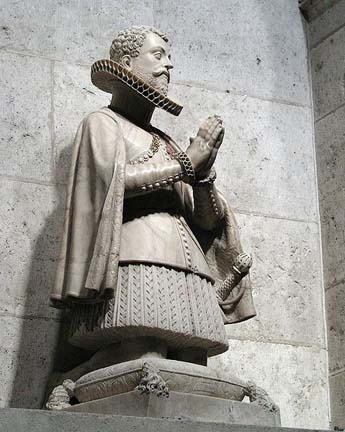 |
Statue of Cabeza
de Vaca
Photo www.wikipedia.org |
Years later,
Cabeza De Vaca addressed an official report of his journey to King
Carlos. The narrative was first published in 1553 under the title
La Relacion. However, most people are more familiar with a
1555 edition of the report that is better organized and divided into
chapters to assist the reader in comprehending De Vaca's somewhat
rambling and confusing narrative. Though La Relacion was written
long after the fact, and is therefore lacking in the precise details
historians would prefer, the narrative of Cabeza de Vaca's experiences
in the New World remains the most valuable source of information we
possess today on the various Native American tribes, landforms, plants,
and animals of early Texas.
© Jeffery
Robenalt
"A Glimpse of Texas Past"
May
1, 2011 Column
jeffrobenalt@yahoo.com
About Jeffery Robenalt
|
|
|
 HOME
HOME