|
April
20, 1881-The Day After
The
little girl tightly held her mother’s hand. They quietly walked the
short distance to the main dirt road that traversed the small community
of Leakey,
Texas. Many people were already gathered. They spoke in hushed
tones this mid April day. There was a light mist falling, just enough
to settle the dust on the road.
The little girl could feel her mother’s hand begin to tremble as the
soft sound of the horse’s hooves could be heard in the distance. The
horses were unaware of their part in this sad but memorable event
as the pulled the wagon to the small settlement. As the wagon bringing
the dead approached, the sound made by the hitched horses pulling
against the hames and harnesses grew louder. The combination of sounds
played a mournful funeral dirge. A dirge the little girl would never
forget. She could sense that it was a sad and scary occasion as she
peeked around her mother’s skirt to get her first glimpse of the wagon
as it drew closer.
It was not a welcoming event for the people of the community. It was
a tragedy that would live in the pages of history for the years to
come. They lined the road on both sides. Women cried softly, while
most of the men coughed and cleared their throats attempting to stifle
their feelings. A few of the men allowed their tears to roll unchecked
down their cheeks. The young children were mostly confused but sensed
their parent’s protection getting stronger.
Everyone had taken for granted that the Indian Wars were over. There
had been no reports of Indian raids of late and because of this many
folks had let down their guard. But yesterday’s attack had brought
everything back to reality. The Frio Canyon was still a place to live
with caution. The creaking wagon proved it. |
April
18, 1881 and the Time Before
The McLaurin Family
The
story of the McLaurins stretches back to the moors of Scotland. Duncan
McLaurin was one of the first to set foot on the soil of America.
He arrived with his wife and eleven children around 1788. They were
mainly farmers. Their lives were devastated after the Civil War so
they salvaged what remained and like many others moved west. The move
brought them to Texas. The many trails to Texas were lined with the
graves of families and friends of these early settlers. Upon arriving
in Texas the settlers realized that they had to make do with the barest
of necessities. They also became acquainted with the Comanche and
Apache. In many instances the acquaintance was not a friendly one.
The settlers felt that the land was theirs for the taking and the
Indians felt that the land was theirs to keep and defend. A bad mix
for both.
The elder John McLaurin, Sr. and his family made their way to the
Frio Canyon in 1872. They built a native limestone rock house with
24 inch thick walls on Flat Creek. The house is standing today.
John McLaurin, Jr. was not satisfied with the original location of
the homestead south of Leakey
so he made the decision to move his family north of the small settlement.
The conflicts with the Comanche and Apache had been few and he felt
that the move north would be a safe one. So he packed up his wife,
Catherine (Kate) and their children: Mary Sytarys, Maude Lee, John
Alonzo and William Franklin and settled on land about six miles north
of Leakey.
The place that he chose was a fertile piece of land that was nestled
between two towering bluffs with the cool, serene West Fork of the
Frio River flowing nearby. The location today is still beautiful,
yet haunting.
Not only was this place the new home to the McLaurin family but fourteen
year old Allen Lease made his home there as well. Allen was an orphan
who was living in a large combined family. Times were hard for everyone
especially Allen’s family and in order to make things easier at home
Allen moved with the McLaurin’s to help with their new homestead.
After all, fourteen year old boys were expected to do a man’s work
in this day and time.
The land between the crude log cabin and the river was ideal for Kate’s
garden. The cabin was probably just large enough for the family. So
with a few free ranging chickens, hogs, milk cow, garden produce and
the abundance of wild game the families needs were adequately met.
|
The
Lease Family
Not
only was this place the new home to the McLaurin family but fourteen
year old Allen Lease made his home there as well. Allen was an orphan
who was living in a large combined family. Times were hard for everyone
especially Allen’s family and in order to make things easier at home
Allen moved with the McLaurin’s to help with their new homestead.
After all, fourteen year old boys were expected to do a man’s work
in this day and time.
The ancestors of Allen Lease were not unaccustomed to hardship. Allen’s
father, William Barney, migrated from Virginia to Texas at a time
when these treks were long and dangerous. William Barney Lease was
married, in Uvalde, Texas to Catherine McCarthy. Catherine had been
widowed twice. She brought to the marriage four children. Catherine
and William Barney Lease had three boys, Thomas Mack, Allen and William
Henry. Catherine met with a tragic accident shortly after the birth
of William Henry. She fell, hitting her head. Head injuries resulting
from the fall would be the cause of her death a few days later.
William Barney, now the father and guardian of seven children, married
Sarah Fulgham. Sarah was a widow which children of her own. It was
a matter of convenience for both. Sarah’s first husband was hung as
a northern sympathizer at the beginning of the Civil War. This was
a hard time in a hard country for this desperate family.
William Barney Lease was employed by John Leakey in the shingle making
business. Lease would haul the shingles south to Sabinal
and Ft. Inge where he would deliver the load of shingles and return
to Leakey
with the payment in gold. It was on his trip home from one of these
deliveries that he was ambushed, murdered and robbed of the gold.
Allen’s step mother was once again left destitute. She moved in with
her son Tom Fulgham. Tom’s wife had recently died leaving him with
five children. Between the two blended families there were eleven
children.
So it is no wonder that Allen went to work for John McLaurin at his
new ranch north on Leakey.
Allen was fourteen or fifteen years old at the time and would be a
great help to the McLaurin family and one less mouth to feed at the
Fulgham home.
Perhaps
what happened that day in April of 1881 was just a robbery gone bad.
It is said that evidence showed that the Lipan Apache may have camped
on the bluff above the McLaurin home for a couple of days. Perhaps
they were waiting for an opportune time to just rob the house. Perhaps
they just wanted to see inside the strange home of a white settler.
Then again, perhaps they were seeking revenge and had decided to take
advantage of an unprotected situation.
The small band of Lipan Apache probably watched John McLaurin as he
rode away for the overnight trip to the Cherry Valley Settlement.
They may have feared that John would soon be back because they then
decided to stay another night on the high bluff.
On the night of April the 18th the Whip-Poor-Wills sang their lonely
call to the sighing of the Cypress trees along the bank of the Frio.
The Katy Dids added their evening songs as Kate put her children down
for the night while high atop the bluff over looking the McLaurin
homestead a small campfire flickered and the stars began to send frescos
dancing across the bluff. Could this peaceful scene be a misleading
charade of the danger soon to come? |
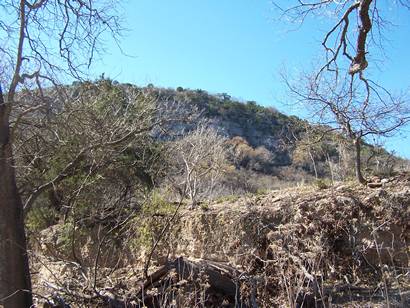 |
The McLaurin
Massacre Site
Photo courtesy Linda Kirkpatrick |
April
19, 1881-The Morning
It
was a crisp, cool morning as Kate McLaurin prepared breakfast for
the family. Allen Lease milked the cow and fed the hogs. The hogs
were fed a little corn, just enough to keep them around. After these
chores were finished, Kate and Allen hauled water from the river.
It was wash day and the pots had to be filled and the water heated
for the morning long chore.
Atop the high hill, the Lipan Apache watched each step that Kate and
Allen took.
It was about mid day when the wash was complete and the clothes were
scattered about on bushes and fences to dry. Kate gathered the children
and went to the garden. The garden was located close to the river,
making it convenient to carry water to irrigate the coveted vegetables.
Baby Frank was laid on a quilt pallet for his afternoon nap.
The eyes from atop the hill saw this as the opportune time to descend
the hill for a closer look at the cabin and it’s contents. Cautiously
they made their way to the cabin all the while Kate, Allen and the
children were working in the garden. No one knows the intentions of
the Lipan Apache. Had it been revenge they could have killed the family
at any time after John left the day before. Maybe they just wanted
to get food and plunder from the cabin. No one will ever know or understand
what would soon happen. |
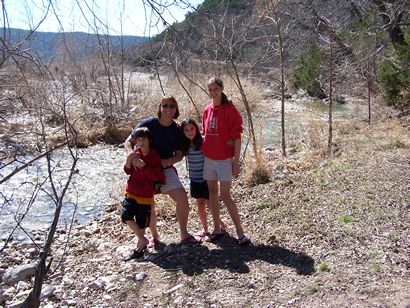
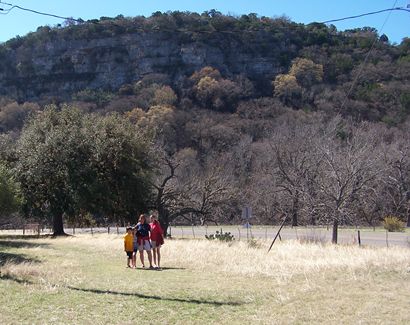 |
The McLaurin
Descendents at the massacre site
Photo courtesy Linda Kirkpatrick and the McLaurin Family |
April
19, 1881-The Afternoon
The
small group of Lipan Apache cautiously approached the cabin. It was
clear to them that everyone was at the garden and the cabin was empty
of danger as they entered the only door. It must have been an exciting
experience for them because in a short time they forgot about the
danger of being discovered and in the process of plundering the cabin
the noise that they made was heard at the garden not too far away.
Baby Frank woke from his nap and as Kate was tending to him she heard
an unfamiliar noise from the direction of the cabin. Immediately,
she figured that the pesky hogs had ventured into the yard and cabin.
She called to Allen to go take care of the situation. Allen trotted
to the cabin only to find that the noise they heard was made by several
Indians. In fear, he turned and yelled to Kate. As he started to run
back to the garden he was shot in the head by one of the Indians.
Allen lay dead on the ground in front of the cabin.
When Kate heard the shot, she screamed for Maude and Alonzo to run.
Kate was picking up the baby when the well aimed shot from one of
the Lipan met it’s mark. She was then shot again as she attempted
to run. Maude and Alonzo escaped the confines of the garden fence
and as Maude turned back she saw her wounded mother struggling to
get over the fence with the baby. Maude, who was only six years old,
ran back and took the baby from her mother. By this time, Kate had
been shot five times but with the help of Maude she managed to get
over the fence.
Kate collapsed on the other side of the fence. Maude and Alonzo were
petrified and Baby Frank was sobbing as his dying, bleeding mother
tried desperately to comfort him. Kate knew that this was a desperate
situation and the only person that she had to rely on was six year
old Maude. The oldest child, Mary was boarding at the community so
that she could attend school. Kate called Maude to her and told her
that she was going to have to go for help. Maude stood and brushed
a wisp of her hair from her eyes as looked south towards help and
safety. Then she looked at her mother, turned west and headed straight
for the cabin. The Lipans were shocked to see this young girl coming
straight towards them. It is possible they might have considered eliminating
her life, or to take her as a captive or maybe they just respected
her bravery. For whatever reason, they did not harm her. They stood
in awe as Maude ran by them and took a pillow from a bed. Maude again
ran by the Indians and back to the garden to her dying mother. She
placed the pillow under her mother’s head in hopes that the pillow
would help ease her mother’s pain.
Everyone still wonders about the compassion shown to the young McLaurin
children. Some even say that a young Indian woman in the group may
have been the determining factor in the lives of the children being
spared. This is just another mystery that will never be solved.
Kate knew her life was fading but she was somewhat comforted by Maude’s
act of courage. She again instructed Maude to run to the home of the
Fisher’s for help. At this point, brave Maude bid her mother farewell
and ran south. She located Mr. Fisher at his favorite fishing hole.
Maude told him that her mom had been shot by Indians and that she
needed help. Mrs. Fisher was also fishing a short distance away and
the three proceeded to the Fisher cabin for a rifle. They knew that
more help was needed so they traveled south towards the Leakey
settlement about six miles away.
The first stop that they made was the homestead of Jim Hicks. They
then picked up Henry Wall and Mrs. Goodman. The next stop was the
home of Dave Thompson. It was here that they left the two women and
Maude. The men kept moving south, gathering a posse.
Meanwhile back at the McLaurin cabin, the Indians felt at ease because
the two main elements of danger lay dead or dying. They finished plundering
the cabin, taking items that were easy to carry. Then they mounted
their horses and headed for the safety of the mountains of Mexico.
John
McLaurin had an uneasy feeling as he rode away from his family the
day before. Some say that he had a premonition, one that was not good.
He was heading home, riding hard in hopes of getting to his family
before the sun set.
As John McLaurin left Leakey heading north he came upon John Leakey,
who delivered the sad news. John Leakey assured him that Maude was
safe at the Thompson home. The women at the Thompson comforted Maude.
The story of the day’s tragic event was told to the women in the voice
of a little six year old girl. They listened intently to this first
hand account of this historical event.
As the sun was beginning to slowly set in the west, the men of Leakey
rode hard to the McLaurin ranch. They arrived to find Kate dying on
the banks of the Frio River. In spite of the five gunshot wounds,
Kate clung to life out of concern for the safety of her children.
John comforted her as best he could but after a few sips of water,
Kate drew her final breath.
As darkness cloaked the tragic site, the men decided to wait until
morning to take the bodies of Kate McLaurin and Allen Lease to Leakey
for burial. The bodies were wrapped in quilts pieced by the hands
of Kate McLaurin and laid in the bed of the wagon. |
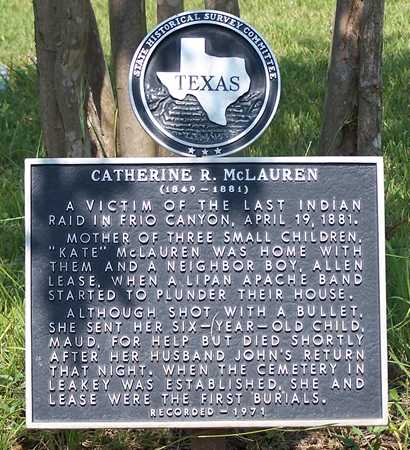 |
Catherine McLauren
Headstone
Photo courtesy Linda Kirkpatrick |
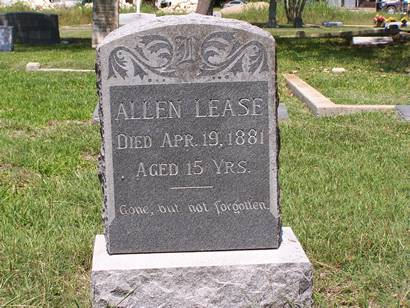
Allen Lease Headstone
Photo courtesy Linda Kirkpatrick |
April
20, The Day After
Early the next morning the wagon, with its cargo, made its way to
Leakey where Kate McLaurin and Allen Lease would be the first bodies
laid to rest in the Leakey Floral Cemetery. It was about mid-morning
when the wagon reached the community. The street was lined with people,
all with sad solemn faces. The silence was deafening except for the
slow plod of the horses and the rhythmic sound of the hames and harnesses.
No one seemed to move, except for a little girl who peeked around
from behind her mother’s skirt to view history as it passed. |
The McLaurin
Descendents
Photo courtesy Linda Kirkpatrick and the McLaurin Family |
More
information on events after the burial of Kate and Allen and the trek
into Mexico to find the band of Lipan Apache can be found in the story,
“Teresita.”
Bibliography
Printed Material
A.J. Sowell, “Early Settlers and Indian Fighters of Southwest Texas”
Alan Stovall, “Breaks of the Balcones”
Alan Stovall, “Upper Nueces Headwater Country”
George Nelson, “The Lipan-Apache”
John Leakey, “The West that Was”
Henderson, Margaret McLaurin, “Tragedy at the McLaurin Ranch”
Oral Stories
Miss Sallye Godbold, The McLaurin Family, Lora B. Garrison, George
Nelson |
|
|
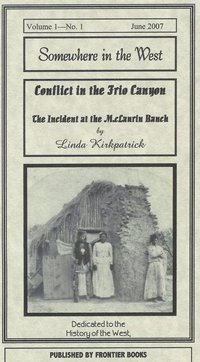
The
Chapbook:
The story of the Last Indian Raid in the Frio Canyon and possibly
the entire state of Texas.
Price - $7.00 includes S&H
Send order to:
Linda Kirkpatrick
P.O. Box 128
Leakey, Texas 78873 |
|
|
 HOME
HOME