|
|
|
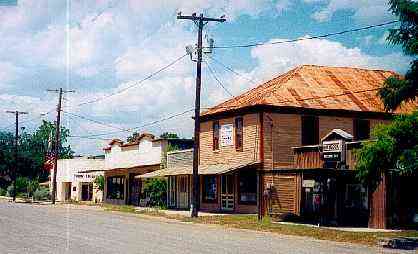
A
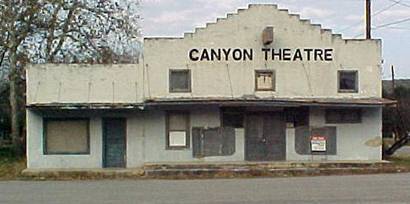
street on the courthouse square
TE photo |
History
in a Pecan Shell
The abundant water of the area drew many Indian tribes
and the entire area was one of the last strongholds of Lipan Apaches
and Comanches who were not happy about being displaced.
After the arrival of the first Anglo-settlers the first industry established
was the same as Bandera,
Kerrville
and other riverfront towns - shingle manufacturing.
Shingle production and lumbering of the abundant Cypress trees was
the major economic force until ranching and the raising of Angora
goats replaced those activities. Tourism increased as roads improved.
A timeline
of significant events in Leakey
1856:
John and Nancy Leakey with a handfull of others settled near the site
at springs that were to be named Leakey Springs.
1883: The post office from the town of Floral moved to the
settlement and opened in the Leakey store
1884: Leakey became county seat of Edwards County and remained
until 1891 when it moved to Rocksprings.
1904: The population was just over 300 persons
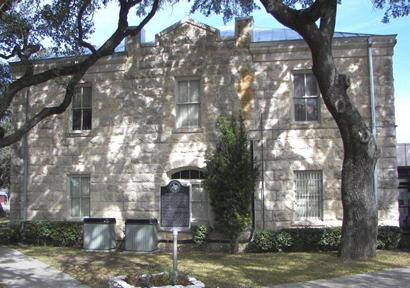
1913: Real County was organized and Leakey became the county
seat. See Real County
Courthouse
1926: The population was only 150 people
1951: Leakey gets around to incorporating
1956: Leakey's population reaches its zenith of 762 people.
|
 |
|
|
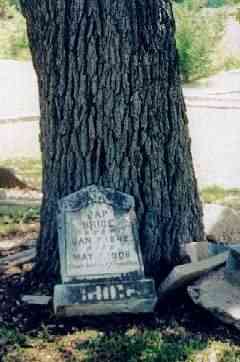
Leaky
Cemetery
FM 337 as you enter Leakey from the East.
It contains the graves of the town founders.
It is perhaps a little ironic that the first interments in the cemetery
were the last to be killed by Indians (in Real County). |
| Photo
courtesy Linda Kirkpatrick |
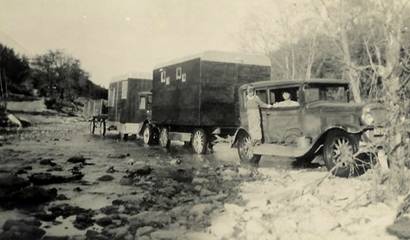
Fording a low-water
crossing in 1936
Vintage photo courtesy Lloyd & Jackie Shultz |
| Photo
courtesy Linda Kirkpatrick |
Leakey Texas
Forum
Leakey founders
I am one of many Leakeys in the UK, and stumbled upon your history
of Leakey in Real County, Texas. I was interested to read that the
founders, John and Nancy Leakey are interred in the Leakey
cemetery and were the last to be killed by Red Indians in Real
County. I wondered if you know anything about the origins of the
founders. Do you know where they came from and can you direct me
to any websites to help? - Chris Leakey, June 03, 2004
|
| Texas
Escapes, in its purpose to preserve historic, endangered and vanishing
Texas, asks that anyone wishing to share their local history, stories,
landmarks and recent or vintage photos, please contact
us. |
|
|
 HOME
HOME

 Texas
Gulf Coast
Texas
Gulf Coast East
Texas
East
Texas Central
Texas North
Central
Texas North Central
Texas South
Central
Texas South Texas
Panhandle
Texas
Panhandle South
Texas
South
Texas Texas
Hill Country
Texas
Hill Country West
Texas
West
Texas Texas
Ghost Towns
Texas
Ghost Towns Texas
Counties
Texas
Counties