|
The
Frio Canyon suffered hard times in the late 1800’s. Lipan Apache still
made soirees through the area, money was scarce, and times were just
plain tuff. The folks, who built up the early ranches in the Leakey
area, did what they could to just get by. They were hardy individuals
who suffered many hardships that would seem impossible to bear in
these days. They “made do” with what little they had and when opportunities
came along they jumped on the chance to take advantage of each situation.
Like the cattle drives of old but just not as classy or as romantic
or as written about were the hog drives of the Frio Canyon. And with
that thought, imagine an old, night-herding, hog driving cowboy singing,
“Get along little piggy, get along, get along.”
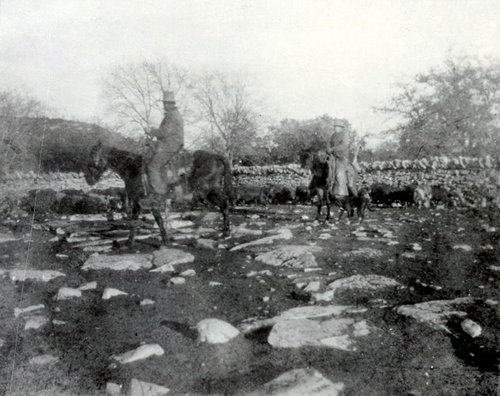
The blood lines on these hogs proved to be as interesting as the hogs
themselves. Most were a cross between domestic “listed” hogs, better
knows as “Hampshire”, and the imported European’s, commonly called
Russian hogs. The settlers ran their animals on open range and as
a result many of the hogs just went feral. Round-up time was very
interesting to say the least! |
 |
Hog Drives at
Rock Pens
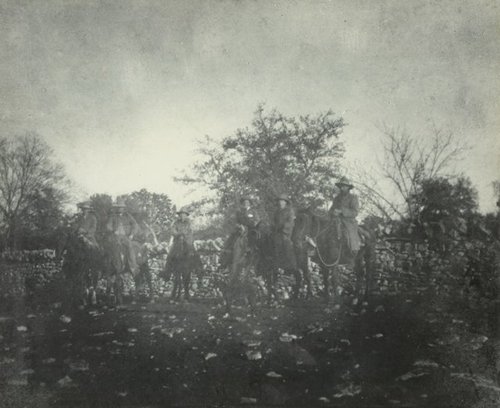
Bud Huffmon, Fred Large, Jared Huffmon, Jeff Thompson, Alex Auld,
John Auld |
Alexander
(Alec) Auld, an early rancher in the area known as the Divide, became
the entrepreneur of these hog drives. He furnished the holding pens.
The pens were actually large pastures where the surrounding ranchers
would bring their hogs until enough were gathered for the drive to
the rail head in either Kerrville
or Sabinal.
The pastures, known as the East Pasture and the Maverick Camp, supplied
an abundance of oaks that in the fall became laden with acorns. These
acorns supplied the main food source necessary to keep the pigs fat
and sassy.
The composition of the hog drives was much like that of the cattle
drives of old. Each rancher would spend several weeks gathering their
hogs. They drove these hogs to Maverick Camp and East Pasture. Then
they gave the drover the number of head that they put in the pens.
The drover recorded the total number of rancher’s hogs and then released
them into the holding pen with the rest to await the drive to Kerrville.
At the end of the drive the rancher collected money for the number
of hogs that he released into the holding pasture. The hogs would
feed on the acorns and continue to fatten until the drovers had enough
gathered and were ready to hit the trail for the rail road some sixty-five
miles away. “Enough” would equal several thousand hogs. Jake Haby,
a descendent of one of the drovers, said, “As the story goes… when
they hit the trail with the pigs you could see hogs from one horizon
to the other.” Now that folks, is a lot of little porkers. |
 |
Group of men
standing
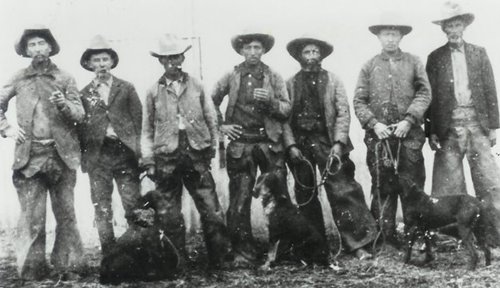
L to R: Walter Large, Luke Large, Drew Large, Jeff Thompson, Callie
Bell, Fred Large, Holmes Ferguson and their favorite hog dogs.
|
Alec
Auld and about ten to fifteen other men made up the drovers. Some
of the names included: William Putum, Whittum Holmes, Fred Large,
Walter Large, Luke Large, Drew Large, Jeff Thompson, Dave Huffmon,
Pete Lowrance, Bud Lowrance, Callie Bell and Holmes Ferguson. Along
with the drovers there would be a chuck wagon and a couple of corn
wagons. And we must not leave out the dogs as they played an important
roll in moving the pigs along.
As the gate opened on an early fall morning, the number of pigs released
could total from one to two thousand head of fat pigs. Keep in mind
these were wild hogs, hogs with a very aggressive attitude. It took
a tuff drover, with a tuff horse and with extra tuff dogs to get the
herd over the sixty five miles of rough terrain. |
| Alex Auld, Fred
Large and favorite dog...Rat |
One
drover owned about ten to fifteen hog dogs. These dogs were probably
hound crosses. The dogs would intimidate the hogs until the hogs would
relent. The hog dogs had to be quick, agile and fearless. I am quite
sure that several dogs probably lost their lives trying to control
these aggressive pigs. The hogs, when on the fight, would attack man,
horse or dog. As the ranchers came upon these wild hogs during the
year they would rope, castrate or spay them in order to control the
population and make them easier to fatten and drive later. Most of
the ranchers would rope the hogs but not Alec Auld. He would run into
the herd on foot, grab a hog by the hind leg and take it to the ground.
Other ranchers kept telling him that one day one of the hogs would
get him and sure enough one day David Huffman came upon Alec sewing
up his arm with a spaying needle. As Alec grabbed for a hind leg the
hog turned and a well aimed tusk ripped a gash in his arm.
Besides good dogs, each drover had to have a pair of durable leggins’.
The leather had to be extra heavy duty, strong enough to resist the
bite or slash of a nasty boar. The leggins’, as we call them in this
part of the world-you may correctly call them chaps, needed to have
a special alteration. Most leggins’ are buckled in the front with
a belt like piece of leather. The smart cowboy removes the buckle
and replaces it with a heavy string, one that would break should a
bucking horse cause the top of the leggins’ to hang up on the saddle
horn. Keep this thought in mind for a future story. |
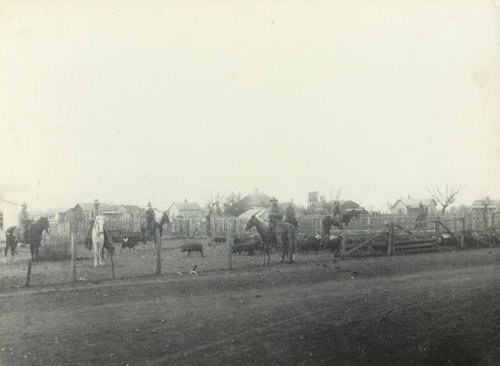 |
Hog drive to
Sabinal. The town in the background was identified to me as Sabinal,
Texas
L to R: Drew Large, Holmes Ferguson, Fred Large, Alex Auld, unidentified
drover, Callie Bell, unidentified drover |
When
enough hogs were gathered, it was then time to hit the trail. A few
gentle hogs mingled with the wild hogs in hopes to keep the herd going
in the direction of the rail head in either Kerrville
or Sabinal.
The corn wagon, loaded with corn, would lead the hogs. Someone would
ride in the back of the wagon and entice the gentle hogs by throwing
corn out to them. The gentle hogs would chase after the corn and the
rest of the hogs would, for the most part, follow. The wilder hogs
would soon get the idea and before long they were, as in the days
of cattle drives, trail broke! And for those hogs that just refused
to conform, the drovers had a little trick for them. A drover would
rope the obnoxious beast. The pig was then enticed to bite a cedar
stave and when he did the drover quickly wrapped leather straps around
his snout in order to keep the pig from biting and gnashing the dogs
and drovers. For some, it became more severe. Before their release,
their eyelids were sewn shut so that they could not see to attack
or escape. They would follow the rest of the herd by scent alone.
The journey to the rail road could take up to three weeks. Some of
the drovers rode horses while others would walk along behind the herd
prodding and yelling to keep them on the move. The dogs constantly
barked and nipped at the heels of the pigs that lagged behind. This
is truly not as romantic as the cattle drives of old.
The ranchers found the hog business to be quite lucrative it was actually
more lucrative than anything else that they did. They could make three
to five cents a pound for the critters. All good things usually come
to and end and so did the hog drives. The weevil that hit the acorn
crops proved to be the demise of this business. This weevil would
burrow into the acorns and eat the meat. The wild hog market soon
fell by the wayside. But since these little porkers can produce three
litters a year, they began to replace the acorns with rancher’s sheep,
goats. To this day, they can literally wreck havoc every where they
go.
Hunting hogs soon became a popular sport which continues today. Sport
hunters do it for the thrill of the hunt, ranchers do it out of necessity.
The January column will feature stories of the hog hunters.
Trilogy: Hog Drives of the Frio Canyon
Part I "Git Along Little Piggy"
Part II “This Little Piggy
Stayed Home”
Part III “Here a Pig, There a
Pig” |
|
|
 HOME
HOME