|
The Streets
of Reynosa
A WALK DOWN
PINATA ROW
by John
Troesser
April 14, 2006
|
 |
"As I walked
out in the streets of Reynosa,
as I walked out in Reynosa
one day,
I stumbled down into an uncovered manhole;
but that's what you get when you walk like a Jay."
Who can forget those timeless lyrics? My tattered, bullet-riddled
Sidekick's Songbook says that it was Trad Ballad that wrote
it. Trad, a prolific songwriter if ever there was one, seems to have
written just about everything from Greensleeves to Frankie
and Johnnie. Last week, when I found myself walking down those
(semi) legendary streets, I decided to take notes and a few snapshots
to share with my friends at Texas Escapes.
|
| First
time visitors to Mexico
should be warned that Mexico
(as a developing country) is a work in progress. It is in a perpetual
state of construction. While half of the country appears to be freshly-painted,
the other half is usually in need of a new coat of paint. This imbalance
is corrected every six years when national elections are held and
every flat, upright surface in Mexico
is covered in bright red, white and green paint. |
No Hay Dos
Mexico
is many things - but one thing it is not is a "nanny-state." The government
doesn't see the need to spend a lot of money on barricades and warnings.
Fancy-schmancy signs for live electrical wires, open trenches or washed-out
bridges simply aren't needed. Mexicans are firm believers in the dictum
of "what doesn't kill you makes you stronger" and to first-timers,
it may seem as if there's a program in place to "strengthen"
as many people in as short a period of time as possible.
Like most visitors, I crossed into Reynosa
from Hidalgo, Texas.*
Soon after clearing the bridge and being ignored by the Mexican customs
guards, I immediately encountered construction. The main street leading
to the town square was being repaved with a snazzy faux-flagstone
surface and although it was nearly finished, electrical wires for
underground utilities and (what appeared to be sharpened) rebar jutted
menacingly from the curb. I considered taking a detour, but remembering
Yogi Berra's sage advice about the fork in the road - I took it. |
Eat My Species!
As
I headed uphill to downtown, I was pleased to see one of my favorite
Chinese restaurants still in business. I'm sure the old typewritten
menu that proudly offered "shrimp with mobster sauce" was
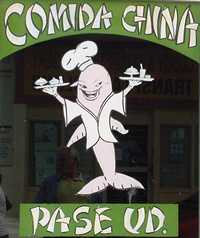
gone. The door still had its aging sign from the "eat my species"
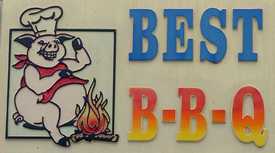
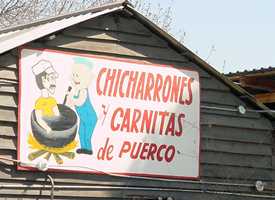
school of signage. You're probably familiar with these signs. They're
the ones where cows proffer you burgers, pigs smile while barbecuing
their offspring and chickens gleefully serve their dismembered kin
with a side order of slaw. In this particular case a fish of Asian
ancestry offers some diced and stir-fried relatives. |
| On
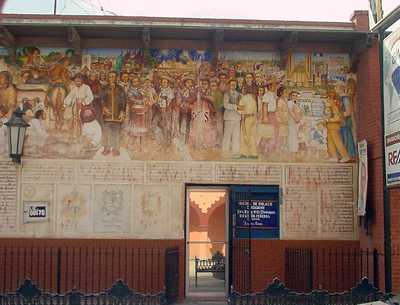
the next block I found another old friend - an elaborate and detailed
Rivera-esque mural. It may be the only historical mural along the
border and it's a nice one, even though it's showing signs of age.
The height of the building across the street has allowed the morning
sun to lighten the bottom third of the painting, but the upper two
thirds are fine. On the far right side of the mural a Mexican family
and an American family cross paths at the border. |
The Rivera-esque
Mural at the wrong time of day
TE photo, March 2006 |
This
part of Reynosa
(on the east side of the town square) is made up of restaurants, drugstores
and nightclubs. The once-numerous liquor stores have have melted away
to just a few. Businesses on the west side of the square are mainly
corner groceries, beauty salons, doctor's offices and residences.
These eventually give way to tire repair businesses, body shops and
pinata factories.
I passed the square (as busy as ever) and started downhill toward
my destination. The streets were blocked with water-delivery trucks,
telephone repair trucks and street repair vehicles. Like the situation
with paint - half of Mexico seems to be undergoing repair while the
other half is awaiting it. Sidewalks were split and cracked or missing
altogether. "When in Mexico, do like the Mexicans." So I started walking
in the street. |
An apprehensive
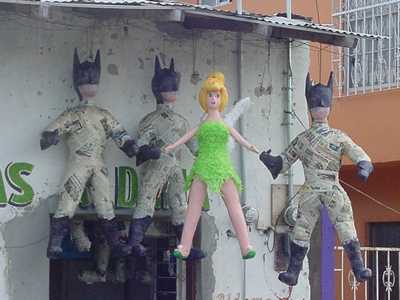
Tinkerbell hopes to be bought before the Batmen are finished.
TE photo, March 2006 |
Pinata City
Soon
I started having the eerie and uneasy feeling that I was being watched.
I could feel scores of eyes following me down the street. It was a
little like the Twilight Zone episode where mannequins got
to spend one day a year among the living - but here it was the eyes
of pinatas that were upon me.
Tip: The best quality pinatas are recognized by their ability to follow
you around the room (or down the street) with their eyes. |
"I was young
and I needed the money."
If
you still think of pinatas as little donkeys - you're showing your
age. The last donkey pinata rolled off the assembly line in 1963.
The government promised to retrain the laid-off workers to work on
more modern models, but the old pinata-dogs were too set in their
ways and hung up their paste pots. They just couldn't adjust to the
likes of Bart Simpson.
The new generation of Pinata makers now take their cues from popular
culture. Smurfs, Ninja Turtles, the stars of 101 Dalmatians and the
aforementioned Bart have all posed for pinatas.
If you've ever wanted to cudgel a Smurf, pummel Batman, or cuff around
Little Nemo (I would strongly suggest that you seek professional help),
but although Pinatas can be a way to release pent-up aggression,
most pinatas are still purchased for children. The papier-mâché
effigies can be made just about anywhere there is adequate space to
construct and hang them. The factories are usually found in the poorer
parts of cities - where rents are cheaper. |
|
|
Headline
hemlines
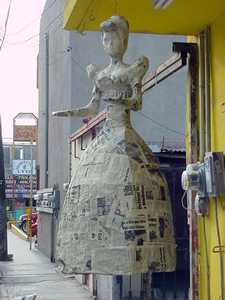
A wasp-waisted princess
TE photo, March 2006 |
|
"To Live
and Die in Tamaulipas"
Pinata
production is cyclical. Born full-sized, early in the week, they reach
maturity as the weekend approaches (and then die a violent death at
the hands of zealous children). Some pinatas escape this horrible
fate by being sent to small town groceries where they'll hang above
the produce section until they gather enough dust to be declared a
hazard by the health department. After the last sacrifices of Sunday,
the cycle starts all over again.
Armatures are twisted into shape on Monday and on Tuesday larval mermaids
and embryonic ninja turtles are covered with their first skin of obituaries
and comics. By Wednesday they are "hung out to dry" - awaiting their
crepe-paper finery. Half-dressed, they sometimes reveal their secrets
to the world. Before my visit I had no idea that Batman favored tabloid
underwear or that Cinderella's hemlines are actually headlines.
Candy, of course, is the objective of every pinata-bash. This is inserted
into the pinata after purchase. Special candy stores stock bulk candy
in a range of prices. Cheap candy for the neighborhood kids - and
perhaps more expensive foil-wrapped candy if your boss' kids are there.
There was a time when pinatas were sold with the candy already inside
- but old timers will tell you how "meltdowns" would result in the
candy settling into one appendage or another. When struck, the molten
caramel.... well, let's just say it wasn't a pretty picture. |
The Walk Resumes
As
I advanced deeper into Pinata Country, it seemed to me that just about
every other building had a group of swinging pinatas awaiting their
final touches. Evidently Cinderella has been re-released, so there
was an excess of princesses as well as legions of Batmen (but not
a single Robin). There were also a few less-popular personalities
- showing that even pinata artists can get burned out and need to
experiment. |
Dog Day Afternoons
Besides
the pinata population, the next largest group of street dwellers I
saw were Reynosa's
dogs. These poor animals are broken and bruised survivors - and many
of them limp and list from improperly-healed injuries. Having survived
their brief puppyhood on these (very) mean streets; they spend their
adulthood bravely defending their master's homes - staying up all
night every night. The next day is spent sleeping (with one
eye open for approaching cars).
While 98% of these dogs wouldn't bite a hot biscuit, once in a while
you will encounter a dangerous one. I'm not talking about Pit Bulls,
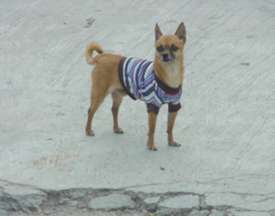
Doberman pinschers or Rottweilers. The most threatening dog I saw
on the streets of Reynosa
was this Pomeranian-Chihuahua hybrid. He was walking toward me down
the middle of the street - forcing other dogs, humans (including myself)
and at least one car onto the sidewalk. Until I encountered this bantam-weight
Cujo, I had never actually seen a dog swagger. Evidently his sweater
gives him elevated status over his unclothed brethren. It shows that
he has a human mother (no man would put a sweater on
a dog) and that means that he is loved. No one is going to challenge
him - knowing that his human "mother" is just seconds away.
To Be Continued...
*Hidalgo
had its fifteen minutes of fame back in the 1980s when it became the
American entry point for Africanized honey bees. The city of Hidalgo
extended their dubious honor by erecting an oversized, semi-comic
killer bee in their main park.
April 14, 2006 Column
Story and photos © John
Troesser
More Columns by John Troesser |
Forum:
I was about to embark on a quest to make a pinata, and did a Google
image search for some creative possibilities, somehow wound up in
the middle of your entertaining piece about Pinata Row. I’m kind of
a tough customer with a short attention span when it comes to reading
stuff on the InterWebs, but I thoroughly enjoyed your article and
your sense of humor. I’m from California, and to my knowledge, have
never been to Texas unless we crossed
the panhandle in
the early ‘50’s on our way from Manhattan, Kansas (where my dad was
going to veterinary school) to our family back in Central California.
I don’t remember those days, as I was a wee lad. My mother was a self-taught
historian, eventually working for the city of Thousand Oaks, Ca. in
that capacity in the 1980’s. She imbued in me the importance of saving
bits of history, recording events, taking pictures of old buildings
etc. Point being, I appreciate your mission, and salute you for doing
this work. If I’m ever in Tejas, I may come and visit. That’s unlikely,
I guess, but if a white-haired dude shows up at your door with a Batman
pinata under his arm...that’ll be me. Sincerely, David Allen, Thousand
Oaks, July 03, 2011 |
|
|
 HOME
HOME