|
HIDALGO, TEXAS
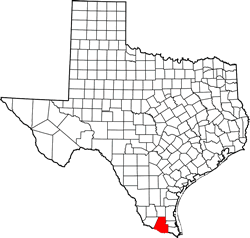
Hidalgo
County, South Texas
26°6'16"N 98°14'47"W (26.104473, -98.246443)
Across the Rio Grande from Reynosa,
Mexico
US 281, TX Hwy 336 and 115
8 Miles S of McAllen
the largest city in Hidalgo County
18 Miles S of Edinburg
the county seat
12 miles SW of Pharr
54 miles NW of Brownsville
ZIP code 78557
Area code 956
Population: 14,183 Est. (2019)
11,198 (2010) 7,322 (2000) 3,292 (1990)
Book
Hotel Here › Hidalgo
Hotels |
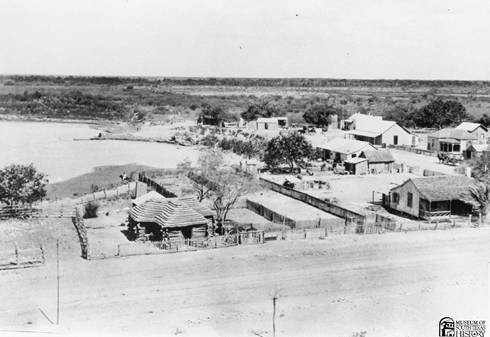
Old Hidalgo
Photo courtesy Museum of South Texas History |
History in
a Pecan Shell
Settlement dates
back to 1749 when what is now Hidalgo was known as La Habitación.
The community was also known as Rancho San Luis or San Luisito.
The town was renamed Edinburgh (with an H) when Scotsman John
Young invested in the community in 1852. Edinburgh became the county
seat - and in 1876 a post office opened under that name. Nine years
later Edinburgh changed its name to Hidalgo.
The county government shifted in 1908 when the courthouse and offices
moved to nearby Chapin, Texas. After County Judge Chapin was involved
in a trial, residents felt the need for another change of name. Chapin,
Texas became Edinburg
(without the H).
During the period of "border unrest" during the turmoil in Mexico,
U.S. troops were stationed at Hidalgo - it had also been home to a
contingent of Texas Rangers. By 1920, Hidalgo had a healthy population
of 250 residents.
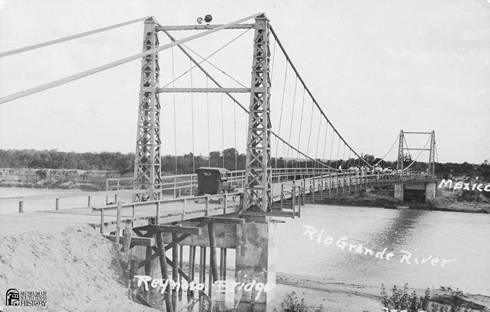
Flooding and erosion of the banks of the Rio Grande necessitated a
move to higher ground. A Hidalgo-Reynosa ferry had been in service
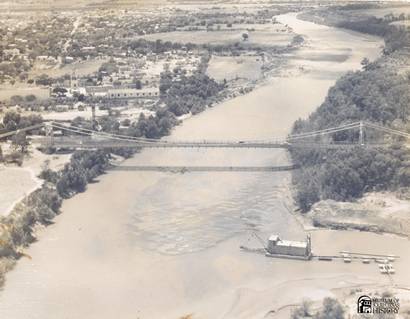
until the suspension bridge below was built in 1926.
By 1930 Hidalgo's population was over 600 and it incorporated in 1931.
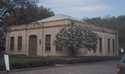
By 1940 most of the original town site had been obliterated by the
currents of the river - which explains the absence of a distinct downtown
or older buildings. At that time the town's population was nearing
700. |
Hidalgo, Texas
Landmarks & Topics
|
Aerial view of
Hidalgo, Rio Grande, Reynosa Bridge crossing into Mexico.
Photo courtesy Museum of South Texas History |
Hidalgo Reynosa
International Bridge
Photo courtesy Museum of South Texas History |
|
Photo courtesy Museum of South Texas History |
In comparison
with its Mexican neighbor, Reynosa,
Hidalgo remained small. From a population of 1,600 in 1980 it leapt
to 3,300 by 1990. New subdivisions provided housing and the town erected
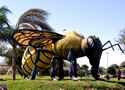
an oversized sculpture
of a bee in the city park; Hidalgo being the alleged entry point
into the U. S. for the dreaded "Killer Bees" that had been migrating
northward from Brazil.
The population of Hidalgo 11,198 in 2010.
Hidalgo
Hotels › Book Hotel Here |
Hidalgo, Texas
Chronicles
Rockets
Over The Rio or Waiting for Goddard By Phil Lately
The First International Rocket Mail in the Western Hemisphere
Rocket
Mail by Clay Coppedge
One sweltering summer afternoon in July of 1936, patrons of the
U.S. Bar in Reynosa, Mexico were nursing their beers and tequila,
hiding from the afternoon heat, when a rocket fired from the American
side of the Rio Grande River plowed into the bar under a sign that
read: "The Only Beer in Mexico." The patrons scattered, suspecting
maybe an earthquake, revolution or worse. Some may have sworn off
the hard stuff right then and there. But no one was injured....
more
|
| Texas
Escapes, in its purpose to preserve historic, endangered and vanishing
Texas, asks that anyone wishing to share their local history, stories,
landmarks and recent or vintage photos, please contact
us. |
|
|
 HOME
HOME