|
Hard-drinking,
crusty Judge
Roy Bean has gotten a lot of ink over the years, but he wasn’t
Texas’ only colorful justice of the peace.
The antics of the so-called Law West of the Pecos have always made
great copy for Western writers, but Norman Porter, Sr., a retired
school principal from South
Texas, has rescued another notable Lone Star jurist from obscurity
– Paul Desmuke.
Born April 25, 1876 in the community of Amphion
in Atascosa County,
Desmuke came into the world normal in every way except one – he had
no arms. With the help of a loving mother, he learned to compensate
for his lack of upper appendages by using his feet. Before long, he
could use his feet as adroitly as others used their hands.
As a school student, he wrote his lessons on a slate board just like
the other kids, only he used his toes. If called on to solve a math
problem on the chalkboard in front of the class, he stood on one foot
and raised his leg up to add and subtract with the other. His disability
also did not affect his voice. He led the choir at the Amphion Methodist
Church. Desmuke also learned to play a mean fiddle.
His handicap apparently did not affect his personality. With one of
his feet, he politely tipped his hat to the ladies or warmly shook
someone’s hand.
Despite his successful efforts to overcome his disability, Desmuke
had his limits. He obviously couldn’t use both of his feet at the
same time unless seated or reclining. But people like him with severe
disabilities almost always could count on landing a job with a circus,
becoming a sideshow freak.
But Desmuke’s mother, naturally wanting as normal a life as possible
for her son, believed the circus life would be demeaning for him.
She argued strongly and successfully against it and Desmuke honored
her wishes. He got by as best he could until, at the age of 26, he
got a break.
When the incumbent Atascosa County Precinct Three justice of the peace
resigned from office in May 1902, Desmuke gained appointment as his
replacement. From all accounts, the young JP served his constituents
well, handling a variety of statutory duties ranging from accepting
criminal complaints to pronouncing people dead and ruling on their
cause of death to performing marriages. |
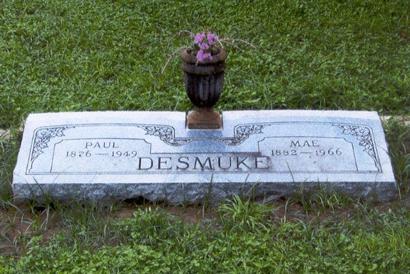 |
Paul and Mae
Desmuke Gravesite at Jourdanton City Cemetery
Photo courtesy Terry
Jeanson, July 2007 |
Still, a yearning
for adventure or money – or both – eventually led him to sign on with
the A. G. Barnes Circus and Sideshow. Somewhere along the way, he
learned to throw knives with his feet and developed an act around
that. He went on to be part of the 400-plus entourage with Zack Miller’s
101 Ranch Wild West show.
The armless judge from South
Texas also played an armless man in a silent movie called “The
Sideshow” (1926) and got paid as a stunt double for Lon Cheney in
“The Unknown” a year later.
After the wild west show went bankrupt at the height of the Great
Depression, Desmuke got a gig at the Century of Progress Expo in Chicago
in 1933-34 with Ripley’s Believe It or Not! Odditorium. In that show,
Desmuke would send 10 butcher knives swooshing toward a human volunteer,
each blade twanging into a backboard within an inch of the living
target. Demonstrating the power of trust in a marriage, the target
was his wife, Mae Dixon.
By the early 1940s, Desmuke had come home to Atascosa
County. Porter, then a youngster living in Jourdanton,
saw Judge Desmuke (as he was known locally) walk into the Post Office
and do something he considered quite routine but which Porter considered
extraordinary.
“He slipped his shoe off, with his toes protruding through the end
of his ‘prepared’ sock, lifted his foot almost head high, turned the
combination with his toes, and opened the box,” Porter wrote in a
short article published by the Atascosa Writer’s Guild. “Sticking
his long toes into the box, he retrieved his mail, stuck it in his
pocket and closed the box. He slipped his shoe back on and walked
out the door.”
In addition to everything else he could do with his feet, Desmuke
could play a spirited game of dominos.
The armless former judge and sideshow star spent the rest of his life
in his native Atascosa
County. He died June 19, 1949 and is buried in the Jourdanton
City Cemetery.
© Mike Cox
"Texas Tales" June
7, 2007 column |
| Books
by Mike Cox - Order Here |
|
|
 HOME
HOME


