|
|
To
all but his political enemies, the government of Mexico and a few
soreheads, the 44-year-old Tennessee transplant stood tall both literally
and figuratively as Texas’ greatest living hero. That spring, lacking
numerical superiority but not grit, he had defeated Gen. Antonio Lopez
de Santa Anna at San
Jacinto and now served as the first elected president of the fledgling
nation he had helped create.
But Sam Houston was yet a mortal with his share of human foibles,
including overindulgence in distilled spirits. And, well, he buckled
and unbuckled his belt just like any other man. When nature called,
he and other officials of the new Republic of Texas repaired to the
nearest privy, a facility more commonly known today as an outhouse.
At intervals as regular as the president happened to be, while living
in what is now West
Columbia during the fall and early winter of 1836 Houston responded
to urges that had nothing to do with nation-building. Taking a break
from the affairs of state, he sat in a small, smelly wooden enclosure
built over a hole dug in the rich Brazoria County soil and made it
all the richer. Given his propensity to drink, it is quite plausible
that while so engaged, he drew one last swig on a bottle and dropped
it down the hole, an old soldier unceremoniously laying a “dead soldier”
to rest.
While the name of its former owner will never been known, 171 years
later an archeologist uncovered from an old privy pit near what once
had been the seat of government of the Republic of Texas, one intact
blown-glass bottle that dates from the mid-1830s along with several
pieces of glass from the same era.
“Who knows?” laughs Austin archeologist Doug Boyd, “that bottle could
have been left there by Sam Houston.”
Boyd is vice president of Prewitt and Associates, an archeological
consulting firm that surveyed the presumed location in West
Columbia of a structure long referred to as the first capitol
of the Texas republic. In truth, the building constituted only half
of the capitol, and there’s no way to prove scientifically that Houston
discarded that bottle, but it is incontrovertible that Houston took
his oath of office on the site. |
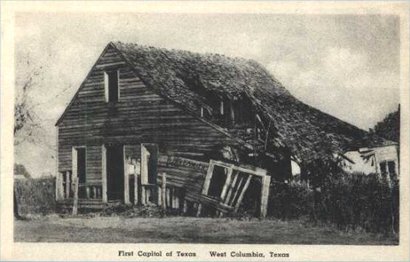 |
First Capitol
of Texas, West
Columbia
Postcard c1927, courtesy rootsweb.com/ %7Etxpstcrd/ |
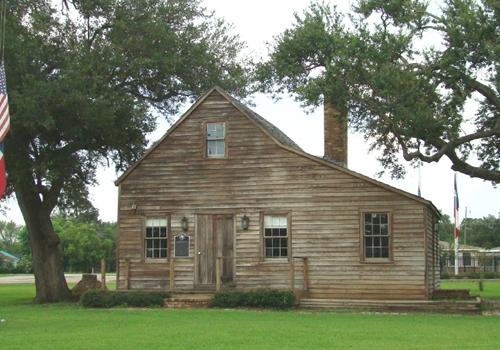 |
Thanks
to a developer’s donation of a 337- by 35-foot strip of land along
State Highway 35, the historic spot has been transformed into Capitol
of Texas Park. Dedicated on April 17, 2009, the park features
a path connecting a series of granite monuments telling the history
of the area.
That history goes back to 1824, when Josiah Bell settled on the nearby
Brazos River at a point soon known as Bell’s Landing. A community
at first called Marion and then East Columbia eventually merged with
the nearby settlement of Columbia, later renamed West
Columbia.
Since by the summer of 1836 Columbia had more buildings than any other
Texas town, not to mention two newspapers, the interim government
of the Republic of Texas decided it would be the capital city.
The nation’s business was done in several frame structures put up
a few years earlier. The House of Representatives met in a one-and-a-half
story structure built in 1833 previously occupied by a merchant named
Leman Kelsey. Across the road from the House, the Senate conducted
its august proceedings in a two-story store formerly used by the firm
of White and Knight.
The First Congress convened in those two buildings Oct. 3, 1836 and
worked through December, when the government removed itself to the
new town of Houston.
The rented government buildings reverted to private use, the structure
that had accommodated the republic’s upper house being torn down in
1888. The former lower chamber survived beyond that, but it had deteriorated
considerably.
It took more than 60 years before some Texans began to appreciate
that the old House building had historic value. A newspaper reporter
from Galveston
came to town and wrote a story about Columbia’s short-lived reign
as a national capital city and boldly contributed $25 toward purchase
of the property so it could be preserved as “a historic relic.”
In 1897, a Houston photographer named F.E. Beach took a picture of
the old structure – a gaping hole in its roof – and labeled it “First
Capitol of Texas.” He sold cardboard-mounted copies for 25 cents.
The Daughters of the Republic of Texas, saviors of the Alamo,
had their collective sights on the old building when the September
1900 Galveston hurricane destroyed
it. Fortunately, Beach’s image and several other photographs survived.
In 1932, the DRT placed a granite historical marker at the site. Seven
years after that, the area was cleared and a series of businesses
went up along the street.
Those structures were razed in 2007 to make way for a new chain drug
store. When the existing pavement was ripped up, workers discovered
an old cistern and assorted artifacts. Boyd’s firm got hired to do
an archeological survey.
With help from the Brazosport Archeological Society, Prewitt and Associates
spent a week that December looking for traces of the government structures.
They excavated the brick-lined cistern, which they believe dates from
early-to-mid 1830s, along with privy remnants and numerous postholes.
Boyd said more archeological work remains to be done in the area,
but that will have to wait on funding.
Until then, any other bottles Old Sam might have stashed – not to
mention more interesting artifacts – will remain buried.
© Mike Cox
"Texas Tales"
March
18, 2010 column
Related Topics:
Columns
| Texas Towns | Texas
| |
| Books
by Mike Cox - Order Here |
|
|