|
Hard
to believe, but Texans haven’t always fished just for fun.
Along the coast,
from the time of the fierce Karankawas until the latter days of the
19th century, fishing was about eating, not a recreational pursuit.
When a skilled laborer named Tim Vought got hired in 1875 to do some
repair work at the 1857-vintage Port
Aransas light house, he soon realized that he was staying in one
of the best fishing spots on the Gulf of Mexico. Accordingly, Vought
spent much of his free time fishing. Well, acquiring fish.
The Port Aransas Museum has on display an excerpt of an interesting
letter Vought wrote home about fishing at Port A:
“We took two cast nets with us and throwed into the bayou that runs
alongside [the] light house. In less than half an hour we caught 65
large mullet and redfish. I never saw fish so thick before in my life.”
Of course, netting game fish long since has been a conservation law
no-no. (It’s OK to net bait, but using a net to catch redfish would
be a costly proposition these days if a game warden happened to see
it.)
Describing another venture in search of free protein, Vought wrote
that he went out with someone named Hart. This time, they “went up
a little bayou.” Again, they carried a cast net, not fishing poles.
“I rowed the boat and Hart throwed the net,” the light house worker
continued. “In about half hour we caught large basket full of mullet
and plenty redfish and drum. Some of them were 18 inches and two feet
long. We had a nice dinner.”
Despite that, Vought concluded his letter with: “Getting sick of the
sight of fish.”
Whether
Vought managed to retain his taste for seafood is not recorded. And
tastes change. Though redfish (technically red drum) is still considered
a delicacy, mullet have long since been relegated to baitfish status.
And no one has ever been interested in eating the boney fish that
for a time reigned as king along the coast, the tarpon.
That species, arguably, is the fish that spawned recreational fishing
as a Port Aransas
pastime. It happened in the mid-1880s, when work began on a set of
rock jetties intended to deepen the ship channel to Corpus
Christi. When mainlanders connected with the construction project
started seeing big schools of tarpon, it occurred to some of them
that catching one of those big fish would be good sport.
Not having boats of their own, these “jetty people” (as the locals
called them) began paying island residents $1.50 to row them out for
some tarpon fishing. That, according to the Port A museum exhibit,
marked the beginning of sport fishing on the Texas
coast. In addition, it was the genesis of the fishing guide business,
a pop-and-sometimes-mom industry that still brings money to this part
of Texas. |
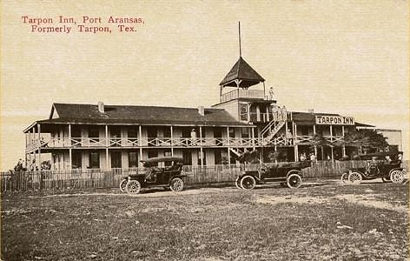 |
Port
Aransas'
Tarpon Inn in the 1920s
Postcard courtesy rootsweb.com/ %7Etxpstcrd/ |
By 1886, tarpon
fishing drew enough visitors to make opening a hotel viable. That
brought the Tarpon
Inn, a two-story wooden hotel still in business. Ten years later,
the small town on the tip of Mustang Island was named Tarpon.
As word of Texas’ mid-coastal tarpon fishery spread across the nation,
a monied New York sportsman named Ned Green came to Tarpon to fish
for the town’s namesake. He had a good time and became a frequent
island visitor, in 1899 building a fishing-duck hunting resort on
Saint Joseph Island he called the Tarpon Club.
In the early 1900s, just as automobiles had begun to replace horses
as a mode of transportation, rowboats began to give way to powerboats.
Green purchased the first motorboat ever seen on the middle coast,
also paying for a guide named Ed Cotter to travel to Chicago to get
schooled in how to run and maintain an international combustion engine.
The advent of gasoline-powered motors further enhanced sport fishing,
though the museum has a photograph documenting that the change didn’t
happen all at once. In the photo, Cotter in his powerboat is towing
a string of rowboats to a tarpon hotspot. |
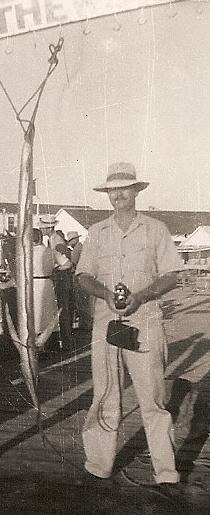 |
"Papa loved
to go fishing at Port Aransas"
Sarah
Reveley 1950s photo |
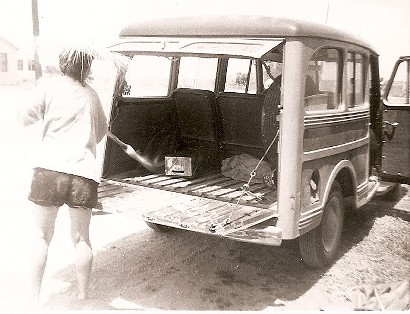
"Here's
Mamma. We always drove down in her jeep. Papa didn't want to get his
Buick Special dirty."
Sarah
Reveley, 1950s photo |
Port
Aransas
got more national attention as a prime tarpon fishing distination
in 1932 with the beginning of the Tarpon Rodeo, an annual tournament
that continued until 1958. By that time, overfishing had severely
depleted the tarpon population and the rodeo got deep-sixed. But the
Deep Sea Roundup, an off-shore fishing tournament that started
in 1941, is still going strong.
Few anglers visiting Port
A today are likely to share or even comprehend old Tim Vought’s
sentiment about getting sick of the sight of fish.
© Mike Cox
"Texas Tales" March
11, 2011 column
See Port
Aransas |
| Books
by Mike Cox - Order Here |
|
|
 HOME
HOME