|
Had
it played out differently, what happened in Real
County in 1924 could have changed aviation history.
The story starts in Missouri, where St. Louis automobile dealer Leon
A. Klink had an abiding interest in flying machines as well as cars.
For $250, he bought a World
War I-surplus JN-4C Canuck, a Canadian version of the OX5 Curtiss.
The one-engine, 90-horsepower bi-plane had a top speed of 75 miles
an hour.
Owning an airplane not being nearly as satisfying as owning an airplane
and flying it, Klink asked a 22-year-old acquaintance most folks called
Slim to teach him how to fly and then join him on a flight to more
southern climes. Slim already had 250 hours flight time but he had
applied to attend the Army's flight school at Brooks Field in San
Antonio to sharpen his skills and serve his country. Not having
received official word of acceptance, he didn't have to be arm-twisted
into escaping Missouri's winter for a multi-state plane trip.
Leaving St. Louis January 24, the two young men winged their way through
Kentucky, Tennessee, Mississippi and Florida, where a minor accident
at Pensacola delayed them for repairs. While there, Slim got word
to report to the Army on March 15. Still having some free time, they
decided to head for California by following the tracks of the Southern
Pacific.
Low on fuel after confusing the Nueces for the Rio Grande, Slim put
the plane down in a plowed field near Camp
Wood. Intending to take off again as soon as they refueled, the
two aviators got a ride into town to buy gasoline.
Getting back to their plane late in the day, the two cross-country
flyers accepted an invitation from a nearby ranch family to spend
the night before resuming their flight. Years later, Ray Chant recalled
that they sat around his family's fireplace enjoying the warmth of
the hearth and good conversation, though Klink talked more than Slim.
The next day when they tried to take off, they found the ground too
soft for the Canuck to get up sufficient airspeed. Removing their
luggage, the passenger seat and tool box, they tried again with only
Slim in the plane.
The plan worked. Slim flew toward Camp
Wood to find a better landing spot while Klink hitched a ride
into town, hauling everything they had taken off the plane. Slim put
the Canuck down on the Uvalde road, the town's gravel main street.
Almost everyone in the county gathered to see the flyers on their
way west. But as Slim taxied, confident he could squeeze the plane's
43-foot wingspan between telephone poles on each side of the street,
one of the wheels hit a rut. The aircraft veered sideways, its wing
clipping one of the telephone poles. Now out of control, the aircraft
crashed into the side of Warren Pruett's hardware store.
Klink and Slim climbed out of the cockpit uninjured, relieved to find
that no one had been inside the store when they hit it. The impact
scattered pots and pans, caused a portrait of President Calvin Coolidge
to drop to the store's wooden floor and, according to some, left a
horse collar draped around the plane's smoking radiator.
With the help of several townspeople, the two aviators pushed the
Canuck to a garage operated by Russell Vernor and Ben Wall. They tried
to repair the plane's wooden propeller, but they couldn't get it balanced.
The fliers ordered a new propeller and shellac (they referred to it
as "dope") from Houston to repair the plane's torn cloth fuselage.
The temporarily grounded aviators rented a room at the Fitzgerald
Hotel and managed to make friends with a couple of Real
County girls while waiting for the repairs to their plane. Once
they had their aircraft flight-worthy, to cover expenses they gave
folks rides for $5 a head before leaving town.
On their next landing after Camp
Wood, a dagger plant tore their plane again. This time it took
eight days to get the plane fixed. Out of time, Slim flew the plane
to San Antonio to report
for duty and Klink continued on to California by train.
No one having been hurt, the Camp
Wood incident went unmentioned in the state's daily newspapers.
Klink and Slim were just another couple of daring young aviators until
May 21, 1927, when Slim - Charles A. Lindbergh - landed in France
after successfully completing the world's first non-stop flight from
New York to Paris.
As the 50th anniversary of the flight approached, writer Jack Keasler
located Klink, who still lived in St. Louis. In 1977, the Nueces Chamber
of Commerce invited him to that year's Old Settlers Reunion. Klink
flew (commercially) to San Antonio, where then Camp Wood Mayor Austin
Dean and chamber president Bob Marshall picked him up at the airport
and escorted him to Real
County.
To give Camp
Wood another tourist attraction, the chamber attached a large
model airplane to the front of their building in such a way that it
looked like it had crashed into the structure. Eventually, the small
plane ended up in the local museum, which also has the wooden propeller
Lindbergh and Klink left behind. |
 |
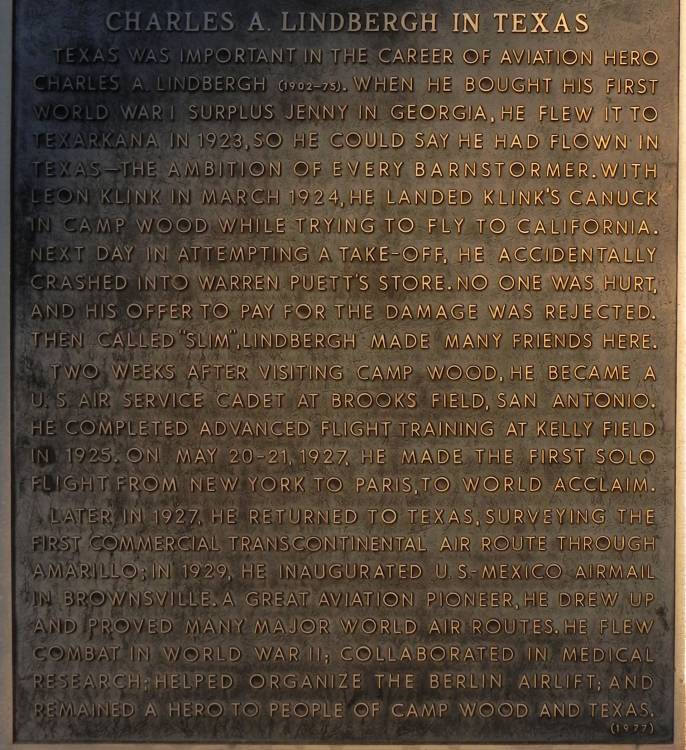
Charles A. Lindbergh
in Texas historical marker in Camp
Wood
Photo courtesy Barclay
Gibson, February 2011
Click on photo for large image |
|
|
 HOME
HOME