|
|
Pecans
are for pies and pralines, and, for the more healthy minded, inclusion
in salads or entres.
But there’s more to the nut produced by Texas’ official state tree
than food value. At least there used to be. Early-day Texas kids,
not having a very wide variety of what used to be called “store bought”
toys, found ways to play with pecans before eating them. |
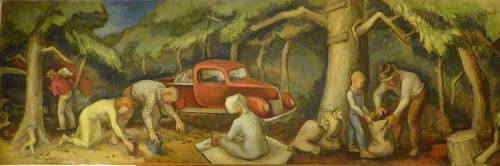 |
Bill Ellis,
born in 1919, grew up in Brownwood
in the 1920s and ‘30s. As he recalled in his 2006 self-published memoir,
“Rubber Guns: ‘Bout a Little Texas Boy in a Texas ‘20s Town,” Brown
County “is big pecan country.” In fact, he wrote, for years the
U.S. Department of Agriculture operated a pecan experiment station
there. And in his youth just about every yard had a pecan tree or
two.
When pecans began to come down from the branches in the fall, Ellis
and his friends had a couple of games they played with them. The kids
called the first game “Crackers.”
As Ellis wrote: “By trial and error I selected he hardest shell pecan
that I could find, (usually a big native) and marked it with my name.
I then approached a buddy with the challenge “Crackers.” He would
give me his hard shell pecan, and I would put the two side by side
in my hands, and press them together.”
Whichever pecan broke under the pressure belonged to the loser, he
said.
Naturally, some kids tried to “game” the game and resorted to sneaky
means to develop a tougher pecan. Ellis said some players soaked their
biggest hardshell in oil to make it even tougher, though he wrote
that he doubted that really worked.
Other kids got more elaborate in their cheating, drilling a small
hole in the pecan, burning out the meat of the nut with a hot wire
and then filling the cavity with hot lead. Ellis said boys with lead-filled
“Crackers” would never let the opposing player hold his, a sure tell
that someone was a cheater.
But this heavy metal scam, the loaded dice of “Crackers,” seems a
bit fanciful since molten lead would have to be at least 621.43 degrees.
Of course, if the pecan cavaity had water in it the scheme might work,
but like the warning goes, best not to try this at home. Besides,
it’s now known that lead is unhealthful.
The second game Ellis remembered playing with pecans was called “Hully-Gully.”
To let him tell it:
“I would put from…three to eight pecans in my hands, shake them near
the ear of a buddy’s, and say, ‘hully-gully.’ He would guess the number
of pecans. He had to then give me pecans equal o the number that his
guess had missed, and then he got to ‘hully-gully.’ If he guessed
right, he got all my pecans…”
Hully-gully is also a game kids used to play with marbles. Pecans
are a logical and free substitute for store-bought marbles.
An experienced “hully-gully” player could employ several strategies
to win. A saavy competitor might bend a couple of his fingers around
some of the pecans he held so they couldn’t make any noise when the
shaking occurred. Or a player could shake very hard or hardly at all.
Finally, a less-than-scrupulously-honest “hully-gully” guy could stuff
so many pecans in his hands that they couldn’t rattle.
Not mentioned in Ellis’ book is that pecans also used to be transformed
into doll heads. All it took was a little paint to turn a pecan into
a face that could be attached to a cotton-stuffed cloth body. Once
an easy-to-make girl’s toy, pecan dolls today are considered collectible
folk art.
Over the years, industrious Texans doubtless have come up with other
imaginative uses for pecans, but their highest and best purpose is
their food value, especially when candied with baked yams for a Thanksgiving
side dish.
© Mike Cox
"Texas Tales" November
25, 2010 column |
|
|
 HOME
HOME


