|
One
year before the American Centennial, most of the nation celebrated
the signing of the Declaration of Independence on Sunday, July 4,
1875.
Three days later, only a decade after the bloody Civil War that nearly
made moot what happened in Philadelphia in 1776, the surviving members
of Terry’s Texas Rangers gathered at Barton
Springs in Austin for
a reunion. That was Wednesday, July 7. |
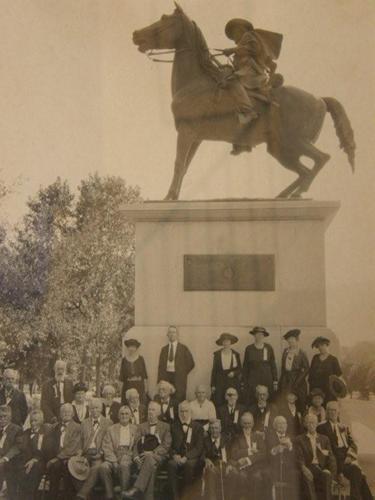
Surviving Members
of Terry's Texas Rangers Gather at the Northside of their Monument
on the Capitol Grounds in Austin
(No date available)
Courtesy United Daughters of the Confederacy, Shropshire-Upton Chapter,
Columbus, Texas |
First
a note on nomenclature: Though popularly known as Terry’s Texas Rangers,
the command organized in Houston
in 1861 by B. F. Terry and T.S. Lubbock was officially the 8th Texas
Cavalry. They were regular gray-clad soldiers, not Indian-fighting
Texas Rangers. Still, some of them had ridden as rangers before the
war.
So why didn’t the ex-Confederates have their get together on Sunday
after church rather than wait until the middle of the work week? Was
it simply a matter of scheduling or were those battle-scared rebels
who had their annual meeting in the Capital City that year still somewhat
unreconstructed?
The account of the event published in the Austin Daily Statesman did
not address the calendar issue, but it’s not hard to imagine that
men who had fought hard for the South and lost many friends in the
process still had a little trouble getting too fired up over the Fourth
of July.
The Texans who rode with the Terry and Lubbock, and later under Col.
John A. Wharton, paid a high price for their beliefs. Of 1,700 who
served in the regiment, the 8th Texas consisted of only 150 men by
the end of the war.
“Many of them died from exposure and disease, many were killed in
battle, many were seriously wounded and forced to retire from the
service, and many became prisoners of war,” The Confederate Veteran
magazine later noted, “but it is said that no one of them ever deserted
the cause. They were the…swiftest horsemen, the surest and best shots,
and of the coolest and bravest…[unit] that ever charged a battery.”
|
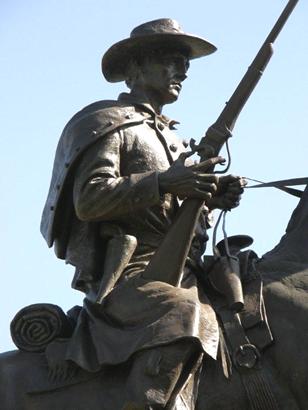
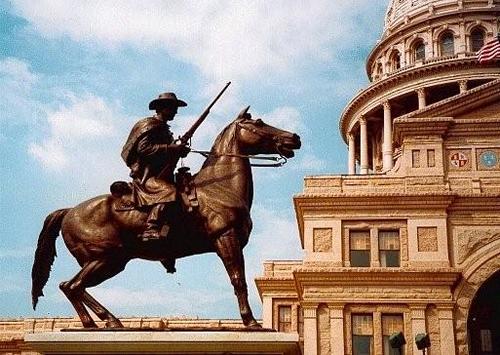 |
Terry's Rangers
monument close-up
TE photo, July 2009 |
No matter why
the veterans set July 7 rather than July 4 as their meeting date,
they had a fine time along Barton
Creek that afternoon.
“The weather was warm,” the newspaper reported, “but the surroundings
of the place are so delightful that this objection was to a great
extent overcome. The clear, limpid, dashing stream added its cheerfulness
to the scene while soldierly hands once more clasped each other in
brotherly affection.”
Though Barton
Springs had long been a popular venue for picnics and other outdoor
activities, the adjacent land was then private property. The Confederate
veterans met under the pecan trees on land belonging to fellow former
rebel William C. Walsh, who owned a nearby quarry.
Capt.
Rufus King, the ranking surviving officer of the regiment, called
the reunion to order at noon. Early in the war, King raised a company
in Bastrop County
and eventually became the ranking captain in the regiment. The newspaper
filled in the rest of his service record:
“He remained with the Rangers until the battle of Shiloh, where he
received three balls in his body, one passing through his shoulders,
another shivering in his arm and the third spending itself in his
thigh.”
After King spoke, he asked another veteran to offer the invocation.
Following the prayer, the captain called the roll. Sixty veterans
answered present.
The
highest ranking former Confederate on hand at Barton
Springs that hot afternoon was Gen. Braxton Bragg, a North Carolinian,
1837 West Point graduate and Mexican War veteran then working as a
railroad inspector in Galveston.
The namesake of future Fort Bragg, home of the 82nd Airborne Division,
Bragg had been one of only eight general officers to lead Confederate
forces during what some sons of the South call the “War of Northern
Aggression.”
Though not the Confederacy’s brightest star, for a time Bragg stood
at the top of the chain of command of the 8th Texas. Known by historians
as a well-organized if sometimes incompetent sourpuss, Bragg was asked
to speak to the Texans.
“Like a soldier…[he] obeyed,” the Statesman reported. The article
continued: “His remarks were on the style of ‘a little more grape,’
[as in “have another drink, boys”] and were enthusiastically received
by his hearers. His towering form, noble demeanor, suavity and age,
are such as to command the respect of any one.”
Barely a year later, only 59, Bragg dropped dead while walking with
a friend down the street in Galveston.
While his body was shipped to Mobile, Ala. for burial, some say his
spirit remains in Texas in the form of an apparition known as Bragg’s
Light. |
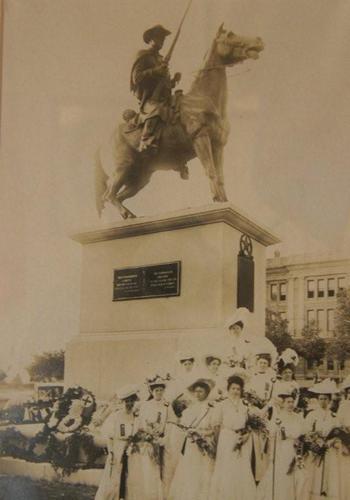 |
Unknown Undated
Event on the Southside of the Monument
Courtesy United Daughters of the Confederacy Shropshire-Upton Chapter,
Columbus, Texas |
As
many of the former rebels meeting at Barton
Springs followed Braggs’ “order” and enjoyed distilled spirits
or cold brew, regimental chaplain R.S. Bunting closed out the formalities
with a reading of another officer’s order, the April 30, 1865 swan
song of Gen. “Fighting” Joseph Wheeler, commander of the corps that
included Terry’s Texas Rangers:
“Gallant Comrades—You have fought your fight: your task is done. During
a four years’ struggle for liberty you have exhibited courage, fortitude
and devotion. You are the victors of more than two hundred sternly
contested fields. You have participated in more than one thousand
conflicts of arms. You are heroes! Veterans! Patriots! The bones of
your comrades mark battle fields upon the soil of Kentucky, Tennessee,
Virginia, North Carolina, South Carolina, Georgia, Alabama and Mississippi.
You have done all that human exertions could accomplish.” |
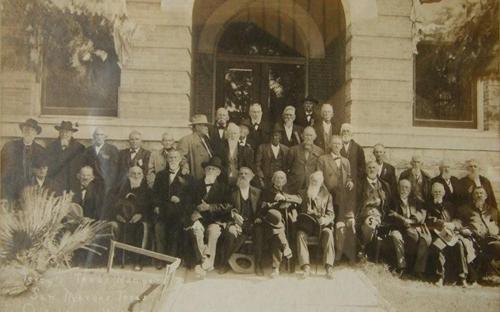
| Reunion of Terry's
Texas Rangers in San
Marcos (No Date) |
© Mike Cox
"Texas Tales" July
3, 2008 column
Announcement
Mike Cox's "The Texas Rangers: Wearing the Cinco Peso, 1821-1900,"
the first of a two-volume, 250,000-word definitive history of the
Rangers, was released by Forge Books in New York on March 18, 2008
Kirkus Review, the American Library Association's Book List and the
San Antonio Express-News have all written rave reviews about this
book, the first mainstream, popular history of the Rangers since 1935. |
| Books
by Mike Cox - Order Here |
|
|
 HOME
HOME