|
| Barton
Springs is Austin.
It is the largest natural swimming pool in the United States located
within an urban area, setting Austin
apart from other metropolitan cities. Barton Springs is Austin's
soul and sums up everything that Austin
stands for. A chilly swimming hole, the center of a political and
environmental debate, a meeting place. Barton Springs is all
of these things. Here you can swim with politicians, musicians, ducks
and salamanders. If you're lucky, you might catch a glimpse of 'Leonard',
a giant fish reputed to patrol the waters. Barton Springs has been
used by people inhabiting this area for tens of thousands of years.
In the days before air conditioning Austinites used the springs to
stay cool. Barton Springs has powered several mills, cooled many Native
American tribes, hosted Spanish missionaries, provided a community
meeting place for early settlers, and soothed millions of people over
the years. |
Barton Springs
TE Editor's
Note: This chapter is the text for pages 27 through 37 of Splash
Accross Texas - courtesy of the book's author, Chandra Moira Beal.
Thorough in research, rich in history, description and recreational
information, this engaging chapter should be read in it's entirety.
However, for quick reference for internet users, we take the liberty
of breaking up the chapter by topics ( in sequence ) as follows:
About
Barton Springs
Sunken
Gardens,1947 Bathhouse, The Environmental Debate
Maintenance,
& Endangered Barton Springs salamander
Philosopher's
Rock, pecan tree
The
Pool
The
Polar Bear Club, Barton Creek Greenbelt, New Trail
Barton
Creek
Swimming
Holes in Barton Creek
Zilker
Park
Botanical
Garden, Zilker Zephyr miniature train ride
Zilker
Hillside Theatre, Austin Nature Center, McBeth Recreation Center,
Beverly Sheffield Education Center
Butler
Brick Company
Addendum:
Barton Springs Endangered Salamander
Book Hotel Here ›
Austin
Hotels
|
Half
a billion years ago what was to become Austin
was covered by an ocean on the edge of an ancient continent which
would become North America. One-third of a billion years ago, the
ocean closed in as massive plates of earth moved in from the southeast
and crushed against the North American Plate, creating mountains from
Arkansas to Uvalde,
Texas. One-quarter of a billion years ago the mountains eroded
into plains. 150 million years ago plates pulled away from North America
and the sea rushed back in. Layered deposits of sediment, rich in
fossils and dinosaur tracks, formed the limestone rocks and caves
of the Edwards Aquifer. Water probably sprang from the rocks about
7,000 BC.
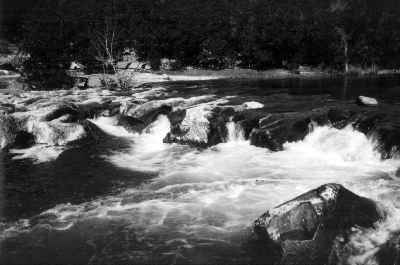
Barton Springs, actually a series of springs, emerges from
fissures in the limestone at a rate of 26 million gallons per day.
People who have witnessed the water surging out of the mouth of the
main spring, Parthenia, say it resembles a pulsating heartbeat.
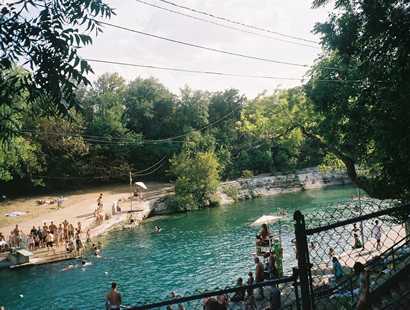
Parthenia is just to the right of the diving board. If you swim down
to it you can see the mouth of a cave about three feet wide and five
to seven feet deep. Water from Barton
Creek no longer enters the pool;
it is kept full from the springs alone, so the water is clearer and
a constant temperature of 68°F. Eliza Springs issues from a
cave-like sinkhole on the north bank near the lower end of the pool,
and Walsh Springs comes from a sinkhole on the south bank below
the pool. Deep Eddy Springs is actually somewhat connected
but is covered by Town
Lake. |
 |
| Photo
courtesy Chandra Moira Beal, 2001 |
Barton
Springs remained about the same until nine thousand years ago. We
know that humans have been using Barton Springs for at least eleven
thousand years. About 5,500 BC the Olmecs were known in the Western
Hemisphere and probably used the springs. Wild horses, too, were once
bountiful at the springs. Native American tribes such as the Lipan
Apache, Jumano and Tonkawa gathered here to cool off and camp. A Comanche
trail made a stop at Barton Springs, and the tribes left numerous
artifacts around the area.
In the 1600s and 1700s Spanish explorers looking for gold came through
Travis County, and some say that de Vaca, Cabeza de Vaca and Coronado
stopped at Barton Springs on their quests. Franciscan friars built
the Mission San Jose de los Nazonis in 1730 at Barton Springs. Later,
San Francisco de los Neches and Nuestra Senora de la Purisma Concepcion
d'Hanis were moved from East
Texas to Barton Springs because French troops were pushing them
westward. The missionaries thought that the land was worthless for
growing crops or settling and moved on to San
Antonio. In 1835 the Governor of Coahuila y Tejas granted Barton
Springs to Henry P. Hill, and Anglo colonists began settling the area.
"Uncle Billy Barton" was one of these early settlers and he settled
on what was then called Spring Creek with his three daughters,
Parthenia, Eliza and Zenobia. Spring Creek was Barton's link to the
outside world, a camp called Waterloo on the Colorado River
which was developing into the new Texas capital. He built a cabin
there and kept two tame buffalo that apparently attracted many sightseers.
Barton started to charge admission to the springs and hired W.C. Walsh
and Henry Steussy to build a gristmill. The mill was three stories
high and located on the south side of the creek near the main dam.
Barton's place was a stage stop and quickly became popular as a favorite
swimming hole. When Waterloo was officially selected as the new Texas
capital in 1839, Barton deeded the springs to the city to furnish
power for a sawmill. William Barton died on April 11, 1840. He was
buried at the springs but his body was later moved to Round
Rock. There are actually six different Barton Springs in Texas,
some that are named after our William Barton. He certainly got around!
There are apparently a few other William Bartons but we all know there's
only one Barton Springs. |
 |
|
Photo courtesy Chia-Wei Wang, August 2006 |
Barton
Springs was still very primitive in 1842. Sam Houston, who was bitter
about Austin becoming
the new capital, said that he wouldn't risk his scalp in that #&?!
hole called Austin. Houston
feared Indians, and since some people had been scalped on their way
to Barton Springs, he was somewhat justified. In the 1850s, peaceful
tribes of Lipan Apaches and Tonkawas were still living near Barton
Springs, but were driven out by Comanches during an attack on white
settlers at the springs.
In 1860, John Rabb bought the Barton property, then deeded it to his
son, Gail T. Rabb. G.T. Rabb sold five acres of the property, not
including the springs, to Jacob Stern. Stern built another gristmill
and allowed Confederate troops to camp there during 1861. W.C. Walsh,
who had built Barton's original gristmill, built a rock quarry in
1866 and moved his family there. Quarrying was done by hand and uncovered
many fossils which were preserved. G.T. Rabb opened a gristmill and
ice factory in 1871 and built a two-story rock house on the south
side of the creek. He also built a dam out of logs and a merry-go-round,
and rented swimsuits to men only! In 1879, Rabb constructed a new
three-story mill but it was destroyed by fire in 1886. In 1889 he
completed a footbridge across the shallow end of the pool
but it was wiped out in the 1900 flood. An entrepreneur soon began
renting bathing suits to people to swim in Barton Springs. People
could also camp there. On Saturdays and Sundays the whole family would
pack a picnic, pay ten cents admission, and spend the day at the springs
enjoying sing-a-long concerts, plays and dances. Swimming societies
and clubs are nothing new in Austin.
A ladies' swimming club was formed in 1884 and only one man was allowed
within hearing distance as a safeguard. He was under oath to keep
his eyes shut and his face turned away from the river. The first bathhouse
was just four walls painted white and open to the sky. The walls didn't
extend all the way to the ground because of the moisture and potential
for rot. Baptisms took place in the springs, sometimes hundreds at
a time. In 1875 the Riverboat Sunbeam shuttled swimmers up and down
what is now Town Lake
and Barton Creek for
fifty cents per person. Barton Springs was still very much 'out in
the country' at the time and getting there was an ordeal. In 1907
Rabb sold more of his property to Andrew Jackson Zilker, who then
bought the other five acres from Stern. Zilker's story is a classic
rags to riches tale. When he was just 18 he moved from Indiana to
Austin in 1876 with fifty
cents in his pocket. The first night he got a job washing dishes and
doubled his money. He then got a job constructing the Congress Avenue
Bridge and befriended the owner of an ice plant who gave him a job
there. Zilker also found the time to be a volunteer fireman, Director
of the First National Bank, Water and Light Commissioner, and head
of the Travis County School Board. He quickly became the engineer
of the ice plant and in 1901 began buying land between the Colorado
River and Barton Creek.
Zilker had soon acquired 350 acres surrounding Barton Springs and
used the land to pasture the horses and mules that pulled his ice
wagons.
During the First World
War Austin attempted
to establish military schools near Barton Springs. In order to do
so they had to provide water, so the Military Affairs Committee suggested
that the city buy Barton Springs and route the water to the soldiers
for bathing. Droughts in the years 1910 and 1917 also prompted the
city to seek alternative sources of water. In 1918 Zilker deeded the
springs and a surrounding thirty-five acres to the city with the provision
that it be used for education. The city also tore down the ruins of
the old flour mill. In 1920, the Chamber of Commerce and Lions Club
raised $8,000 to build a new bathhouse, completed in 1922. The new
bathhouse was a two-story pavilion with a dance hall upstairs and
dressing rooms downstairs. People recall it as quite romantic, with
wood paneling and open-air screens. Schools of fish were visible in
the springs, and water pageants and carnivals were held there annually.
In 1932 Zilker donated another 330 acres to the military schools on
the condition that the city would buy them for $200,000 from the schools.
A bond election approved the information center and souvenir shop...
Barton Springs - Page 2
› |
2100-2200
Barton Springs Road
Austin, Texas 78704
(512) 476-9044 Pool
(512) 867-3080 Hotline
(512) 478-0905 Park
(512) 477-8672 Botanical Garden
(512) 327-8180 Nature Center
(512) 327-6498 McBeth Recreation Center
(512) 327-6662 TDD
(512) 478-8167 Zephyr Train
(512) 397-1464 Hillside Theatre
http://www.tec.org/bartonsprings
April, 2001
Excerpted
from Splash
Across Texas, 1999
Copyright Chandra Moira Beal and La Luna Publishing
See Austin,
Texas
Book Hotel › Austin
Hotels |
|
|
|
 HOME
HOME


