|
|
 |
History in
a Pecan Shell
Although,
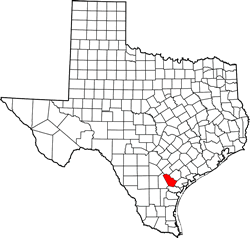
Bernard Bee left Texas in 1846, his service as Texas Secretary
of State and Texas Secretary of War, was enough to have both county
and county seat named in his honor.
Early settlers in the 1830s lost family members to Indian raids. The
county was organized in 1858 and the county seat was about 7 miles
from the current courthouse. A post office was established in 1859
and the next year the first courthouse was built.
Beeville only had about 300 people in 1880, but when the San Antonio
and Aransas Pass Railroad came through in 1886, the population
rose to one thousand.
Beeville got a water works and electricity in 1903 and the sewer was
built in 1910.
There was a small oil boom in 1929, but it wasn't enough for Beeville
to escape the Great Depression.
A Naval Aviation Station was set up during World
War II and although it was deactivated at war's end, it was reopened
for Korea. It was closed again in 1992, and a reminder of its presence
is noted by the aircraft on the courthouse
lawn.
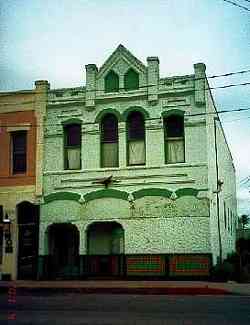
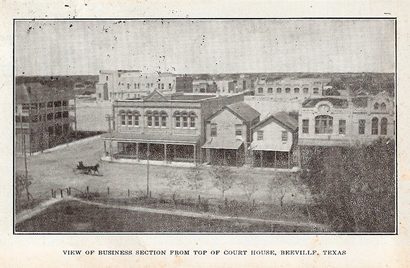
About the time this building went up in the 1920s, Beeville was paving
its streets.
The Beeville Bee and The Picayune, the towns rival newspapers
merged in 1928. |
Historical
Marker on Courthouse
lawn:
Beeville on
the Poesta
Long before Mexico
granted land (1834) on Poesta Creek to the first settlers, Anne Burke
and James Heffernan, savage Indians roamed this valley at will. Their
colony, although successful at first, soon met disaster. In 1836 James
Heffernan, his brother John, and John Ryan, who had planned to join
Texas patriots at Goliad,
were planting a crop in a field at this site when they were massacred
by Comanches. Also killed was James' family, in his picket house upcreek.
Bee County was organized
in 1858 and named for Col. Barnard E. Bee, a Republic of Texas statesman.
Soon after, choice of a county seat came into hot dispute. A site
seven miles east, on Medio
Creek, was chosen for "Beeville". But ten months later, voters
made the 150-acre donation of Anne Burke "O'Carroll permanent county
seat, on the banks on the Poesta. The new town, first called "Maryville"
for Mary Heffernan (relative of those killed in 1836) was soon renamed
Beeville.
In its first decade, it had two stores, one saloon, and a blacksmith
shop. First courthouse was built for $750 on west side of present
square, 1860. First railroad came through, 1866, and a larger courthouse
was soon built. After it burned, the present
one was erected in 1913.
(1967) |
Beeville, Texas
Landmarks / Attractions
|
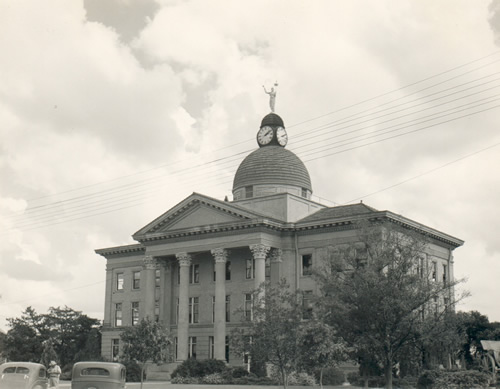
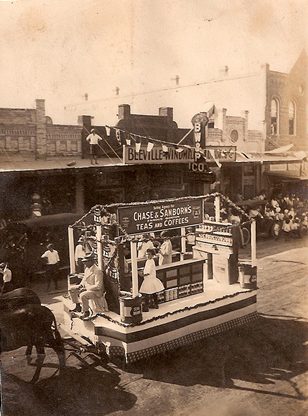
| 1939
photo courtesy TXDoT |
Bee
County Courthouse
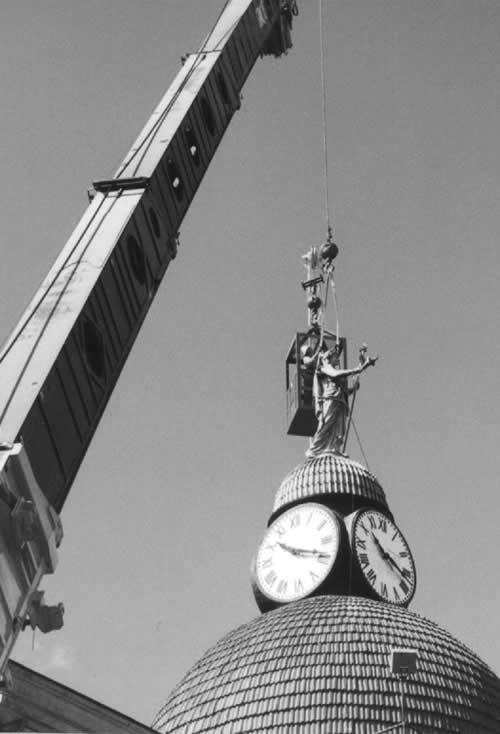
The 1912 Bee County Courthouse has most of the accessories you look
for in a courthouse - A clock, dome, statue of the Goddess of Justice
and large Corinthian columns. |
| Photo
courtesy Cori Stewart |
Medio
Creek - Recorded Texas Historic Landmark
Beeville Art
Museum - 401 E. Fannin Street.
Phone: 361-358-8615. Hours: Tuesdays - Saturdays, 9 to 5.
Veterans Memorial
Park (200 acres) is the largest of eight city parks.
Beeville
Hotels > Book
Hotel Here |
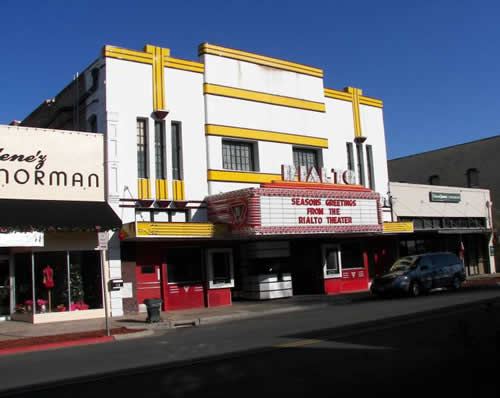
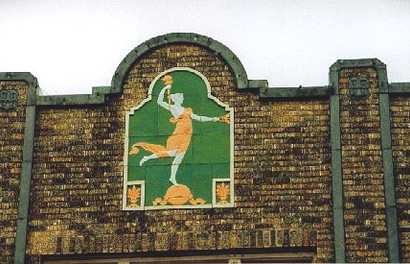
"The building
with 'The Spirit of Progress' on it was a Montgomery-Ward store. This
image was M-W's logo and appears on many of their storefronts from
the early 20th century. It's a good way to spot old M-W stores that
have been converted to new uses." - Dwight Young
TE photo, 2001 |
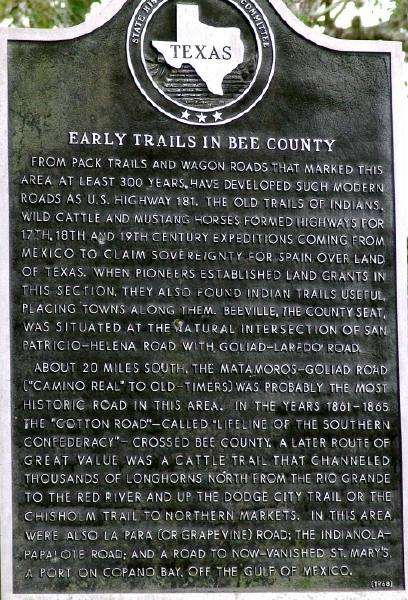
Early
Trails in Bee County Historical Marker
On US 181 roadside park 3.6 miles N of Beeville
Photo courtesy Ken
Rudine |
Historical
marker:
Early Trails in Bee County
From pack trails and wagon roads that
marked this area at least 300 years, have developed such modern roads
as U.S. Highway 181. The old trails of Indians, wild cattle and mustang
horses formed highways for 17th, 18th and 19th century expeditions
coming from Mexico to claim sovereignty for Spain over land of Texas.
When pioneers established land grants in this section, they also found
Indian trails useful, placing towns along them. Beeville, the county
seat, was situated at the natural intersection of San Patricio-Helena
Road with Goliad-Laredo Road.
About 20 miles south, the Matamoros-Goliad road ("Camino Real" to
old-timers) was probably the most historic road in this area. In the
years 1861-1865 the "cotton road"--called "lifeline of the southern
Confederacy"--crossed Bee
County. A later route of great value was a cattle trail that channeled
thousands of Longhorns
from the Rio Grande to the Red River and up the Dodge City Trail or
the Chisholm Trail to northern markets. In this area were also La
Para (or Grapevine) Road; the Indianola-Papalote Road; and a road
to now vanished St. Mary's, a port on Copano
Bay, off the Gulf of Mexico.
(1968) |
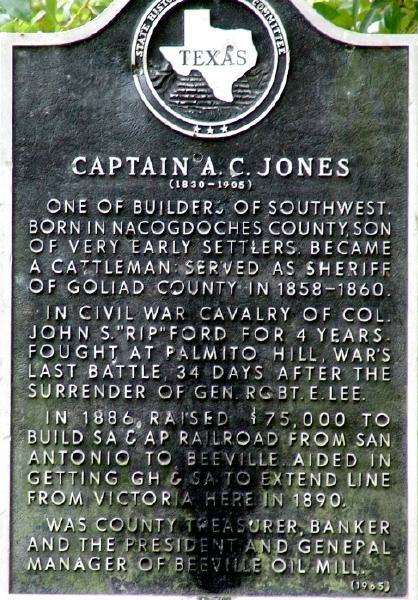 |
Captain
A. C. Jones Historical Marker
Photo courtesy Ken
Rudine |
Beeville, Texas
Chronicles
Beeville
Memories
by Yvonne Hastings (Winfrey)
German Spies, Flim-Flam Men and Stolen Tortillas
|
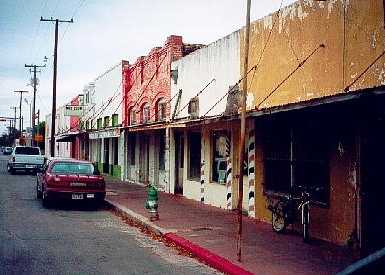
Beeville street
scene.
TE photo, 2001 |
Beeville
Local and Tourist Information
Bee County Chamber of Commerce - 361-358-3267.
Beeville Chamber website:
www.beeville.net/ChamberofCommerce/index.htm
City of Beeville website:
www.beeville.net/CityofBeeville/
Beeville
Hotels |
Beeville,
Texas Forum
The building
with "The Spirit of Progress" on it was a Montgomery-Ward store.
There's another one on your Hillsboro
page. This image was M-W's logo and appears on many of their storefronts
from the early 20th century. It's a good way to spot old M-W stores
that have been converted to new uses.
I just discovered your website today and have been enjoying it immensely.
I grew up in Plainview
and Lubbock
but have lived away from Texas since
1966. Your photos have sent me on a real nostalgia trip.
I write a regular column for Preservation magazine, published by
the National Trust for Historic Preservation. ... - Dwight Young,
January 07, 2005
|
|
Texas
Escapes,
in its purpose to preserve historic, endangered and vanishing Texas,
asks that anyone wishing to share their local history and vintage/historic
photos, please contact
us.
|
|
|
 HOME
HOME

 Texas
Gulf Coast
Texas
Gulf Coast East
Texas
East
Texas Central
Texas North
Central
Texas North Central
Texas South
Central
Texas South Texas
Panhandle
Texas
Panhandle South
Texas
South
Texas Texas
Hill Country
Texas
Hill Country West
Texas
West
Texas Texas
Ghost Towns
Texas
Ghost Towns Texas
Counties
Texas
Counties