|
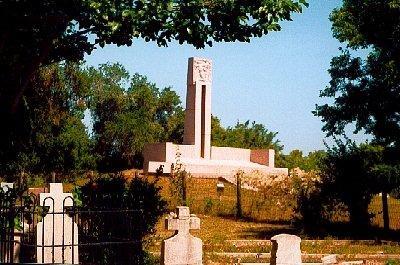
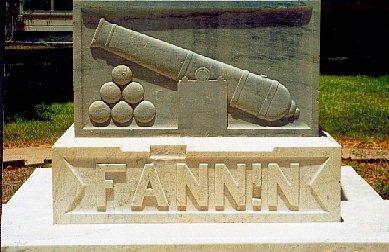
Grave
of Fannin and his men just East of the Presidio
TE photo, 2001 |
History in a Pecan Shell
The site of Goliad was inhabited by Indians prior to the Spanish establishing
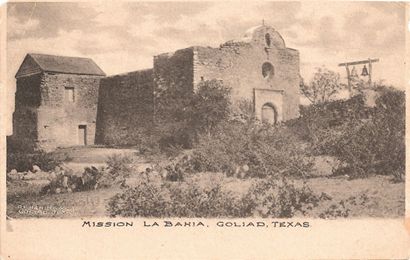
a mission and fort in 1749. The Mission was Mission Nuestra
Senora del Espiratu Santo de Zuniga. The fort was originally Presidio
Nuestra Senora de Loreto de La Bahia.
Both the mission and fort had originally been established in 1722
on what is presently Lavaca Bay, hence the designation "La Bahia"
- Spanish for bay.
An earlier mission (Mission Nuestra Senora del Rosario) just west
of town was founded in 1754 with the purpose of converting
the Indians. The mission was quite successful in breeding cattle,
but was abandoned in 1807. There's a marker on the former site
four miles west on highway 59.
The mission (La Bahia) is considered to be the first large cattle
ranch in Texas since it was successful in raising an estimated herd
of 40,000. Goliad was set up as a Mexican municipality in 1829.
The town of Goliad moved across the river to the present location
in 1836 when the
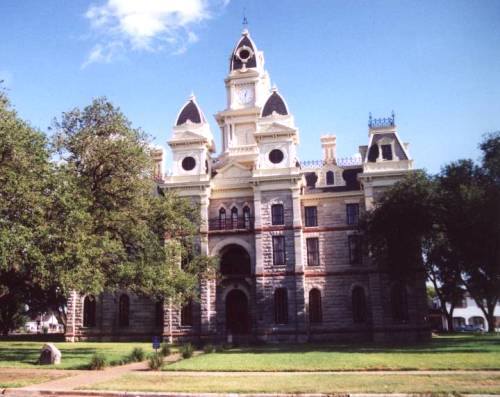
county was organized and it was made the county seat of government.
Later in its history, Goliad
County was the scene of the "Cart Wars" - an ugly series
of incidents in Texas history which was brought to a close by a legislative
ruling and the employment of the large Live Oak on the courthouse
lawn. Details on the "wars" and the Hanging
Tree can be read by clicking here. |
 |
Historical Marker:
Goliad
One of the three
first Texas municipalities. Old Aranama Indian village called Santa
Dorotea by the Spanish. Presidio La Bahia and Mission Espiritu de
Zuniga established 1749. Here early events leading to the Texas Revolution
were expeditions
of Magee-Gutierrez, 1812; Henry Perry, 1817; James Long, 1821.
Name changed Feb. 4, 1829, from La Bahia (the Bay) to Goliad. Honoring
(in anagram) Mexican patriot (H)idalgo. Capt. George Collingsworth,
Ben Milam and 48 men took Mexican garrison Oct. 8, 1835.
Goliad Declaration of Independence signed Dec. 20, 1835, and Goliad
flag unfurled. Defender Capt. Philip Dimmit succeeded by Col. James
Walker Fannin, Feb. 7, 1836. On order of Gen.
Sam Houston to evacuate Goliad, Fannin on Mar. 19, moved toward
Victoria.
Overtaken 9 miles out by a large Mexican army, Fannin and his men
battled until night, surrendered next morning. From La Bahia Prison
they were marched out, massacred and partially cremated on Palm Sunday,
Mar. 27, 1836. After Texas won independence, Gen. Thomas Rusk's army
gave them military rites and burial, June 1836.
Goliad County
Seat since 1836. Incorporated 1840 and built on present site. Received
4 leagues of land in grant signed by President Sam Houston, 1844.
(1965) |
Goliad, Texas
Historic Landmarks / Attractions
|
Goliad is declared
a National Historic District
The attractions
are many in Goliad and you can easily spend the entire day. The chamber
of commerce is located in the former Frels Theater on the south side
of the town square (large building - small sign). They can supply
you with a complete driving/ walking tour of the town. |
The Grave
of Fannin and his men
Off US 183, 2 miles S of Goliad
near Presidio La Bahia
See Goliad Massacre
|
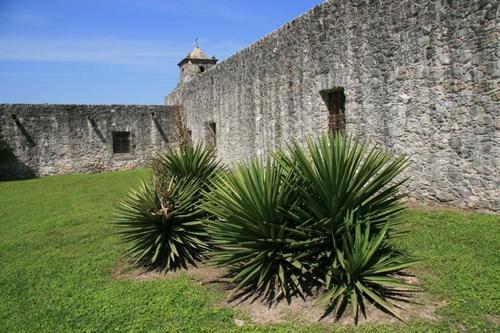
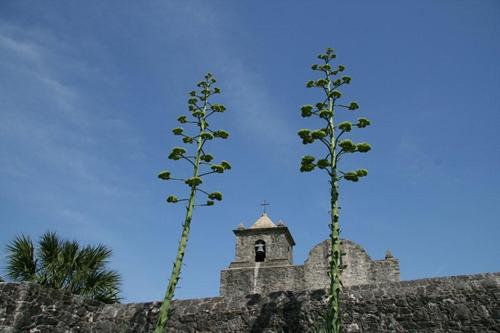
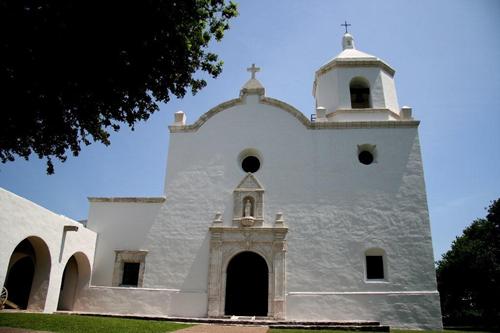
Presidio La
Bahia
South of San Antonio River
2 Miles S off US 183 |
 |
 |
Goliad
State Park & Historic Site
Goliad State Park & Historic Site consists of the land that
the Mission Espíritu Santo Zuniga is on, and extends across the
road below the Centennial
Auditorium, which is next to the Goliad State Park, within the
City Limits.
Presidio
La Bahia - Located 1/4 mile south of Goliad State Park on US
Highway 183 and 77A. Operated by the Catholic Diocese of Victoria.
Fannin's
Men Memorial is just east of Presidio La Bahía.
Fannin Battleground
- Now owned by The THC. It is no longer a part of the Park system.
Fannin Plaza
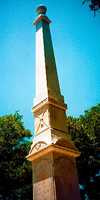
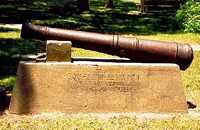
Park - One block NE of the town square - obelisk, with a cannon
used by Fannin's forces. Dedicated for the 50th Anniversary of the
Goliad Massacre.
Goliad
Town Square
Walking Tour: The chamber of commerce has a walking tour with some
information on the collection of buildings downtown.
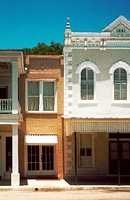
Buildings downtown include a handsome Bank, a former hotel, a Masonic
Lodge and the Lott Building - a very thin building sandwiched between
the buildings of the Cole Block.
Goliad
Memorial Auditorium
A Centennial Building from 1936. Rather plain - as was the style
then - but interesting details and ornamentation. This is the site
of the Goliad County Fair
Market
House Museum:
c. 1853 On the corner of Franklin and Market Streets
Goliad's
Historic Trees:
The
Hanging Tree (Cart War Oak)
The
Baptist Oak
The
Tree in the Street Sorority
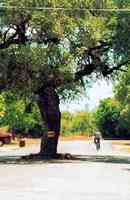
Besides being declared a National Historic District, Goliad is also
a member of The Tree in the Street Sorority - a loose group of cities
whose citizens acknowledge that the trees were there before the
settlers.
|
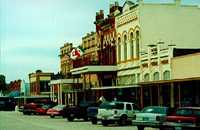
L - Street scene
in Goliad Square
R - The former Frels Theater on the south side of the town square
is now the Goliad Chamber of Commerce
TE photos, 2001 |
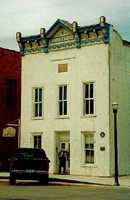
L - Masonic Lodge
R - Lott Building - a very thin building
TE photos, 2001 |
|
|
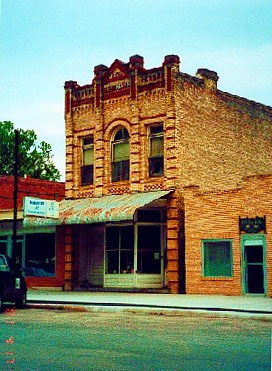
Building
on the square
TE photo, 2001 |
L - The trees
have the right of way in Goliad
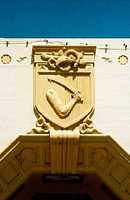
Center - Memorial Auditorium architectural detail
R - Architectural detail above a doorway
TE photos, 2001 |
|
|
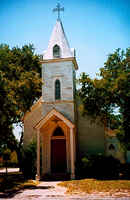
A
church in Goliad
TE Photo |
|
|
Goliad Massacre
& Related Stories
|
Massacre
at Goliad: A Texas Tragedy by Jeffery Robenalt
The massacre at Goliad branded Santa Anna as an inhuman despot and
the Mexican people, whether deserved or not, with a reputation for
cruelty. As a result of the needless slaughter, a burning desire
for revenge arose among the people of Texas, and Americans became
firmly united behind the Texas cause of independence.
A
Survivor's Account of the Goliad Massacre by Murray Montgomery
("Lone Star Diary")
The
Life and Times of a Goliad Survivor by Murray Montgomery
The story of Hermann Ehrenberg
Death
at Goliad by Murray Montgomery
A letter written by J.G. Ferguson to his (Ferguson’s) twin brother
on March 2, 1836. This document gives a real insight into the final
days surrounding the tragedy at Goliad as seen through the eyes
of a man who lived and died there.
A
Soldier's Story by Bob Bowman (From "All Things Historical")
Milton Irish, one of only 28 survivors of the massacre.
Thomas
Deye Owings of Maryland, Kentucky and Texas by W. T. Block Jr.
"He was a colonel and hero of the War of 1812 [and] was Kentucky's
original industrialist and iron master, also holding several political
offices. He was also commissioned by Stephen F. Austin in Jan. 1836
to raise 2 regiments of Kentuckians to fight for Texas Independence
from Mexico, sacrificing as a result the life of one of his sons
during the Goliad Massacre..."
The
Angel of Goliad by Murray Montgomery ( "Lone Star Diary")
|
|
|
L - The Fannin
Monument in Fannin Square
R - Cannon used by Fannin and his men
TE Photos, 7-01 |
The base of the
monument
TE photo, 2001 |
Goliad Nearby
Destinations
See Goliad County
Do not miss Fannin, Refugio,
Cuero,
Victoria
and Beeville.
Coleto Creek Park -
On Coleto Creek Reservoir
On US 59, 13 miles N of Goliad
361-575-6366
www.coletocreekpark.com
Goliad Local and Tourist Information
Goliad Chamber
of Commerce -
131 Courthouse Square in the former Frels Theater
Hours - 9:00 am until 5:00 pm Monday thru Friday. 361-645-3563.
website: http://www.goliadcc.org/
Goliad County
Economic Development/Main Street.
361-645-3540
website: www.goliad.org
|
| Texas
Escapes, in its purpose to preserve historic, endangered and vanishing
Texas, asks that anyone wishing to share their local history and vintage/historic
photos, please contact
us. |
|
|
 HOME
HOME