|
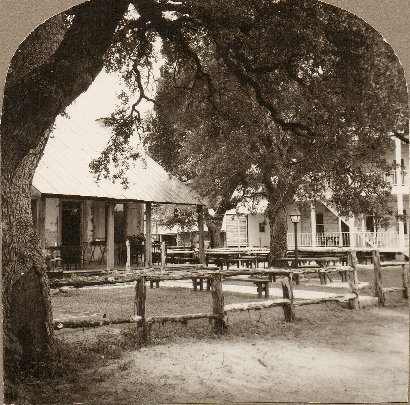
The Leon Springs
Hotel in 1981
Photo courtesy Ken Bates |
History in
a Pecan Shell
The town began
as a stage stop in 1846. Operated by George von Pleve, a former German
nobleman, the stage stop received a post office in 1857 (which closed
in 1918).
By the mid 1880s, the community was thriving with a population of
50, a store and two hotels. It was an officer’s training facility
for WWI and during WWII
was the site of at least one military execution (the hanging of an
enlisted man from Camp
Swift for the killing of a young girl). During the Great Depression
the town declined to only 25 residents but grew again due to military
establishing Camps Stanley and Bullis. The population was back to
100 by 1946 where it has more or less remained. The stage stop was
extant in 2004 and it said to be haunted although it is now privately
owned. |
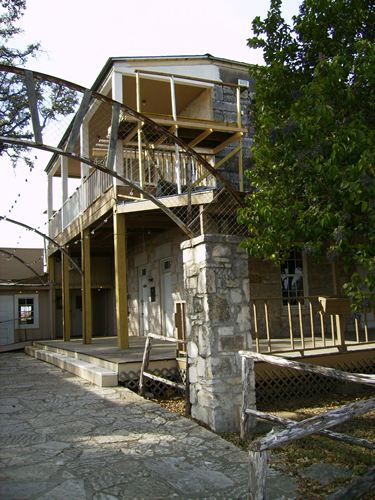
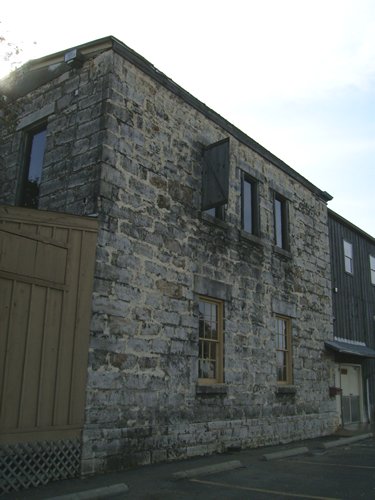
The
Leon Springs Hotel today
Photo courtesy Sarah
Reveley, January 2008 |
Leon Springs
Today
Photographer's'
Notes:
"Leon Springs is a sad example of a lovely little spot being wiped
out by a subdivision. For a while it was filled with shops and cute
little houses painted up along with a gas station and a barbecue place,
then [the developers came]. The Leon Springs Hotel, on the Historical
Register, has been obliterated by creeping expansion of a BBQ place
and a "marker" was erected to the man responsible. I have no idea
where the National Register marker is. When I was a kid, Leon Springs
Hotel was in a state of decay in the middle of nowhere, then it got
fixed up, then it got wiped out. I wonder why the town let them do
that?" - Sarah
Reveley, January 2008
"I read with some sadness your description of the old stage stop
in Leon Springs. I lived down Boerne Stage Rd. for twelve years and
passed this place on my way home from work each day. I am so sorry
to see what has happened to it in these past 30 years. I am attaching
a photo taken in 1981 when they were just beginning to commercialize
the area." - Ken Bates, September 11, 2010 |
 |
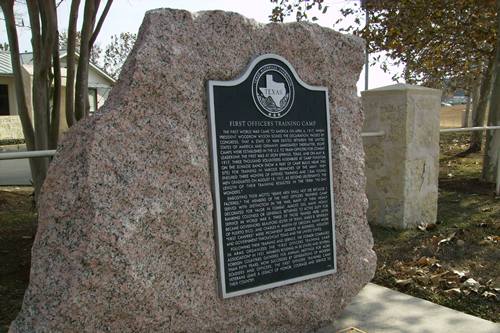 |
Historical Marker
- (Location: I-10 & Boerne Stage Rd)
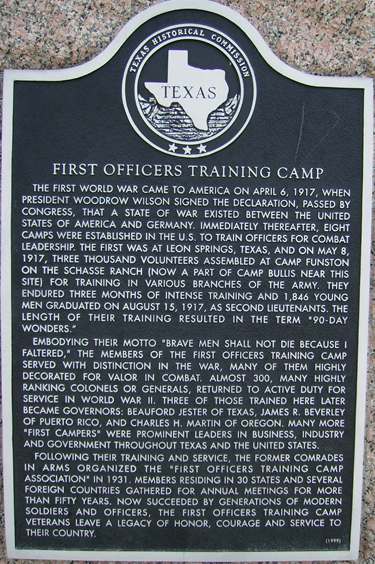
First Officers
Training Camp
The first
World War came to America on April 6, 1917, when President Woodrow
Wilson signed the declaration, passed by Congress, that a state of
war existed between the United States of America and Germany. Immediately
thereafter, eight camps were established in the U.S. to train officers
for combat leadership. The first was at Leon Springs, Texas, and on
May 8, 1917, three thousand volunteers assembled at Camp Funston on
the Schasse Ranch (now a part of Camp Bullis near this site) for training
in various branches of the army. They endured three months of intense
training and 1,846 young men graduated on August 15, 1917, as second
lieutenants. The length of their training resulted in the term "90-day
wonders."
Embodying their motto "brave men shall not die because I faltered,"
the members of the first officers training camp served with distinction
in the war, many of them highly decorated for valor in combat. Almost
300, many highly ranking colonels or generals, returned to active
duty for service in World
War II. Three of those trained here later became governors: Beauford
Jester of Texas, James R. Beverley of Puerto Rico, and Charles H.
Martin of Oregon. Many more "first campers" were prominent leaders
in business, industry and government throughout Texas
and the United States.
Following their training and service, the former comrades in arms
organized the "First Officers Training Camp Association" in 1931.
Members residing in 30 states and several foreign countries gathered
for annual meetings for more than fifty years. Now succeeded by generations
of modern soldiers and officers, the First Officers Training Camp
veterans leave a legacy of honor, courage and service to their country.
(1999) |
 |
WWI
First Officers Training Camp historical marker
Photo courtesy Sarah
Reveley, January 2008 |
| Texas
Escapes, in its purpose to preserve historic, endangered and vanishing
Texas, asks that anyone wishing to share their local history, stories,
landmarks and recent or vintage photos, please contact
us. |
|
|
 HOME
HOME

 Texas
Gulf Coast
Texas
Gulf Coast East
Texas
East
Texas Central
Texas North
Central
Texas North Central
Texas South
Central
Texas South Texas
Panhandle
Texas
Panhandle South
Texas
South
Texas Texas
Hill Country
Texas
Hill Country West
Texas
West
Texas Texas
Ghost Towns
Texas
Ghost Towns Texas
Counties
Texas
Counties